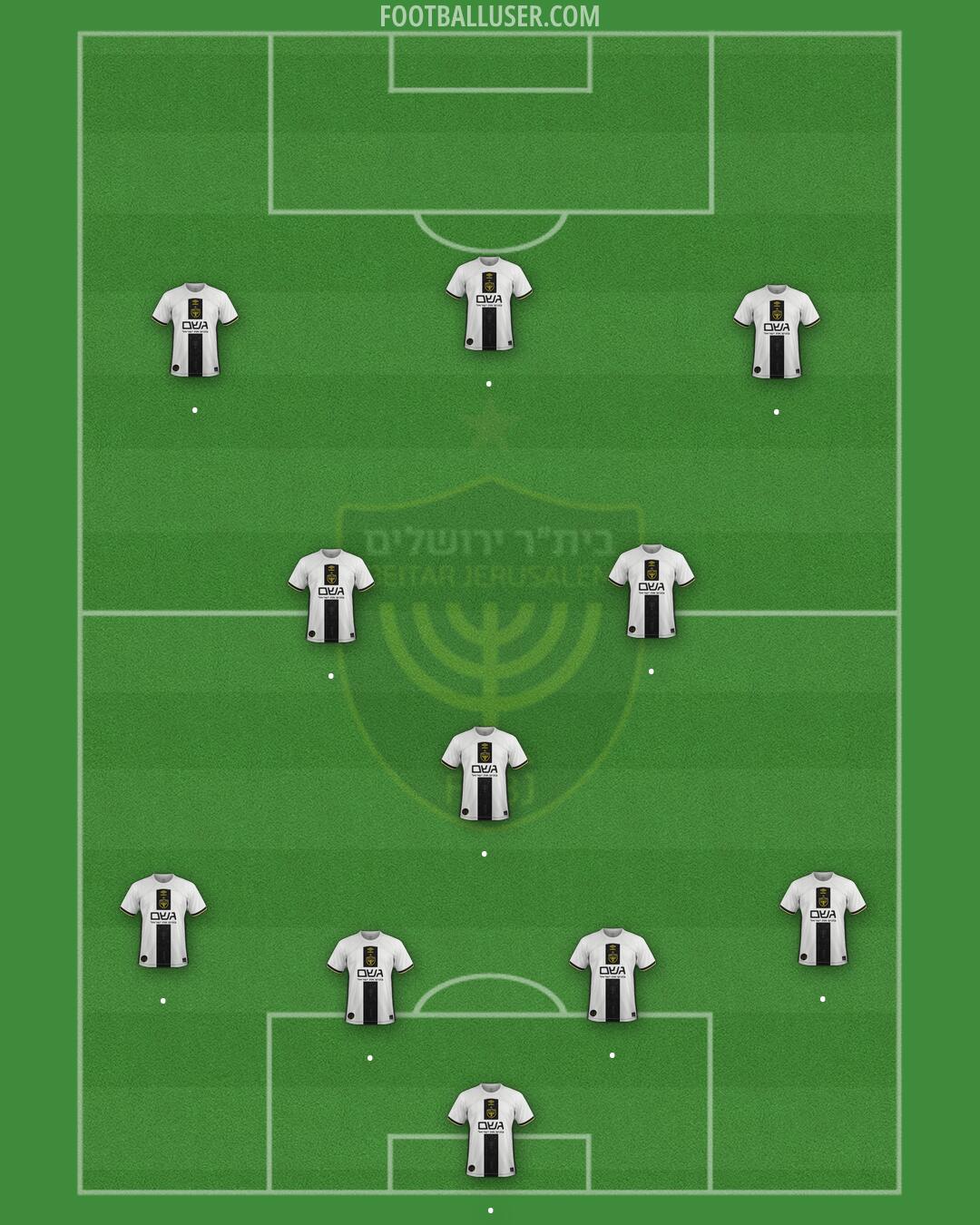

Beitar Jerusalem Football Formation
 Today, November 11, 2026


Starting Lineup
. · . · . · . · . · . · . · . · . · . · .Beitar Jerusalem focuses on a heavy defensive presence and quick transitions through a 5-2-3 formation. This lineup aims to sit deep and absorb pressure before launching direct attacks to catch the opposition out of position. By utilizing a back five, the team creates a dense block that is difficult to penetrate through the middle.
The goalkeeper acts as the final line of defense behind a back five. A central CB anchors the unit, flanked by two LCB and RCB players who defend zonally to secure the middle. To provide width, the LWB and RWB act as attacking wing backs, pushing high to support the attack when possible. These wing backs must track back quickly to ensure the defensive unit maintains a compact shape when the ball is lost.
The midfield operates as a double pivot with an LCM and an RCM. These two players work to protect the central area and break up opposition plays. The LCM and RCM must be prepared to win the second ball and quickly distribute it to the front line. This pairing connects the defense to the attack by recycling possession or playing long passes to the wingers during a transition.
In the attacking third, Beitar Jerusalem uses three attackers to stretch the defense. The LW and RW act as wide wingers who look to isolate defenders in one on one situations, while the ST functions as a pressing centre-forward to force the opposition into mistakes. The attackers work in combinations to create runs in behind the back line. When the LWB and RWB overlap the winger, the team creates overloads on the flanks to deliver crosses into the box.
This formation provides significant tactical advantages, particularly in creating wide overloads from the overlapping wing backs. The defensive compactness makes it very hard for opponents to find space between the lines. Additionally, the team can use the speed of transition to hit the opposition on the break before they can settle into their defensive positions.
Beitar Jerusalem relies on a solid defensive block and rapid verticality to win matches. This formation is best suited for games against dominant teams where sitting deep and countering at pace is necessary.