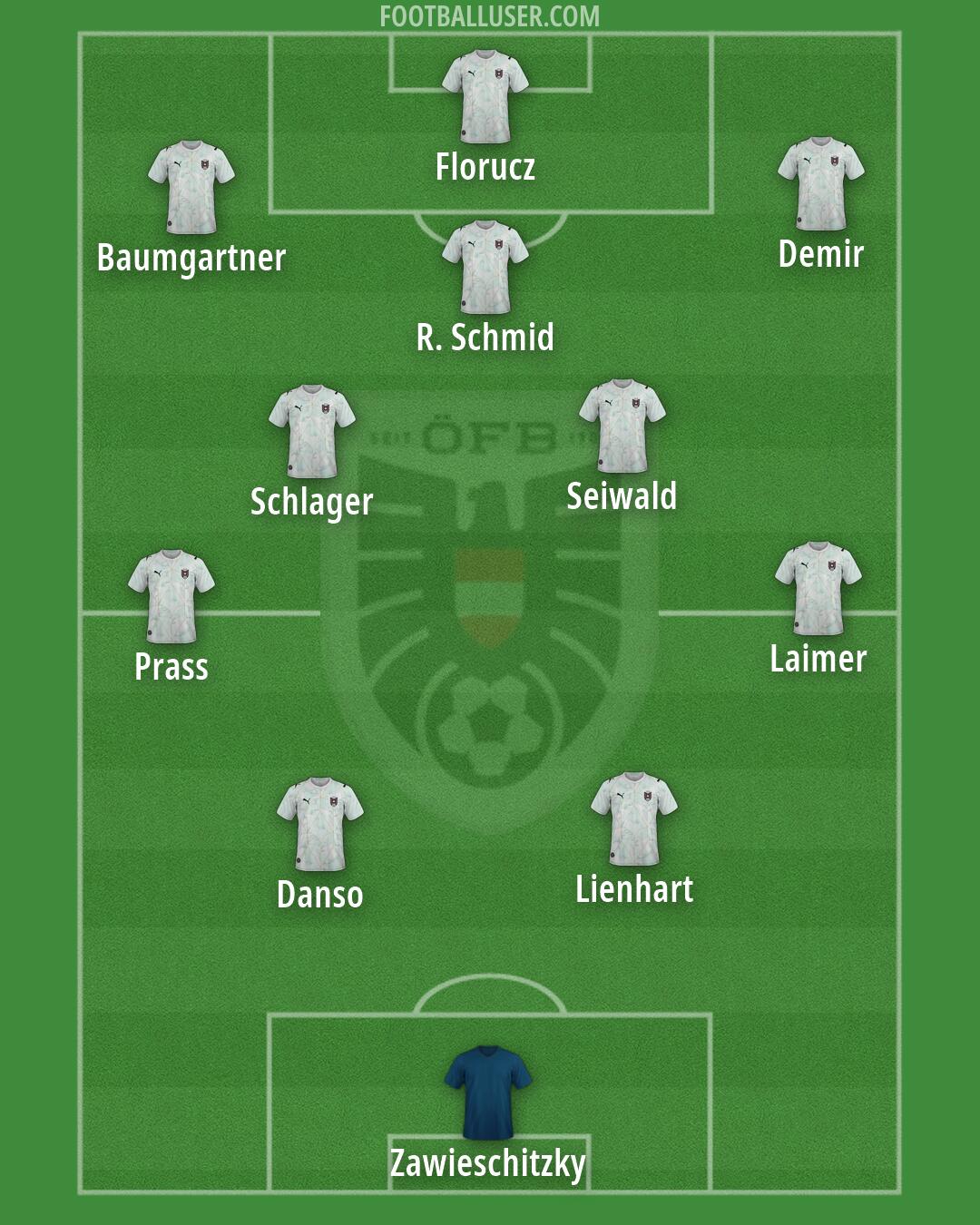

Austria National Football Team Formation
 Today, November 12, 2026


Starting Lineup
Prass · Laimer · Danso · Lienhart · Florucz · Baumgartner · R. Schmid · Demir · Schlager · Seiwald · ZawieschitzkyAustria relies on a high press and verticality to disrupt opponents, utilizing a 2-5-3 formation. This lineup aims to win the ball high up the pitch and immediately look to break the lines to catch the opposition out of position. By pushing many players forward, the team seeks to overwhelm the middle of the park and create chaos in the final third.
Zawieschitzky operates between the posts, acting as the foundation for the defensive unit. The back line consists of a narrow pairing with Danso and Lienhart acting as the two central defenders. Danso uses his aerial strength to win headers, while Lienhart focuses on covering and intercepting passes. Because this formation uses only two defenders, the defensive unit must stay compact and step up together to set the offside trap, relying on the midfield to protect the space behind them.
The midfield is a heavy engine room designed to control the center of the pitch. Prass and Laimer function as a double pivot to shield the defense and win second balls. Schlager and Seiwald operate as inverted eights, pushing into the half-spaces to connect the lines and provide extra passing options. R. Schmid plays as an attacking ten behind the striker, looking to receive on the half-turn and play through the lines. This five man block allows Austria to compress the midfield and deny the turn for opposition players.
In the attacking third, the team employs three attackers to stretch the defense. Florucz acts as a pressing centre forward, leading the line by forcing long balls from the opposition. Baumgartner and Demir play as wide attackers, with Baumgartner looking to cut inside and Demir pushing to find space on the flank. The goal is to use combinations in tight spaces and create runs in behind the opposition back line. When attacking, the wide midfielders often tuck in to allow for quick transitions and vertical passing.
Austria gains a massive advantage through numerical superiority in midfield, making it very hard for opponents to play through the center. The coordination between the five midfielders allows the team to press in waves, squeezing the space and forcing errors. This formation also allows for great speed of transition, as the players are already positioned to move forward the moment the ball is recovered.
This formation is built for an aggressive, high tempo game that seeks to dominate the middle third. It is best suited for matches where Austria can exploit a disorganized opponent through intense pressing and quick verticality.