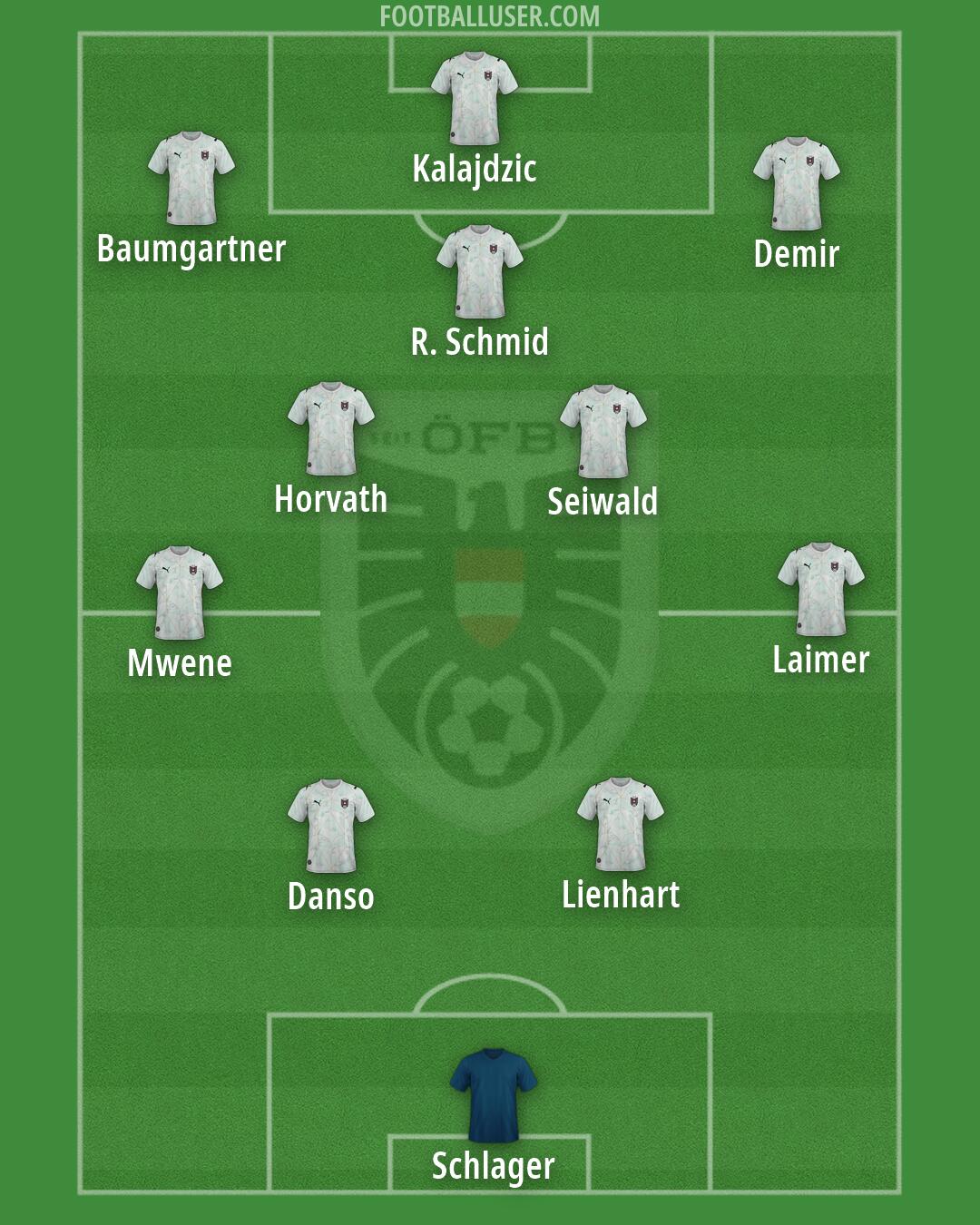

Austria National Football Team Formation
 November 14, 2026


Starting Lineup
Laimer · Danso · Mwene · Baumgartner · R. Schmid · Horvath · Seiwald · Demir · Lienhart · Kalajdzic · SchlagerAustria looks to control the center of the pitch through a heavy presence in the middle of the park using a 2-5-3. This formation is built to dominate the ball and squeeze the space for the opposition by flooding the central zones. By packing the midfield, Austria can quickly recycle possession and look to overwhelm opponents with numbers in the half-spaces.
Schlager stays between the posts to command his area while the defensive unit operates with a very high line. Danso and Lienhart form the two central defenders, acting as the foundation for the team. Danso is dominant in the air and provides physical presence, while Lienhart works to cover space and play out from the back. Because there are only two players in the back line, they must step up to trigger a press and manage the distance between themselves and the midfield to avoid being caught by long balls.
The midfield acts as a massive engine room, utilizing a complex five man lineup to control the tempo. Mwene and Laimer work as a double pivot to shield the two centre backs, with Mwene providing energy to cover wide areas. Seiwald and Horvath operate as the two central midfielders, with Seiwald looking to carry the ball forward and Horvath working to win the second ball. R. Schmid operates as an attacking ten behind the striker, finding pockets of space to create chances and link the midfield to the front three.
The attacking unit uses three players across the front to stretch the defence. Kalajdzic acts as the target man, using his strength to hold up the ball and bring others into play. Baumgartner and Demir provide width, with Baumgartner operating from the left and Demir from the right. These wide attackers often cut inside to create overloads in the middle, allowing the midfield to push higher. The front line is tasked to press from the front, forcing the opposition to play long and allowing the midfield to regain possession high up the pitch.
A major tactical advantage for Austria is the numerical superiority in midfield which makes it very difficult for opponents to play through the middle. The high density of players in the center allows the team to win it back high up the pitch and launch quick attacks. Another strength is the ability to isolate Demir or Baumgartner in one on one situations when the opposition is pulled wide by the central congestion.
This 2-5-3 formation relies on high intensity and total control of the central zones. It is best suited for matches against teams that sit deep and struggle to cope with heavy central pressure.