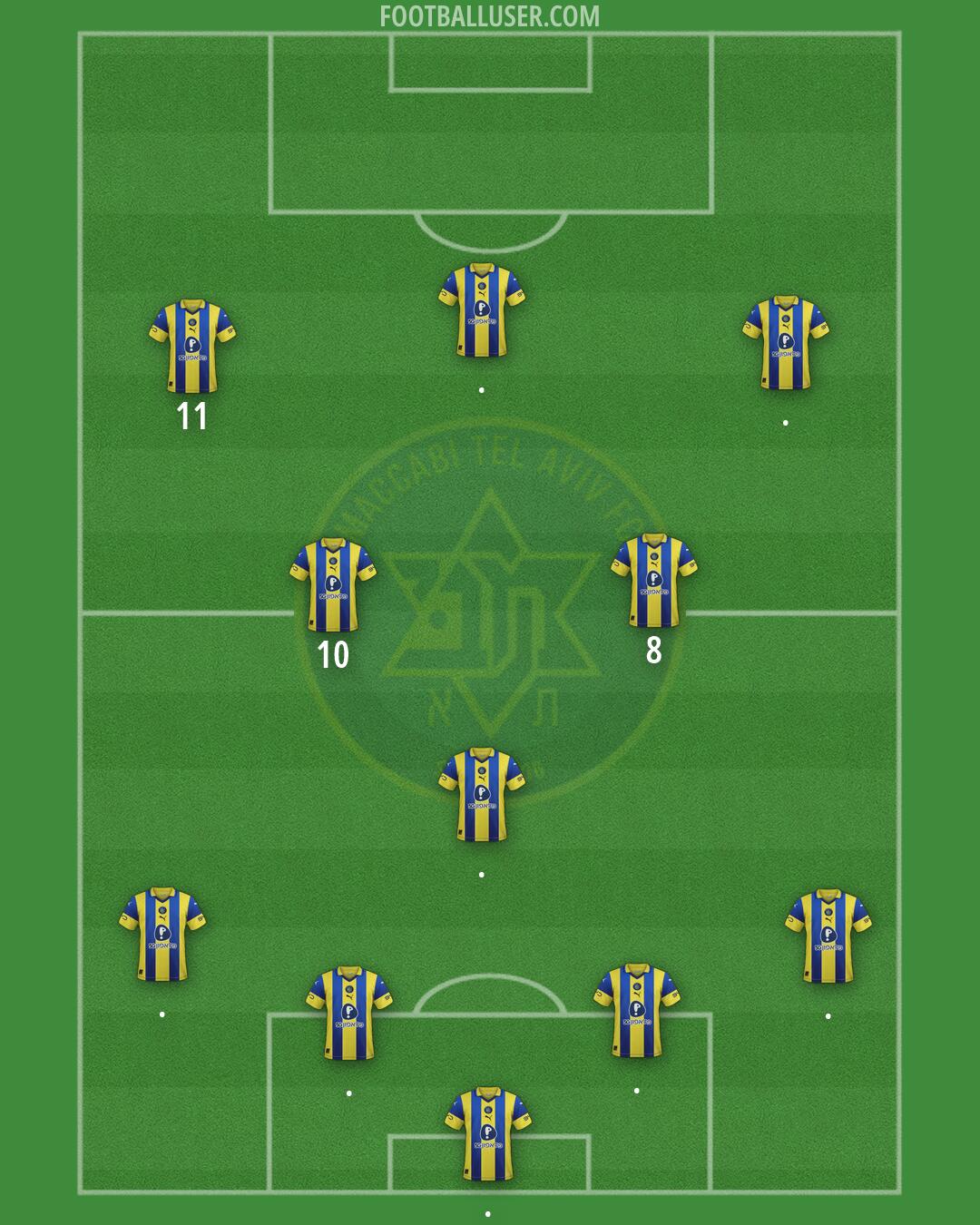

Maccabi Tel-Aviv Football Formation
 Today, November 16, 2026


Starting Lineup
. · . · . · . · . · . · 8 · 10 · . · . · 11Maccabi Tel-Aviv focuses on a high press and rapid transitions using a 5-2-3 formation. This lineup is built to win the ball high up the pitch and hit the opposition in behind before they can get organized. The team aims to stretch the defence through wide play while maintaining a compact block when out of possession.
The goalkeeper starts the build up as the defensive unit sits in a back five. The central defenders consist of a middle CB flanked by a LCB and RCB to protect the central area and defend zonally. To provide width, the RWB and LWB act as attacking wing backs to push high up the flank. This formation allows the wide defenders to cover the space behind the wingers while the central defenders stay deep to win the header and clear the lines.
The midfield operates as a double pivot consisting of 10 at LCM and 8 at RCM. These two players are tasked to connect the defensive and attacking lines by recycling possession and finding the feet of the striker. 10 and 8 must work to compress the midfield and prevent the opposition from playing through the lines. They also need to track back and cover the space left by the advancing wing backs to ensure the team does not get caught on the break.
Maccabi Tel-Aviv utilizes three attackers across the front with 11 acting as a LW and a RW supported by a lone ST. The 11 and the RW are expected to stretch the pitch by hugging the touchline or cutting inside to create space. The ST acts as a pressing centre-forward to trigger a press against the opposition back line. This attacking unit looks to play one-two combinations to break the line and deliver early crosses into the box for runs in behind.
A major tactical strength for Maccabi Tel-Aviv is the ability to create wide overloads when the RWB and LWB push forward to join the wingers. This forces the opposition to defend deep and leaves gaps in the half-spaces. The team also benefits from their ability to press high in coordinated waves, making it difficult for the opponent to play out from the back.
This 5-2-3 formation provides a solid base for teams looking to transition from a defensive block to a lethal counter attack. It is best suited for matches against opponents who play with a high defensive line and can be punished by speed in the wide areas.