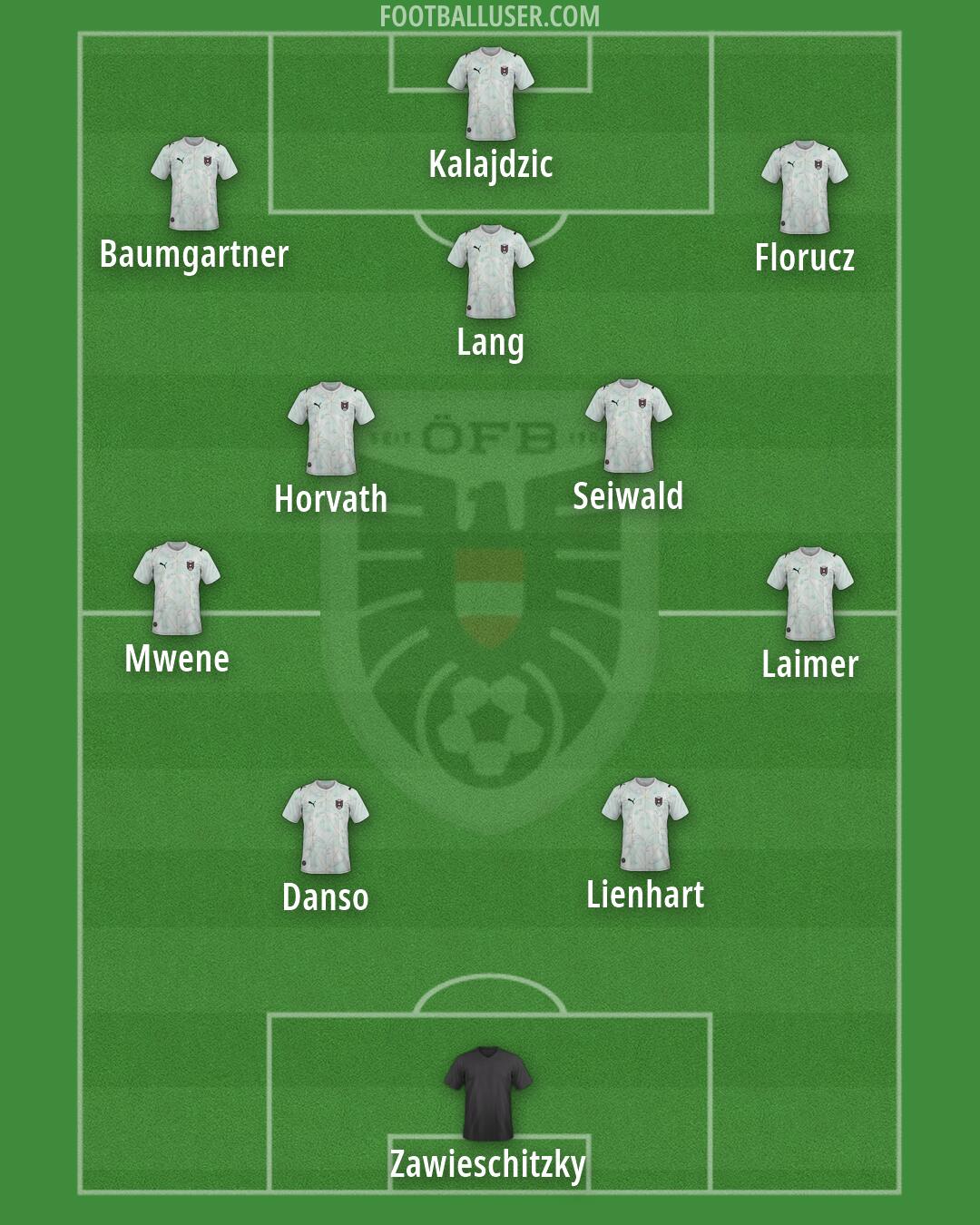

Austria National Football Team Formation
 Today, November 16, 2026


Starting Lineup
Mwene · Danso · Lienhart · Laimer · Horvath · Seiwald · Kalajdzic · Baumgartner · Lang · Florucz · ZawieschitzkyAustria focuses on heavy verticality and high pressure, operating within a 2-5-3 formation. This lineup is built to overload the center of the pitch and win the ball high up the pitch to catch opponents out of position. The tactical identity relies on aggressive movement and rapid transitions to break the line of the opposition defense.
Zawieschitzky acts as the last line of defense, often needing to sweep behind a high line when the team pushes forward. The back line consists of a narrow two man unit with Danso and Lienhart acting as the central defenders. Danso provides aerial strength and physical presence to win the second ball, while Lienhart serves as a ball playing defender to help play out from the back. This small defensive unit must hold the line and stay compact to prevent long balls from bypassing the midfield.
The midfield is a crowded five man block designed to control the middle third. Laimer and Mwene act as a double pivot to shield the defense and provide cover when the two center backs are isolated. Seiwald and Horvath operate in the half spaces to connect the defensive and attacking lines, with Seiwald often looking to carry the ball forward into space. Lang plays as an attacking ten behind the striker, finding pockets of space to play through the lines and deliver passes to the front three.
In the final third, Austria utilizes three attackers to stretch the defense. Kalajdzic operates as a target man, using his height to win the header and hold up the ball for others. Baumgartner plays as an inverted winger on the left, looking to cut inside and create chances, while Florucz stays wide on the right to spread the play. This front line is designed to press from the front, forcing a long ball from the opposition so the midfield can intercept and start a new attack.
A major strength of this Austria lineup is the ability to create numerical superiority in midfield, making it difficult for opponents to play through the center. The formation also allows for high pressing in coordinated waves, as the five midfielders and three attackers can squeeze the space quickly. This setup creates many chances for runs in behind when the opposition is caught transitioning from attack to defense.
This formation is built for a high intensity game that relies on winning possession in advanced areas. It is best suited for matches against teams that struggle to play under pressure and leave space between their midfield and defensive lines.