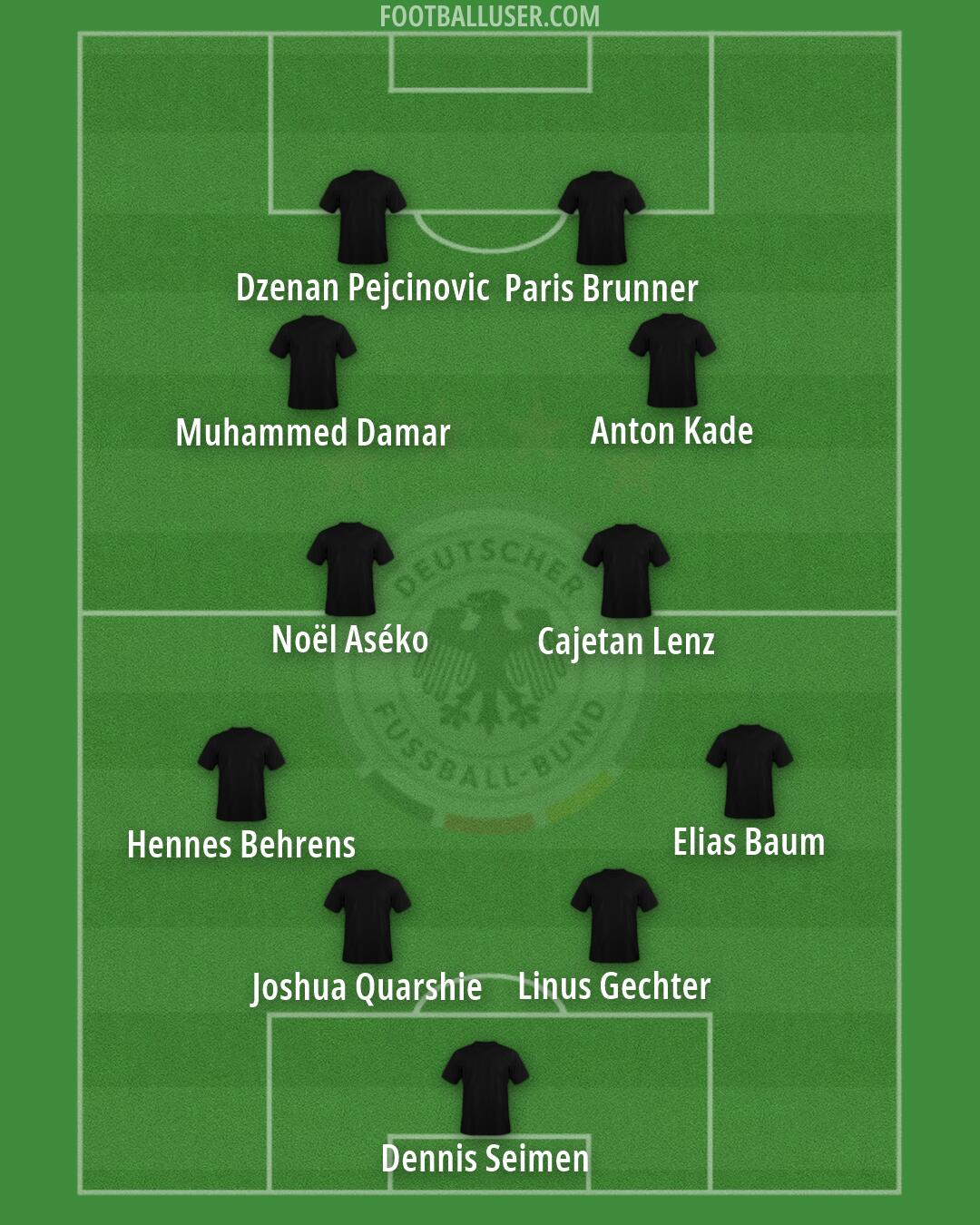

Germany National Football Team Formation
 Today, November 18, 2026
 peter.vicey


Starting Lineup
Paris Brunner · Dzenan Pejcinovic · Muhammed Damar · Anton Kade · Noël Aséko · Cajetan Lenz · Hennes Behrens · Joshua Quarshie · Linus Gechter · Elias Baum · Dennis SeimenGermany looks to win the ball high and strike with heavy verticality using a 4-2-4. This lineup is built to overwhelm opponents with numbers in the final third and use directness to punish teams on the break. The intention is to squeeze the space in the opposition half and create chaos through high pressure.
Dennis Seimen stands between the posts to guard the goal. The back four functions as a flat line that must remain compact when the team sits deep. Joshua Quarshie and Linus Gechter act as the central defenders, where they need to be dominant in the air and quick to cover when the high line is bypassed. Hennes Behrens and Elias Baum operate as wide defenders who must balance their positioning to avoid being caught too far up the pitch during transitions. The defensive unit relies on staying narrow to deny central passes.
The midfield relies on a double pivot to provide stability. Cajetan Lenz and Noël Aséko sit in front of the back four to shield the defence and recycle possession. One of them must act as the carrier to drive forward with the ball, while the other looks to win the second ball and intercept play. These two players are the link between the defensive line and the four attackers. They have the heavy task of protecting the center while the rest of the team pushes forward.
The attacking unit is composed of four players designed to stretch the defence. Anton Kade and Muhammed Damar act as wide wingers who aim to get to the byline and whip it in or cut inside to threaten the goal. In the middle, Paris Brunner and Dzenan Pejcinovic operate as a partnership of two forwards. They look to play one-two combinations and make runs in behind the opposition back line. The forwards press from the front to force a long ball and prevent the opposition from playing out from the back.
Germany offers significant tactical advantages through this aggressive formation. The team creates wide overloads when the wingers and full backs combine to overlap the winger. There is also the potential for speed of transition, as the four attackers can immediately hit in behind on the transition once the ball is won. This setup forces the opponent to defend a massive amount of space behind their midfield.
This 4-2-4 formation is built for high intensity and heavy attacking pressure. It is best suited for games where Germany needs to break down a low block or exploit a tired opponent through rapid counter attacks.