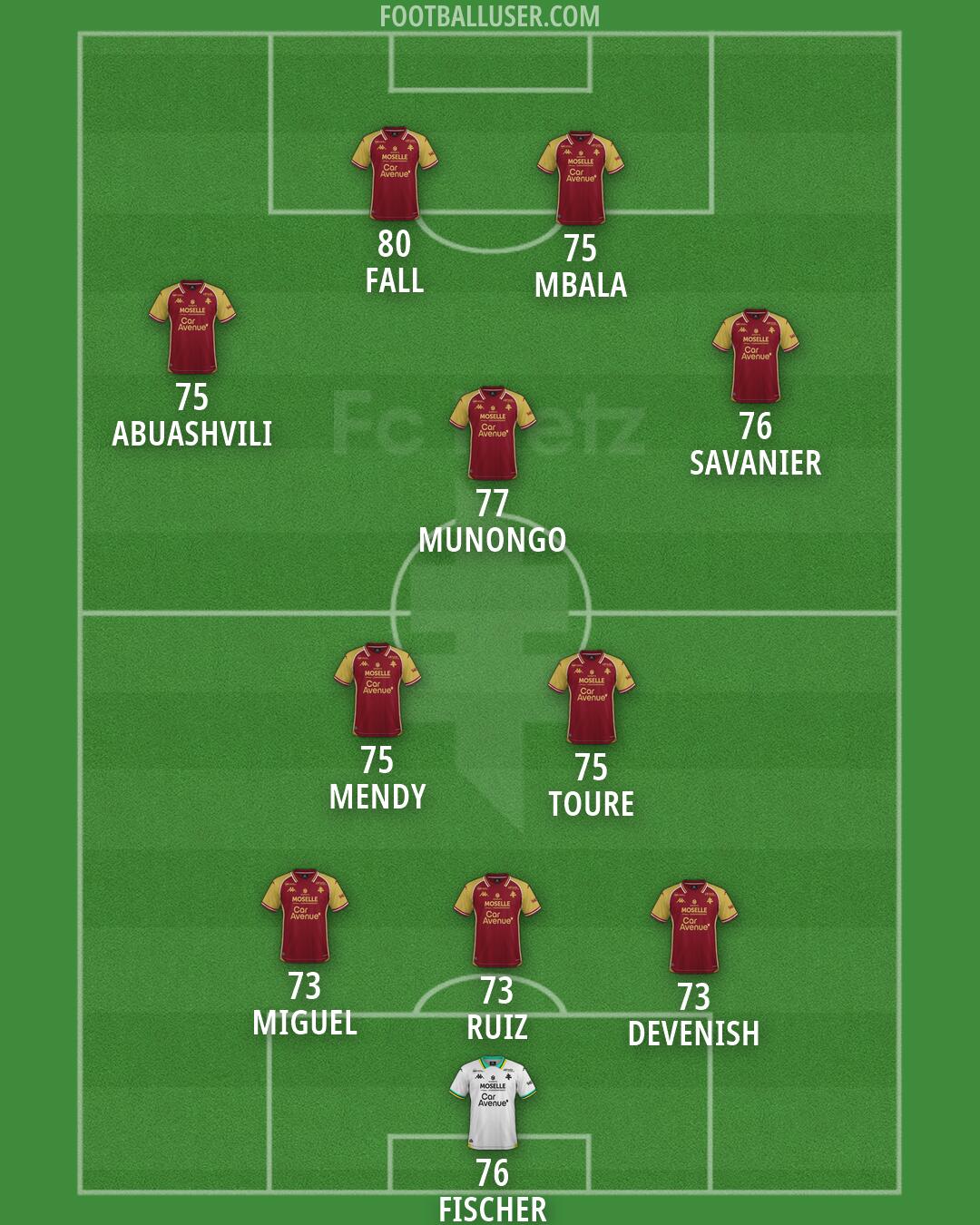

Metz Football Formation
 Today, November 18, 2026


Starting Lineup
76 (FISCHER)73 (RUIZ)
73 (DEVENISH)
73 (MIGUEL)
75 (TOURE)
75 (MENDY)
77 (MUNONGO)
75 (ABUASHVILI)
76 (SAVANIER)
80 (FALL)
75 (MBALA)
Metz relies on a heavy defensive block to absorb pressure and strike on the transition, utilizing a 5-3-2 formation. This lineup is built to sit deep and deny space between the lines, waiting for the right moment to break quickly. The team aims to stay compact and force opponents into wide areas where they can easily defend the cross.
In goal, 76 acts as the last line of defense for Metz. The defensive unit functions as a back five, with 75 (RCB) and 75 (LCB) acting as the central pillars of the zonal line. These two central defenders focus on winning the header and clearing the lines when the ball enters the box. They are supported by 73 (RWB) and 73 (LWB), who act as attacking wing backs to provide width in possession but must track back to form a narrow defensive block when the team lacks the ball. The 73 (CB) sits slightly deeper to sweep behind the line and cover any runners who manage to break through the initial press.
The midfield operates as a three man midfield with a carrier. The 77 (DM) plays the role of the single pivot to shield the defense and disrupt opposition attacks. Next to him, 76 (RCM) and 75 (LCM) are tasked with winning the second ball and connecting the defensive and attacking lines. These two midfielders work to compress the midfield and ensure that the opposition cannot play through the lines. When Metz wins possession, the midfielders look to immediately find the forwards to initiate a counter at pace.
Metz employs two forwards in a partnership to lead the attack. The 80 (LS) acts as a primary threat, often looking to run in behind the defense or find space in the channels. The 75 (RS) plays as a second striker in the hole, working to link up play with the midfield and hold up the ball to allow the wing backs to move up the pitch. This duo works to press the opposition back line, forcing long balls that the back five can easily collect. The attacking movement relies on the 73 (RWB) and 73 (LWB) to overlap the winger and provide service from the flanks.
One major advantage for Metz is the compactness when defending, making it very difficult for opponents to find passing lanes into the box. The formation also allows for wide overloads when the wing backs push high, creating two on one situations against opposing full backs. Additionally, the setup provides great security in central areas, allowing the team to defend man to man in the final third if necessary.
This 5-3-2 formation is a defensive setup designed to frustrate teams that dominate possession. It is best suited for matches against heavy favorites where sitting deep and hitting on the transition is the most effective way to score.