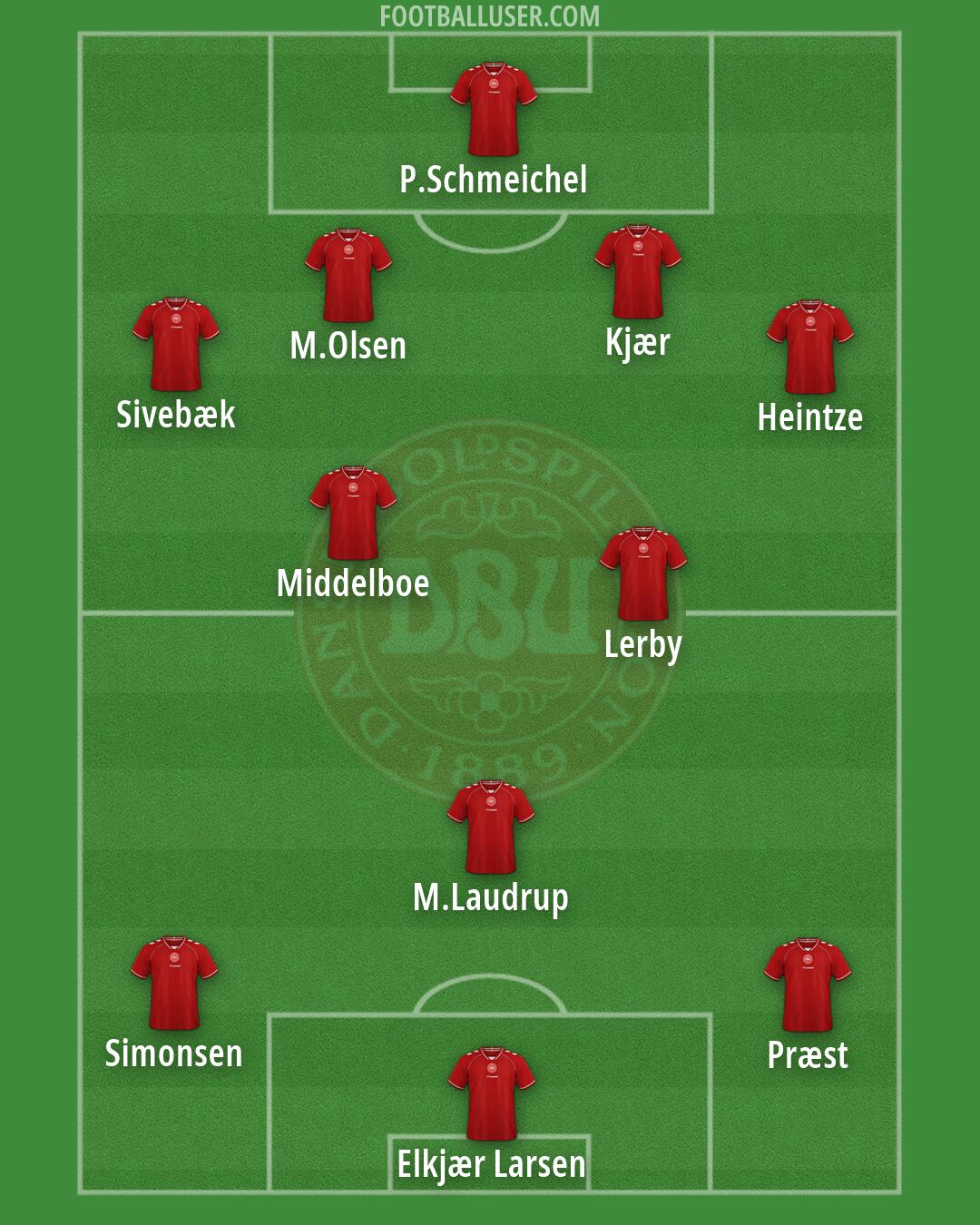

Denmark National Football Team Formation
 Today, November 19, 2026


Starting Lineup
P.Schmeichel · M.Olsen · Kjær · Heintze · Sivebæk · Middelboe · Lerby · M.Laudrup · Elkjær Larsen · Simonsen · PræstDenmark plays a high press with a vertical style of play using a 4-3-3 formation. The team aims to win the ball high up the pitch and break quickly to catch the opposition out of position. This lineup relies on directness to penetrate defensive lines and uses the width of the pitch to stretch the defence.
In goal, P.Schmeichel acts as the last line of defence with strong shot stopping abilities. The back line functions as a flat back four that can step up to set the offside trap. Kjær and M.Olsen operate as the central defenders, with Kjær often acting as a ball playing defender to start attacks. Heintze and Sivebæk provide the width as full backs, tasked with tracking back to cover wide areas and supporting the press when the ball is lost.
The midfield consists of a three man midfield with a carrier and a creative presence. Middelboe and Lerby work to control the center, with Lerby often driving forward with the ball to link the lines. M.Laudrup plays as an attacking ten behind the striker, looking to find pockets of space and play through the lines. This unit works to compress the midfield and win the second ball to maintain pressure on the opponent.
Denmark utilizes three attackers across the front to pin the last defender. Elkjær Larsen acts as a pressing centre forward who can hold up the ball and lead the line. Simonsen and Præst operate as wide wingers, with Simonsen often cutting inside to create central overloads. These forwards are tasked to press from the front, forcing a long ball from the opposition. They look to arrive late into the box or collect cutbacks from the byline to finish chances.
The tactical advantages for Denmark include the ability to press high in coordinated waves to win the ball back quickly. The team can also exploit the wings through the combination of the full backs and the wide forwards. Numerical superiority in the middle thirds allows them to recycle possession or launch direct attacks. This setup creates significant pressure on the opposition back line during transitions.
Denmark relies on a high intensity game plan to disrupt the rhythm of the opponent. This formation is best suited for matches against teams that try to play out from the back and struggle under heavy pressure.