Custom Team Football Formation
 Today, November 21, 2026


Starting Lineup
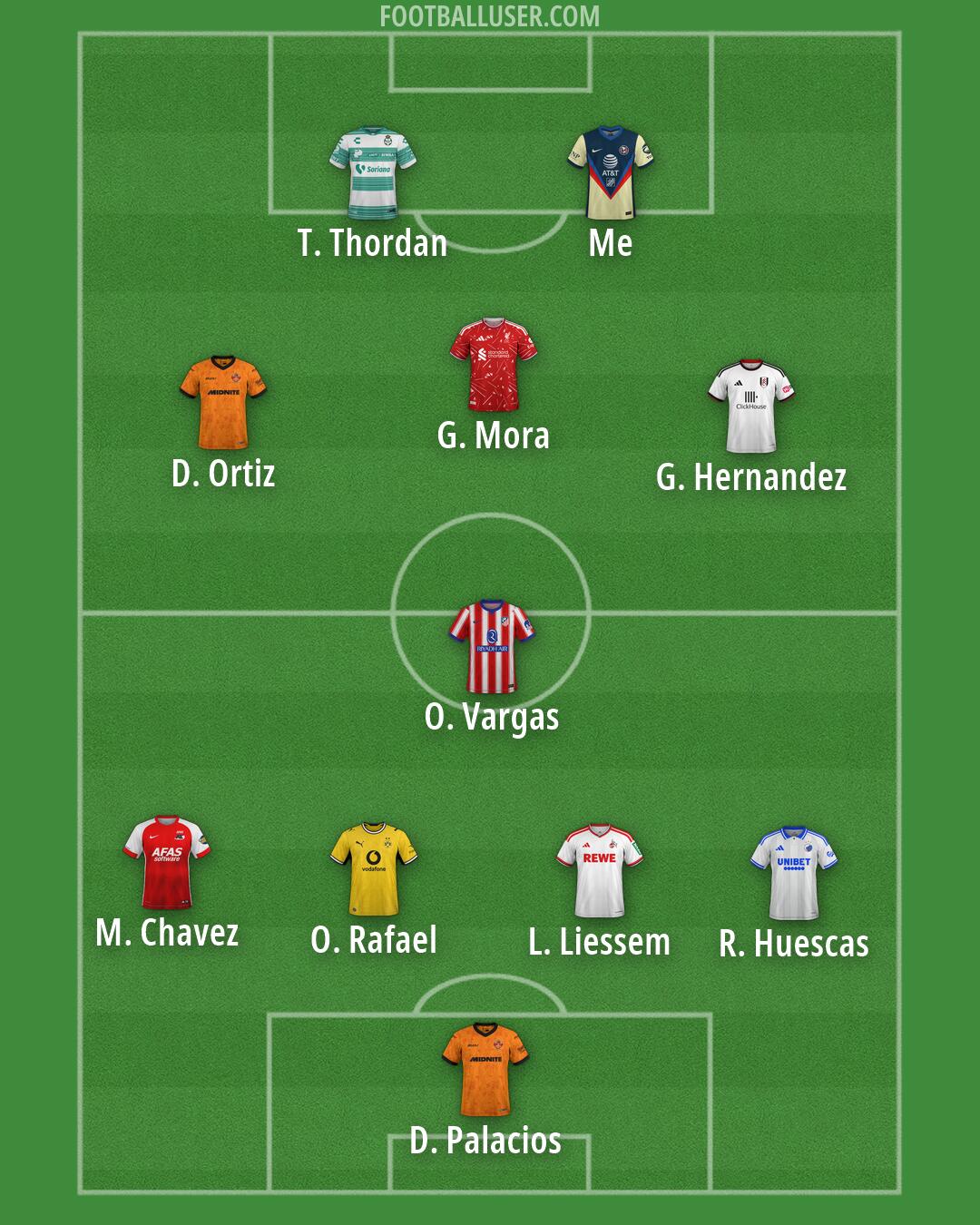
D. Palacios (Wolves) · O. Rafael (Borussia Dortmund) · M. Chavez (AZ) · L. Liessem (Köln) · R. Huescas (FC København) · O. Vargas (Atlético) · G. Mora (Liverpool) · D. Ortiz (Wolves) · G. Hernandez (Fulham) · Me (América) · T. Thordan (Santos Laguna)A focus on defensive solidity and rapid verticality defines this lineup, which operates in a 5-3-2 formation. The team looks to sit deep when out of possession and hit opponents on the transition to catch them behind the line. This formation is built to play a reactive style of football where the goal is to absorb pressure before launching quick attacks.
D. Palacios guards the goal and manages the space behind the defense. The back five consists of a central trio with O. Vargas acting as the anchor to hold the line while L. Liessem and O. Rafael provide cover. R. Huescas and M. Chavez act as attacking wing backs to provide the necessary width. These wide defenders are expected to push high to support the attack but must track back to form a narrow defensive block when the ball is lost.
The midfield works as a three-man midfield with a carrier to drive the team forward. G. Mora sits in the middle to shield the defense and collect the ball from the center backs. G. Hernandez and D. Ortiz occupy the half spaces to connect the defensive and attacking lines. They work to win the second ball and press in a mid-block to disrupt the opposition before they can progress through the thirds.
Two forwards lead the line in a partnership to stretch the opposition. T. Thordan and Me operate as a duo that looks to run in behind the defenders. T. Thordan acts as a pressing centre-forward to force long balls from the opponent, while Me focuses on link-up play to pull defenders out of position. The attackers use combinations to create runs in behind and target the space between the opposition full backs and center backs.
The team gains a significant advantage through the width provided by R. Huescas and M. Chavez. This allows for wide overloads when they overlap the wingers, creating space for the central midfielders to arrive late into the box. Additionally, the back five ensures compactness when defending, making it very difficult for opponents to find gaps in the central areas.
This 5-3-2 formation relies on a strong defensive core and quick forward movements. It is best suited for matches against high pressing teams where catching them on the break is the primary goal.