Custom Team Football Formation
 Today, November 27, 2026


Starting Lineup
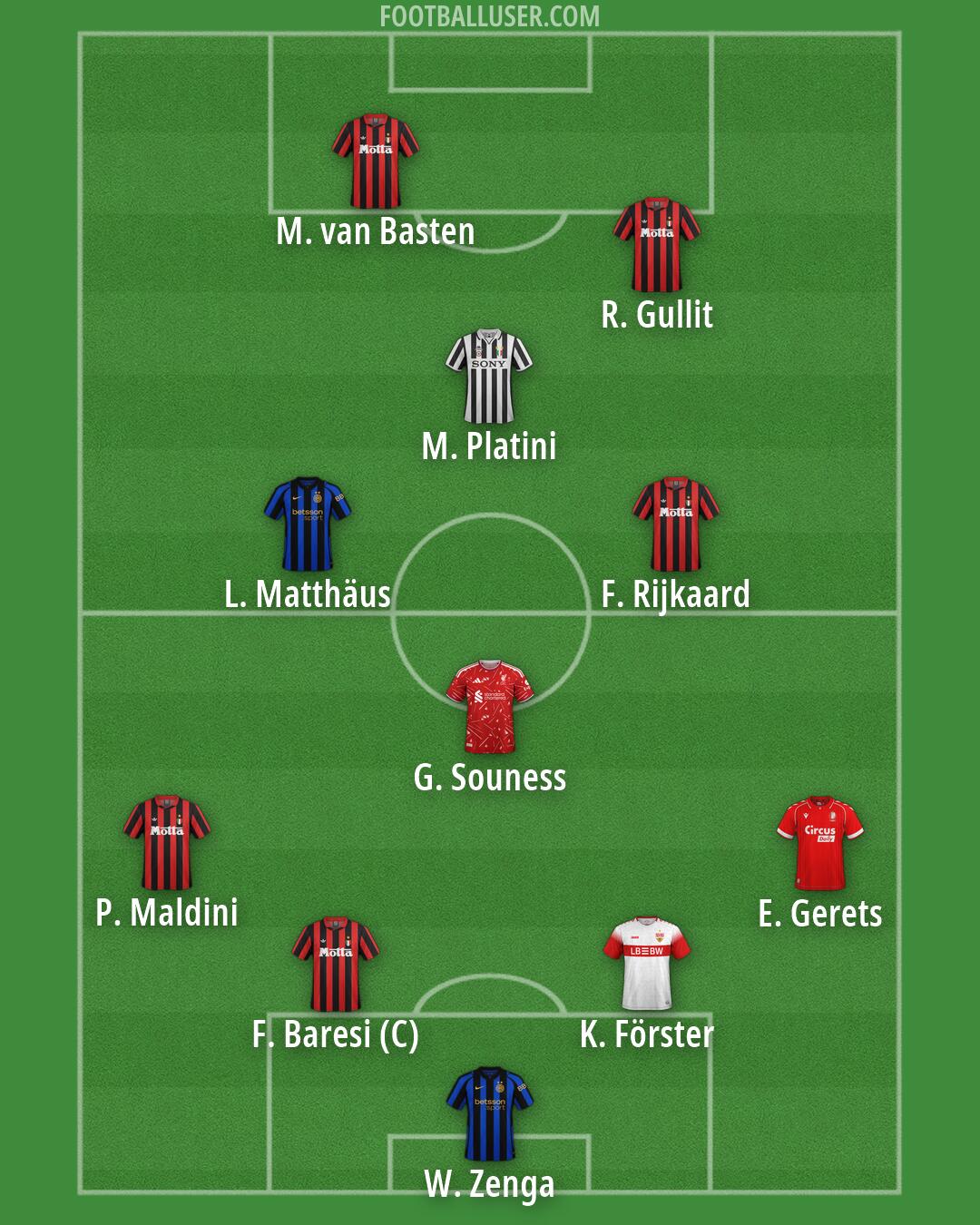
W. Zenga (Inter) · K. Förster (Stuttgart) · F. Baresi (C) (Milan) · E. Gerets (Standard) · P. Maldini (Milan) · G. Souness (Liverpool) · F. Rijkaard (Milan) · L. Matthäus (Inter) · M. Platini (Juventus) · M. van Basten (Milan) · R. Gullit (Milan)Focusing on a strong defensive block and quick transitions, this lineup utilizes a 5-4-1 formation to control matches. The team aims to stay compact and win the ball in the middle of the pitch before hitting the opposition with direct verticality. This specific formation is built to play a way that relies on heavy defensive discipline and the individual quality of players to break lines during a counter at pace.
W. Zenga guards the goal while a back five provides a massive presence in the defensive third. F. Baresi (C), serving as the captain, leads the line from the left side of the central trio, acting as a dominant defender who reads the game to intercept play. Beside him, G. Souness provides extra strength in the center, while K. Förster holds the right side of the central group. To add width, E. Gerets operates as a right wing back to push forward, and P. Maldini plays as a left wing back, providing coverage and ability to overlap the midfield. This unit works to stay narrow to deny the turn to attackers and force play wide.
The midfield operates as a flat four that can transition into a heavy pressing unit. L. Matthäus and F. Rijkaard form a powerful double pivot that sits in front of the back five to shield the defense and win the second ball. Matthäus uses his incredible work rate and passing range to drive the team forward, while Rijkaard helps to recycle possession and protect the central zone. Ahead of them, M. Platini and R. Gullit operate in the half spaces, acting as two tens who can carry the ball forward or arrive late into the box to support the attack. They link the deep midfield to the lone striker by playing through the lines.
In the final third, the team relies on a lone striker, M. van Basten, to lead the line. He acts as a clinical presence who can hold up the ball to allow the midfield to push up. The attack is built by using the wide players to stretch the defense, with M. Platini and R. Gullit cutting inside to create central threats. When the team wins the ball high up the pitch, the wing backs look to deliver early crosses to find the feet of the striker. This movement creates runs in behind and allows the team to attack in combinations.
One major advantage of this formation is the ability to maintain compactness when defending, making it very difficult for opponents to find gaps between the lines. The team also gains numerical superiority in the middle of the pitch when the two attacking midfielders drop back to help the pivot. Furthermore, the presence of high quality individuals allows for a rapid speed of transition, turning defensive stability into an immediate offensive threat.
This 5-4-1 formation provides a rock solid base that is perfect for neutralizing heavy attacking sides. It is best suited for games where the team needs to sit deep and hit the opponent on the break.