
São Paulo Football Formation
 Today, November 28, 2026
 RPLemos


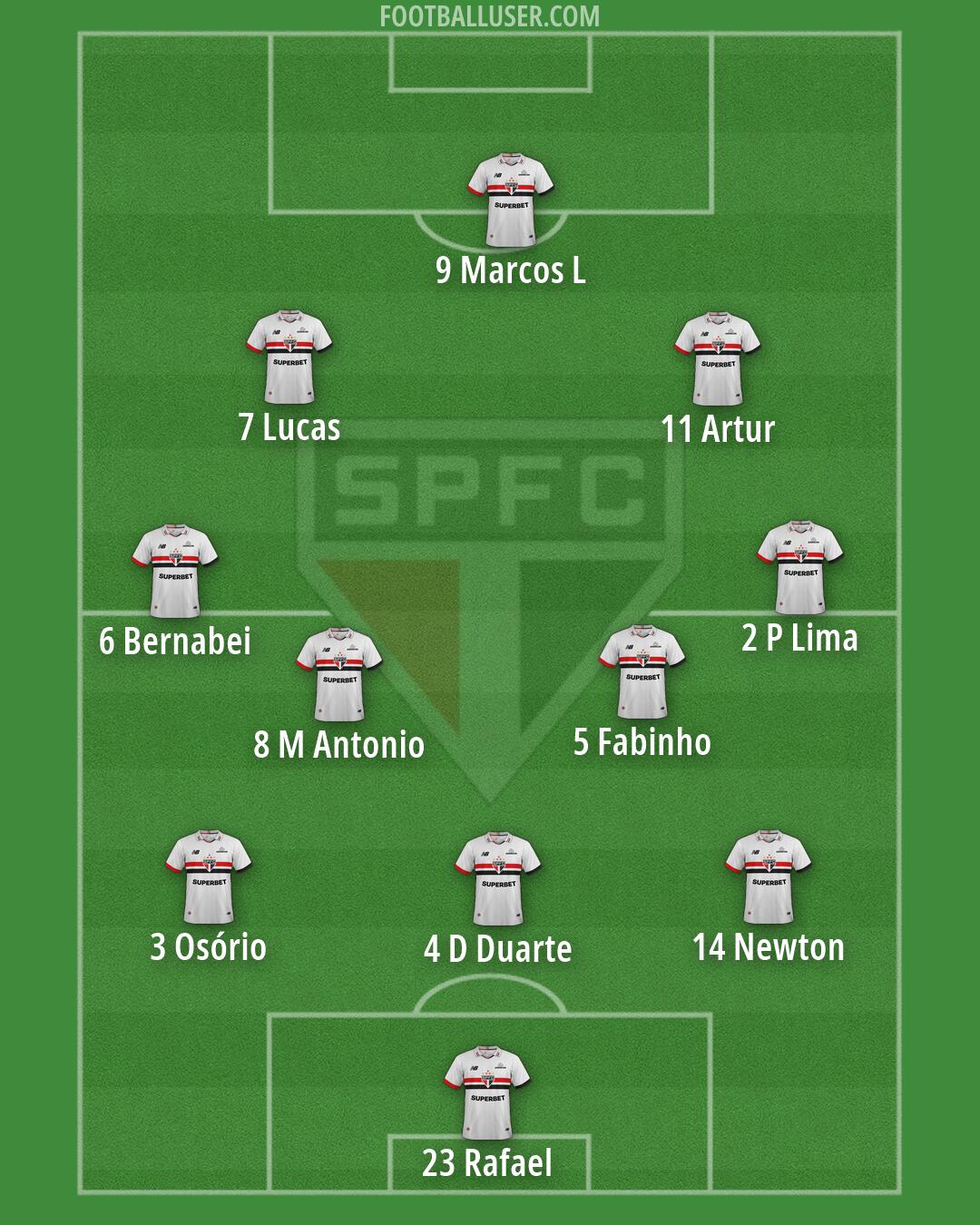
Starting Lineup
23 Rafael2 P Lima
5 Fabinho
4 D Duarte
6 Bernabei
14 Newton
3 Osório
11 Artur
8 M Antonio
9 Marcos L
7 Lucas
São Paulo focuses on aggressive pressing and direct vertical play through a 3-4-3. This lineup aims to win the ball high up the pitch and quickly move it toward the final third to catch opponents out of position. The goal is to dominate the wide areas and use rapid transitions to punish teams that struggle to manage space.
Rafael acts as the last line of defense, playing a vital role when the team plays out from the back. The defensive unit operates with a back three consisting of Osório, D Duarte, and Newton. Osório and Newton act as wide centre-backs to provide cover when the wingers push up, while D Duarte sits centrally to sweep behind the line and win headers. This back three provides a solid base, allowing the team to maintain a high line to squeeze the space in the middle of the pitch.
The midfield functions with a double pivot of M Antonio and Fabinho who sit in front of the defense. Fabinho works to shield the back three and intercept passes, while M Antonio looks to carry the ball forward and connect the defensive lines to the attack. On the flanks, Bernabei and P Lima operate as wing backs to provide width and stretch the defense. Bernabei is expected to push high to overlap the attackers, while P Lima provides balance and covers the wide areas during defensive shifts.
The attacking front three uses a central striker supported by wide players. Marcos L operates as a pressing centre-forward, looking to pin the last defender and hold up the ball for others. Lucas and Artur play as inverted wingers who cut inside to create goalscoring chances in the half-spaces. This movement creates space for Bernabei and P Lima to deliver crosses from the byline. The forwards work in pairs to press the opposition back line, forcing long balls that the central defenders can easily collect.
São Paulo gains a significant advantage through wide overloads when the wing backs join the attackers. This creates numerical superiority in the final third, making it difficult for opposition full backs to track runners. The formation also offers speed of transition, as the midfield trio can quickly switch play to the wide players once the ball is recovered. The compactness when defending in a mid-block makes it hard for opponents to play through the center.
This 3-4-3 formation relies on high intensity and quick ball movement to break down opponents. It is best suited for matches against teams that play a high defensive line or struggle with wide coverage.