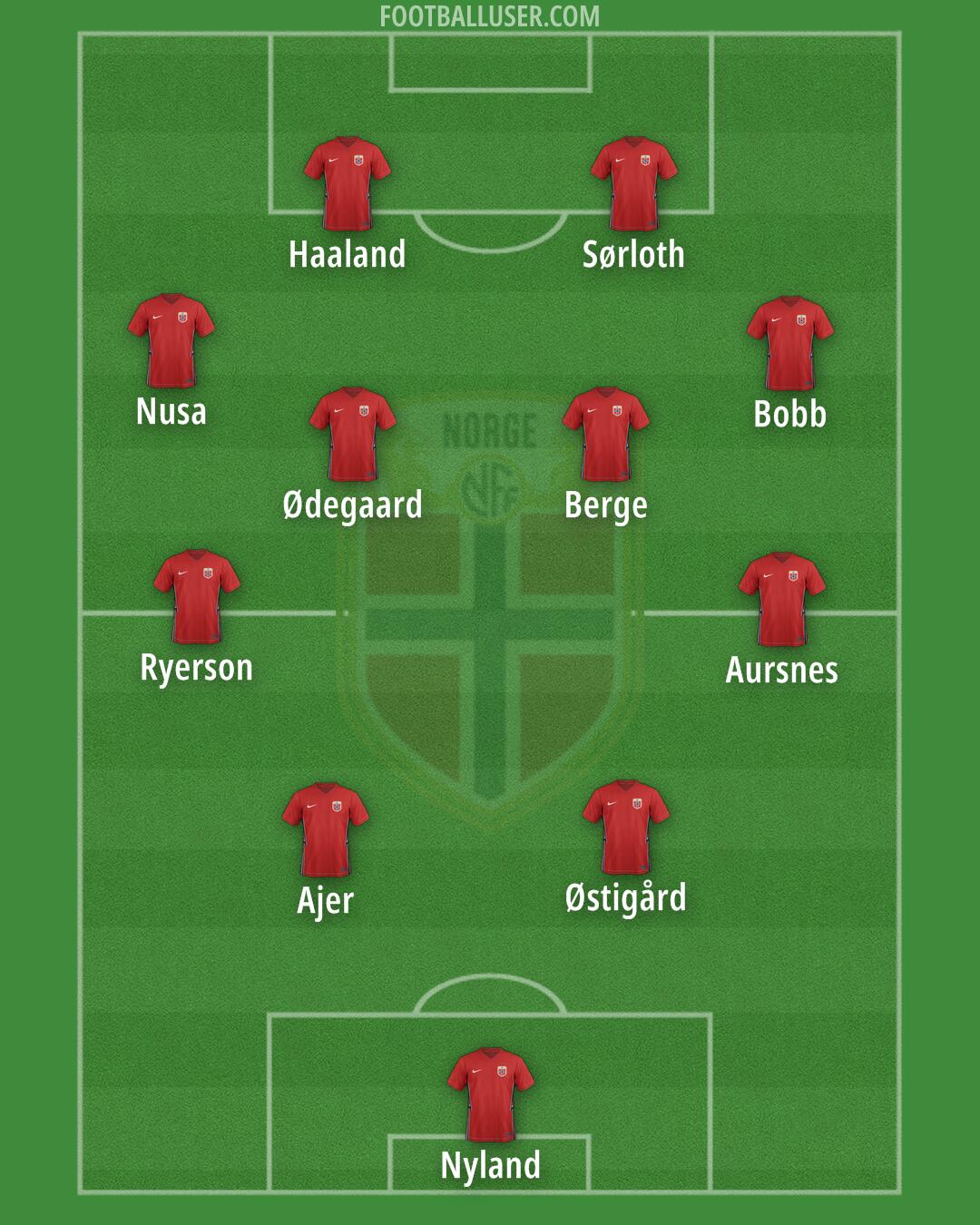

Norway National Football Team Formation
 June 16, 2024


Starting Lineup
Ryerson · Aursnes · Ajer · Østigård · Nyland · Haaland · Sørloth · Ødegaard · Nusa · Bobb · BergeNorway plays with a direct and vertical intent, using a 4-4-2 formation to stretch the opposition. The Red Devils look to win the ball and move quickly toward the goal, utilizing the physical presence of their attackers to stay high up the pitch. This lineup is built to play with high intensity and fast transitions, making it difficult for teams to keep possession.
Nyland sits between the posts to guard the goal. The defensive line consists of a flat back four, where Ryerson and Aursnes act as full backs to provide width and track back when needed. Ajer and Østigård operate as the two central defenders, with Østigård providing aerial strength and Ajer acting as a covering defender to sweep behind a high line. This unit works together to squeeze the space and defend zonally across the pitch.
A four man midfield provides the engine for Norway. Berge operates in a central role to shield the defence and win the second ball, while Ødegaard plays as an inverted eight, looking to drive forward with the ball and create through the lines. On the flanks, Bobb and Nusa act as wide midfielders who provide energy and help to press in a mid-block. This midfield links the defensive line to the attack by recycling possession and finding the feet of the forwards.
The attack relies on a powerful duo of two forwards. Haaland works as a pressing centre-forward to pin the last defender and make runs in behind, while Sørloth acts as a target man to hold up the ball and allow others to join the play. The front line is designed to create chaos through combinations and quick movements. When the ball moves wide, the wingers look to deliver early crosses for Haaland and Sørloth to attack the near post or far post.
This 4-4-2 formation offers significant tactical advantages for Norway. The team creates numerical superiority in the attacking third through the movement of the two strikers. They also benefit from a high press in coordinated waves, which allows them to win the ball back high up the pitch. The speed of transition is another key strength, as the team can break quickly once the midfield recovers the ball.
Norway uses this setup to overwhelm opponents through physical dominance and rapid vertical play. It is a formation best suited for games where the team can exploit space behind a high defensive line.