
Barcelona Football Formation
 July 19, 2024


Starting Lineup
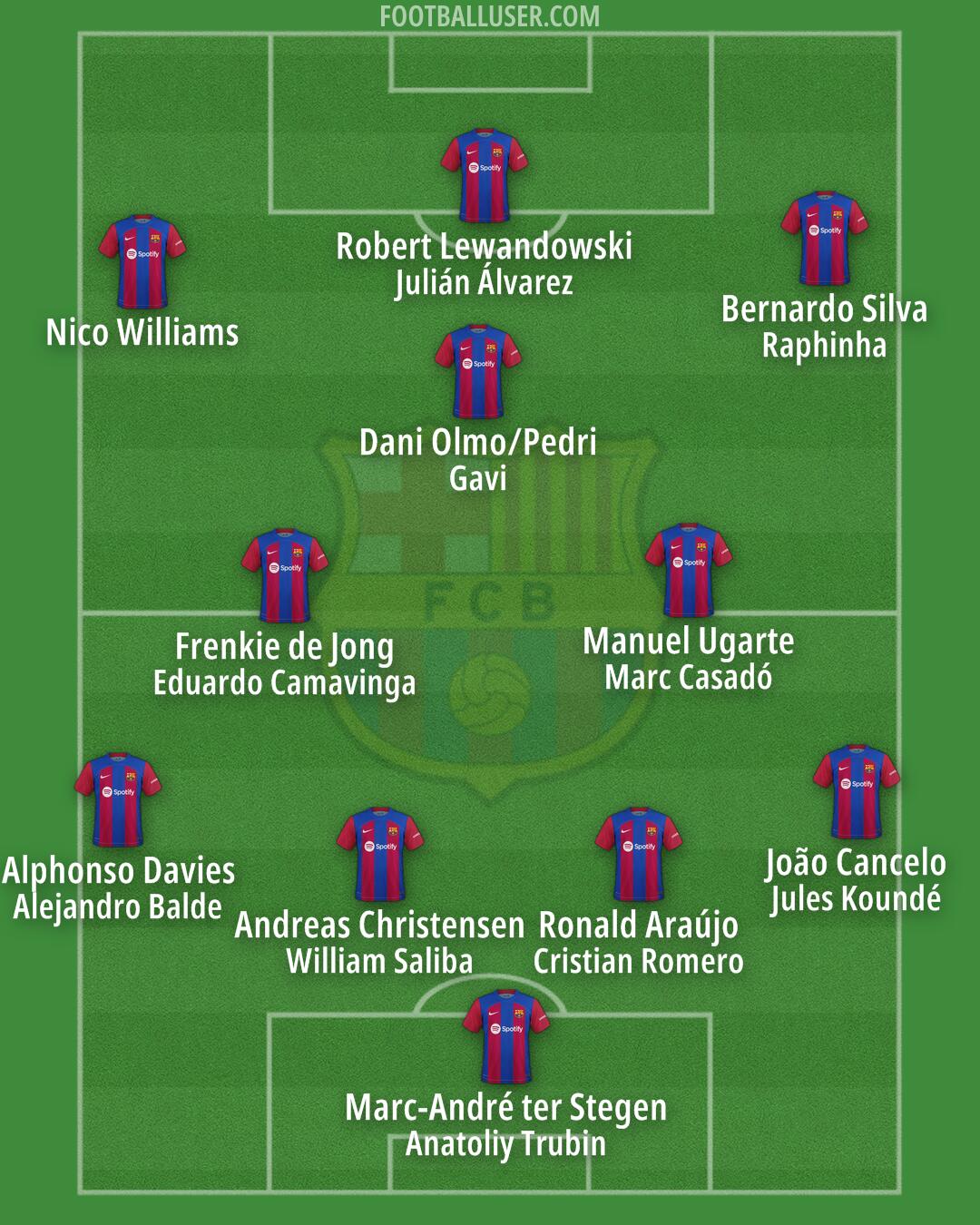
Nico Williams · Bernardo Silva (Raphinha) · Robert Lewandowski (Julián Álvarez) · Dani Olmo/Pedri (Gavi) · Frenkie de Jong (Eduardo Camavinga) · Manuel Ugarte (Marc Casadó) · Alphonso Davies (Alejandro Balde) · Andreas Christensen (William Saliba) · Ronald Araújo (Cristian Romero) · João Cancelo (Jules Koundé) · Marc-André ter Stegen (Anatoliy Trubin)Barcelona relies on heavy possession and high pressure through a 4-3-3 formation. This lineup is built to control the ball and squeeze the pitch to dominate games. The team uses the width of the field to stretch opponents before playing through the lines.
Marc-André ter Stegen plays behind a flat back four. He is able to play short from the back to start attacks. Ronald Araújo acts as a dominant presence in the air and covers the right side of the defense. Andreas Christensen plays as a ball playing defender to help move the ball from the defensive third. On the flanks, Alphonso Davies and João Cancelo act as attacking full backs who push up to provide width. They will overlap the wingers to create more passing lanes in the final third.
A three man midfield handles the central work. Manuel Ugarte acts as a single pivot to shield the defense and win the second ball. Frenkie de Jong receives the ball on the half-turn to carry the ball forward and connect the lines. Dani Olmo or Pedri operates as an attacking ten behind the striker to create in tight spaces. This midfield unit works to win it back high up the pitch when the ball is lost.
The attack features three players across the front. Robert Lewandowski acts as a lone striker to hold up the ball and pin the last defender. Nico Williams plays as an inverted winger who will cut inside to threaten the goal. Bernardo Silva operates on the right and will often pull wide to help the fullback or drift inside to link up with the midfield. The forwards press from the front to force a long ball from the opposition.
One major strength for Barcelona is the ability to create wide overloads through the movement of the full backs. The team also finds success through numerical superiority in midfield when the attacking ten drops deep. This allows the players to recycle possession and move the opponent side to side.
This 4-3-3 formation is designed for a side that wants to dictate the tempo of the match. It works best against teams that sit deep and struggle to cope with constant pressure.