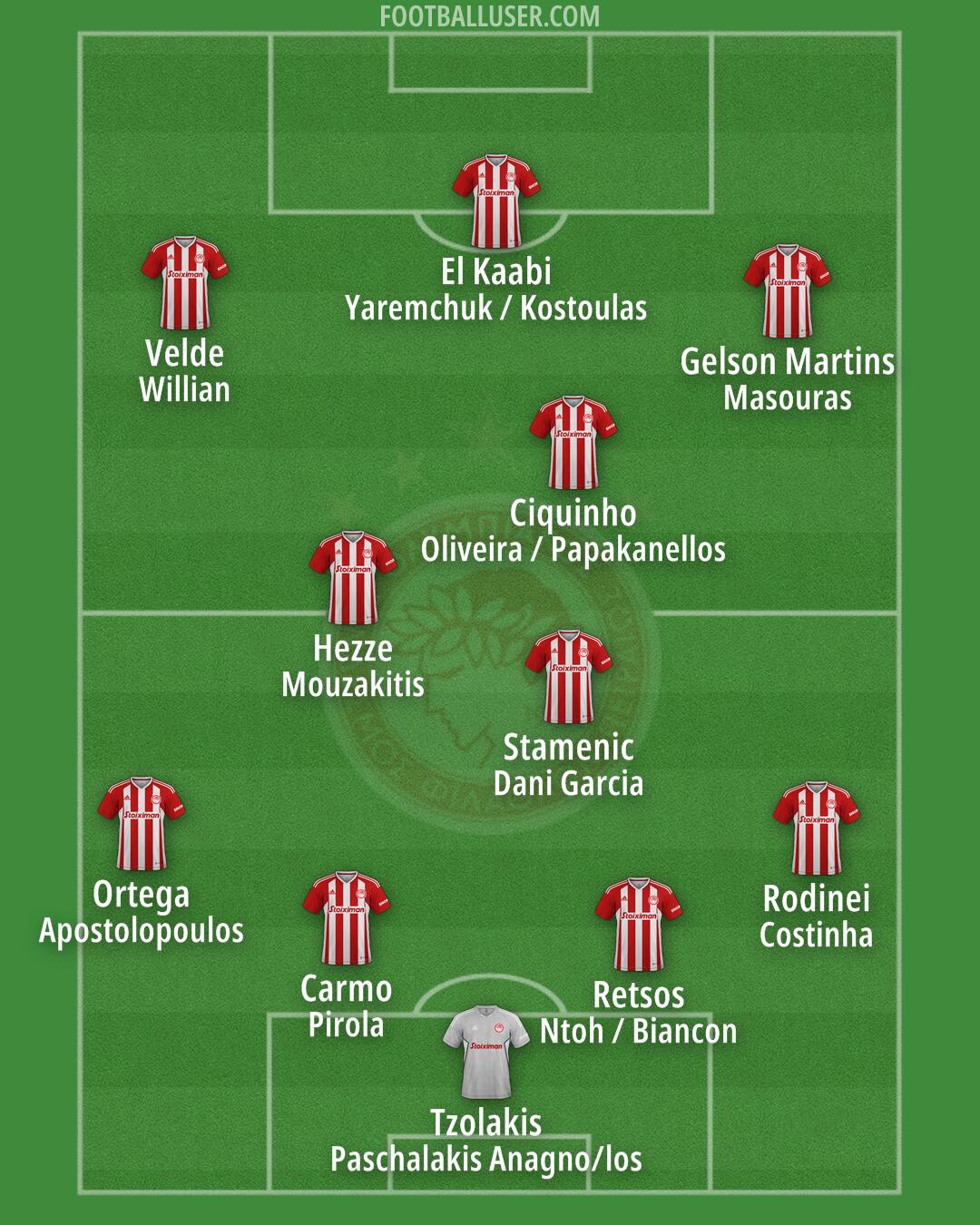

Olympiacos Football Formation
 September 12, 2024
 Donrosa13


Starting Lineup
Tzolakis (Paschalakis Anagno/los) · Carmo (Pirola) · Retsos (Ntoh / Biancon) · Rodinei (Costinha) · Ortega (Apostolopoulos) · Stamenic (Dani Garcia) · Hezze (Mouzakitis) · Ciquinho (Oliveira / Papakanellos) · Velde (Willian) · Gelson Martins (Masouras) · El Kaabi (Yaremchuk / Kostoulas)Olympiacos relies on a high press and quick transitions, utilizing a 4-3-3 formation. This lineup is built to hunt for the ball high up the pitch and strike fast once possession is won. The goal is to stretch the defence through wide players while maintaining a central presence to control the tempo of the game.
In goal, Tzolakis acts as the first line of defense. The back line operates as a flat back four, with Rodinei and Ortega providing width from the flanks. Rodinei looks to overlap the winger, while Ortega tucks in to support the central pairing of Retsos and Carmo. Retsos and Carmo act as the ball playing defenders to help play out from the back. They must hold the line and step up to catch opponents offside, while ensuring they cover the space if the high press is bypassed.
The midfield works as a three-man midfield with a single pivot. Stamenic sits in front of the defense to shield the back four and win the second ball. Beside him, Hezze functions as a carrier who can drive forward with the ball to connect the lines. Ciquinho plays as an attacking ten behind the striker, looking to find the feet of the forwards or arrive late into the box. This trio works to compress the midfield and win it back high up the pitch whenever the ball is lost.
The attack features three attackers across the front. Velde and Gelson Martins act as inverted wingers who cut inside to create goalscoring chances, often pulling wide to stretch the defence. El Kaabi serves as the central presence, acting as a pressing centre-forward to harass the opposition back line. The team looks to move the ball through the lines to find El Kaabi or exploit the space left by defenders when the wingers cut inside.
This formation offers several tactical advantages for Olympiacos. The high press from the front three can force a long ball from the opposition, making it easier for the defenders to intercept. There is also a significant threat from wide overloads when Rodinei and Ortega push forward to support the wingers. This creates numerical superiority in the attacking third, forcing the opposition to defend in tight spaces.
Olympiacos uses this 4-3-3 to dominate games through aggressive pressing and rapid ball movement. This formation is best suited for facing teams that struggle to play out from the back under pressure.