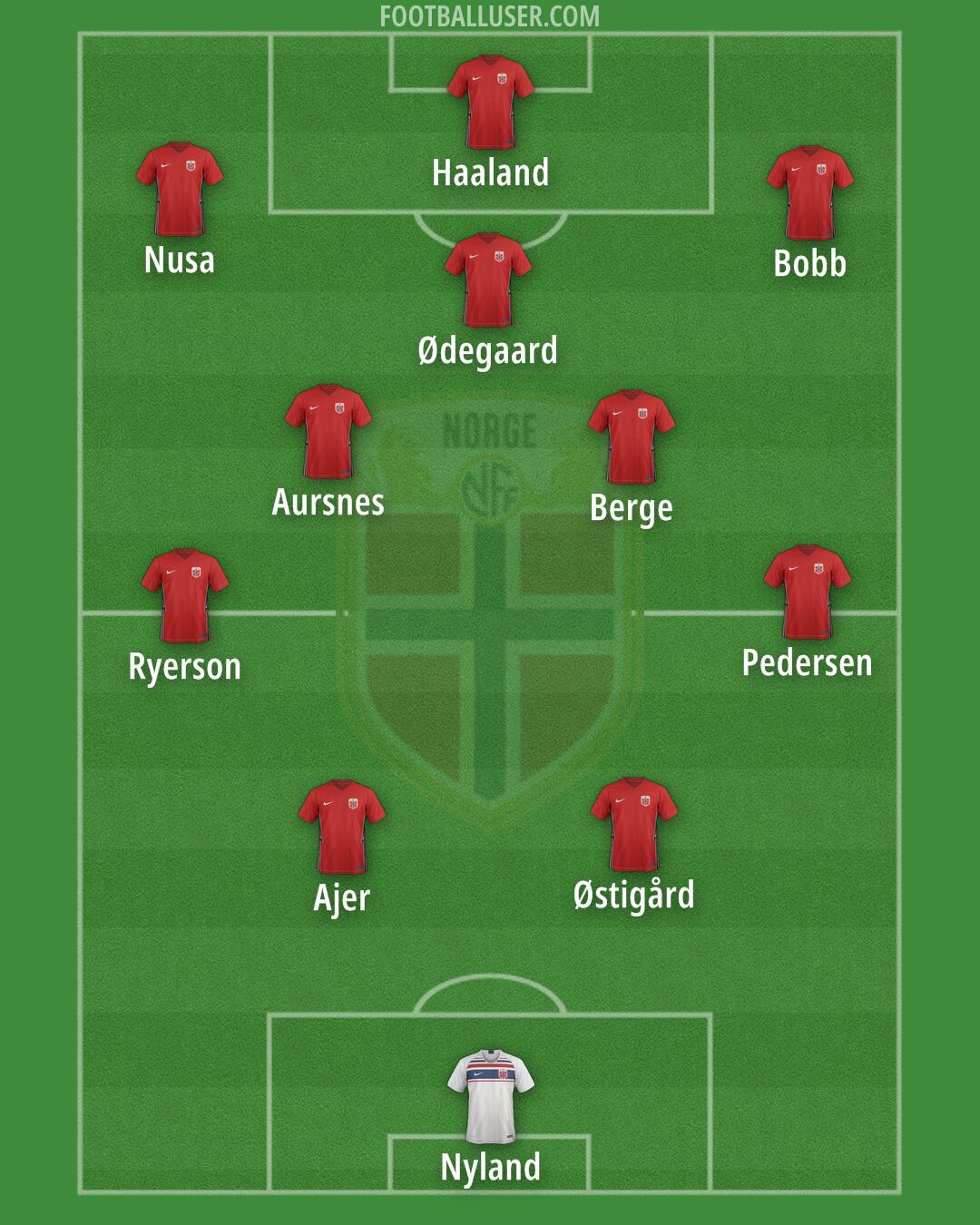

Norway National Football Team Formation
 October 16, 2024


Starting Lineup
Haaland · Ødegaard · Nusa · Bobb · Aursnes · Berge · Pedersen · Ryerson · Ajer · Østigård · NylandNorway aims to play a highly vertical game that relies on winning the ball back high up the pitch, utilizing a 2-5-3 formation. This lineup focuses on aggressive pressing and rapid transitions to catch opponents off guard. By committing many players forward, the team seeks to overwhelm the opposition in their own half, creating constant pressure through a high volume of attacking movements.
Nyland stays between the posts to manage the defensive line from deep. The back line consists of a narrow pairing of Ajer and Østigård, who act as the primary central defenders. Because there are only two players in the deep defensive line, Ajer and Østigård must be prepared to cover large spaces and step up to intercept through balls. They often play out from the back to find the midfielders, requiring them to be comfortable under pressure. This system places a heavy burden on the defenders to maintain focus while the rest of the team pushes high.
The midfield is the engine room of the Norway lineup, featuring a heavy presence in the center of the park. Ryerson and Pedersen operate as a double pivot to shield the two central defenders and provide stability. Berge acts as a carrier in the right central midfield role, driving the ball forward to link the defensive and attacking lines. Aursnes plays in the left central midfield position to help recycle possession and press aggressively to win the ball back. Ødegaard plays as the attacking ten, operating in the pocket behind the striker to create chances and pass through the lines with his vision.
The attacking front line uses three attackers to stretch the opposition defence. Nusa and Bobb occupy the wide areas as wingers, with Nusa looking to cut inside and Bobb to provide width or run in behind. Haaland operates as a lone striker and a pressing centre-forward, using his physical presence to hold up the ball and pin the last defender. The team looks to attack in combinations, using the link-up play between Haaland and Ødegaard to find gaps. Movements are designed to create runs in behind and allow the wide players to cross into the box for Haaland.
This formation offers several tactical advantages, most notably numerical superiority in the midfield which allows Norway to control the central areas. The ability to press high in coordinated waves can force mistakes from the opposition goalkeeper and defenders. Furthermore, the system creates quick transitions where the team can quickly spread wide to exploit space on the flanks.
Norway employs an aggressive and high-risk tactical identity designed to dominate the ball in advanced areas. This 2-5-3 formation is best suited for games where the team can isolate wide players in one on one situations against a retreating opponent.