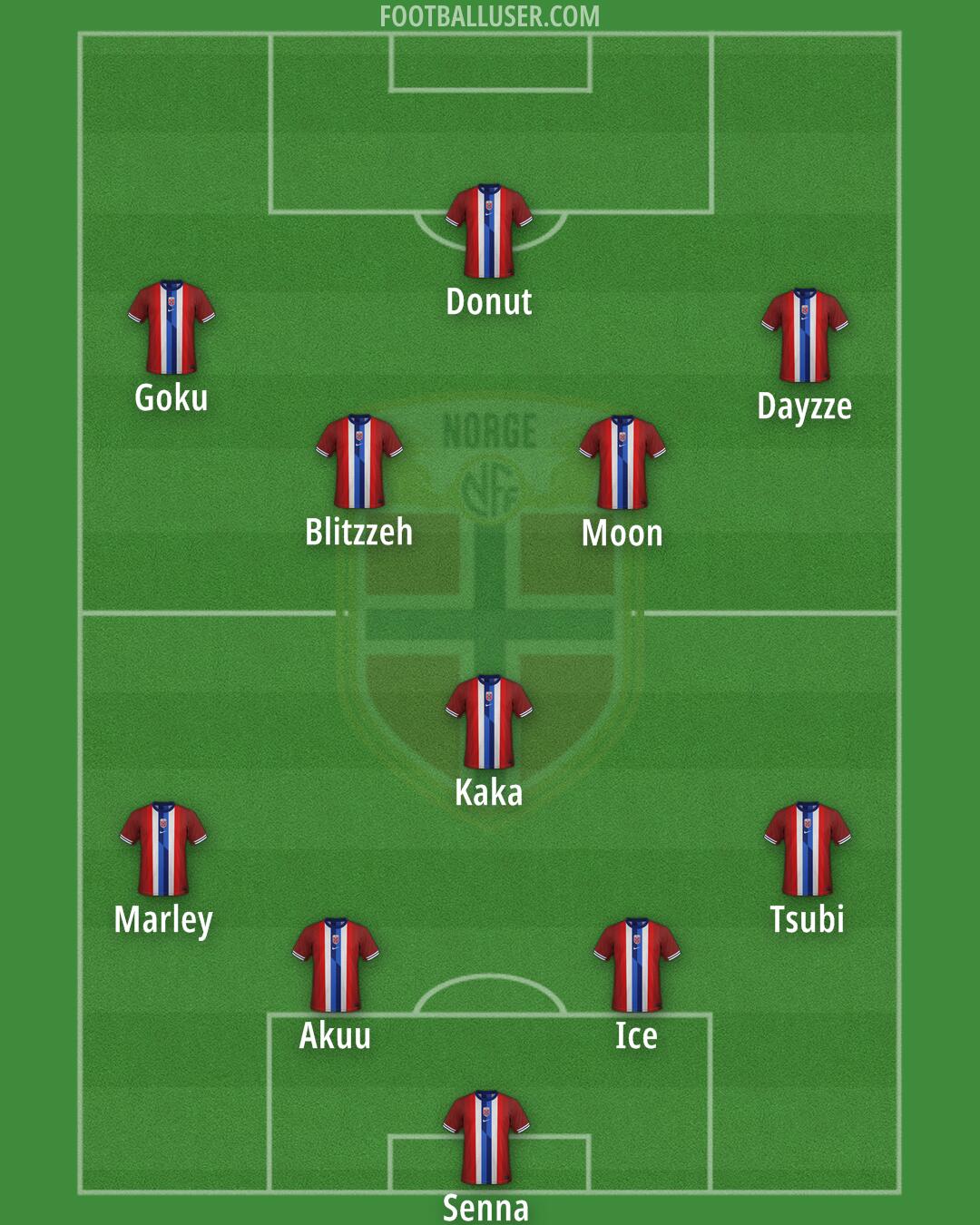

Norway National Football Team Formation
 January 27, 2025


Starting Lineup
Blitzzeh · Moon · Donut · Kaka · Goku · Dayzze · Akuu · Ice · Tsubi · Marley · SennaNorway focuses on a heavy defensive block and quick transitions using a 5-2-3. This formation is built to sit deep and absorb pressure before hitting opponents on the break. The lineup seeks to deny space in the middle and use wide areas to stretch the play when moving forward.
Senna stays between the posts to organize the back line. The defensive unit operates with a back three consisting of Kaka, Akuu, and Ice. Kaka acts as the central defender to command the area and win headers. Akuu and Ice operate as wide centre backs to cover the space between the central zone and the flanks. Marley and Tsubi function as attacking wing backs, pushing high to provide width while tracking back to form a five man line when defending. This unit works to keep the team compact and protect the box.
The midfield consists of a two man pairing with Moon and Blitzzeh. They work in a double pivot to protect the central zone and shield the defense. Moon and Blitzzeh are tasked to win the second ball and connect the defensive line to the attackers. They must press in a mid block to force the opposition wide and then carry the ball forward to start the attack. Their job is to recycle possession and ensure the team is not overrun in the middle.
Norway utilizes three attackers across the front with Donut as the lone striker. Goku and Dayzze operate as wide wingers who look to cut inside and create chaos. Donut acts as a physical presence to hold up the ball and wait for support. The wingers look to get to the byline or find space to shoot. This front three works to press the opposition back line and create runs in behind during the transition.
One major advantage for Norway is the ability to create wide overloads through the movement of Marley and Tsubi. This pushes the opposition defenders out of position. The team also benefits from extreme compactness when defending in a low block. This makes it very difficult for opponents to find gaps between the lines.
This formation provides a strong defensive foundation and relies on clinical counter attacks. It is best suited for facing teams that dominate possession and leave space behind their high defensive line.