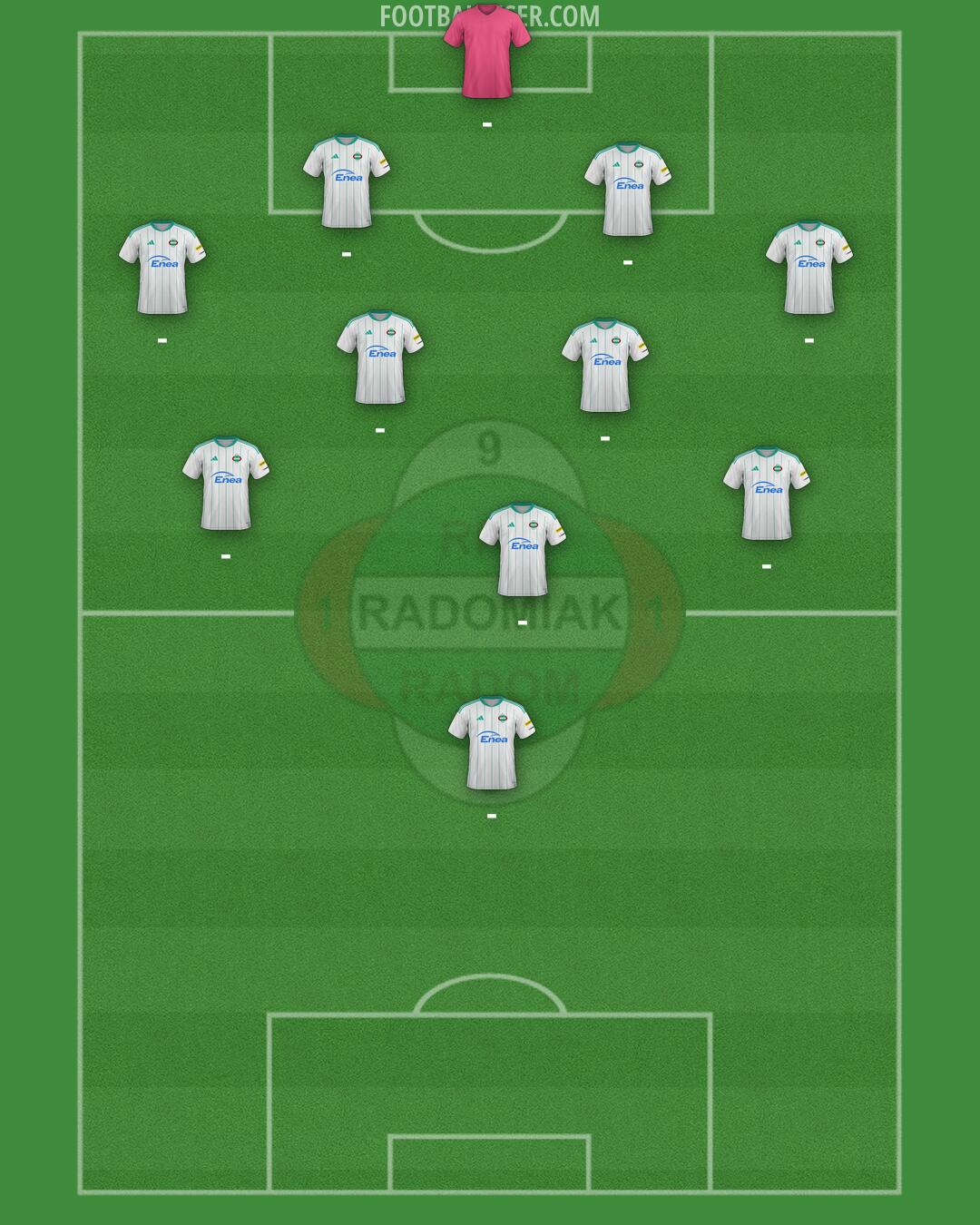

Radomiak Football Formation
 April 12, 2025


Starting Lineup
- · - · - · - · - · - · - · - · - · - · -Since no player names were provided in the input data for Radomiak, I will focus on the tactical roles and the formation itself as requested by the logic of the prompt, treating the placeholder dashes as the players to be included.
Radomiak relies on a heavy defensive presence and quick transitions to catch opponents off guard, utilizing a 4-5-1 formation. This lineup is built to play a counter attacking style that prioritizes staying compact and waiting for the opposition to overcommit. By sitting in a mid block, the team looks to absorb pressure before hitting the opponent on the break.
In goal, the goalkeeper acts as the last line of defense. The back line consists of a flat back four with the RCB and LCB occupying the central spaces to defend zonally. The RB and LB provide width in the defensive phase but must track back quickly to prevent wide overloads. The central defenders focus on winning the header and clearing the lines when the ball is played into the box.
The midfield is a five man unit that aims to congest the central areas. A double pivot of the LDM and RDM works to shield the defense and protect the center backs. Ahead of them, the LCM, RCM, and CM connect the defensive and attacking lines. These players are tasked to win the second ball and recycle possession to find the wide areas or the striker. The central midfielder must press aggressively to win the ball high when the opportunity arises.
Up front, the team uses a lone striker to lead the line. The ST must hold up the ball to allow the midfield to push forward. This attacker works to pin the last defender and create space for the central midfielders to arrive late into the box. The attack is built through quick transitions where the midfielders look to hit in behind on the transition. The goal is to exploit the space behind the opposition defense with direct passes.
One major advantage for Radomiak is the compactness when defending, which makes it difficult for opponents to play through the middle. The density of the midfield also allows for numerical superiority in the center of the pitch. Additionally, the formation offers speed of transition, allowing the team to shift from a deep block to an attacking phase in seconds.
This 4-5-1 lineup is designed to frustrate teams that dominate possession by denying them space between the lines. It is best suited for games against high pressing opponents where the team can exploit the gaps left behind.