
Barcelona Football Formation
 May 3, 2025


Starting Lineup
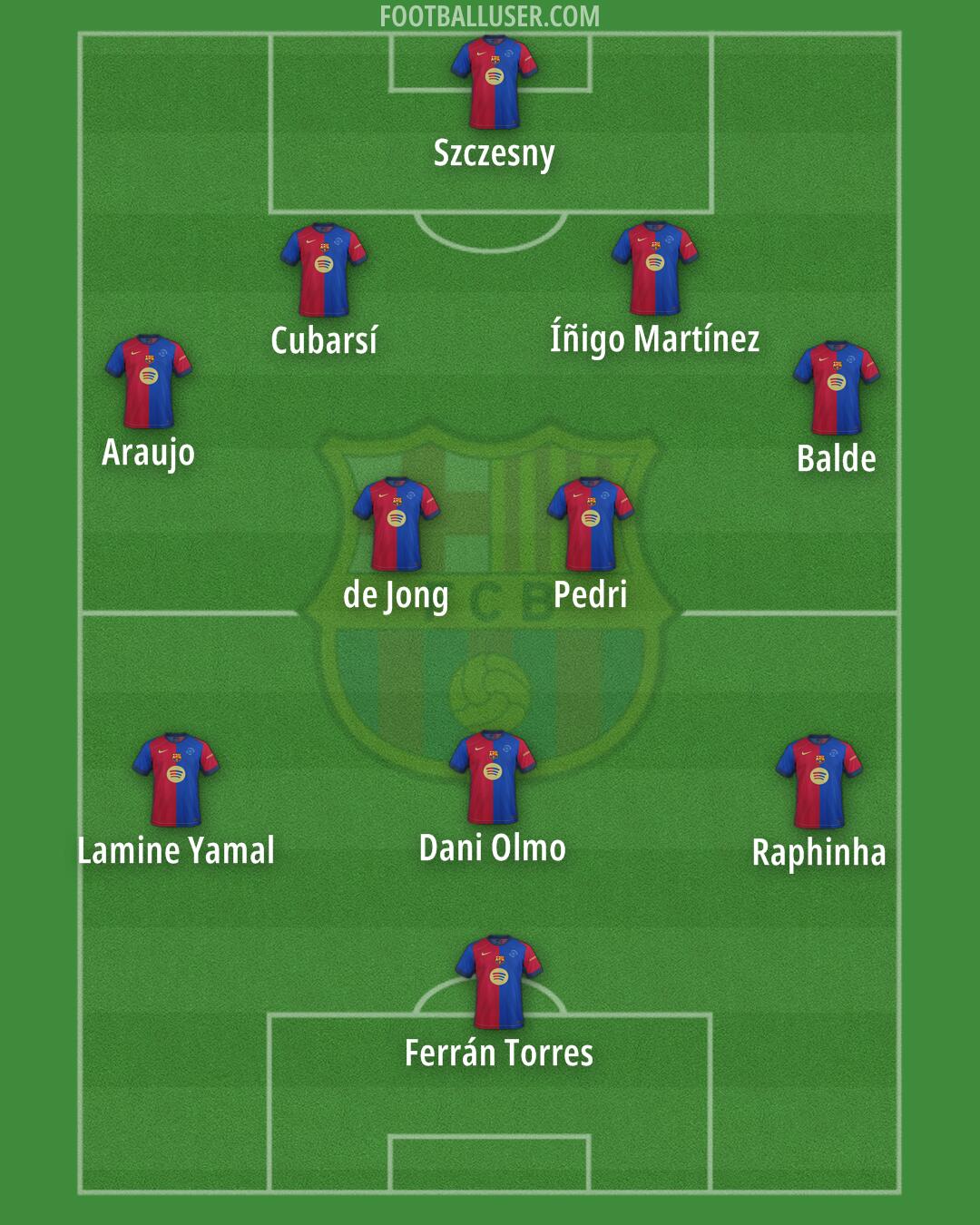
Szczesny · Íñigo Martínez · Cubarsí · Pedri · Araujo · Raphinha · de Jong · Dani Olmo · Balde · Lamine Yamal · Ferrán TorresThe tactical identity of Barcelona focuses on high intensity and verticality within a 4-2-4 formation. This lineup is built to overwhelm opponents by committing many players to the attacking phase and winning the ball back quickly. By pushing the team forward, FC Barcelona aims to control the tempo through aggressive pressing and quick transitions. It is a formation designed to pin the opposition back and create constant pressure in their own half.
Szczesny sits in goal to manage the defensive line. The back four features Araujo at right back and Balde at left back. Cubarsí and Íñigo Martínez operate as the central defenders. Cubarsí acts as a ball playing defender to help play out from the back, while Íñigo Martínez provides cover and strength in the air. The defensive unit often holds a high line to squeeze the space, requiring the wide defenders to track back and cover the channels if the team loses possession in the middle third.
The midfield is composed of a double pivot where Pedri and de Jong manage the center. Pedri uses his passing range to find teammates in advanced positions and break the line, while de Jong uses his ability to carry the ball forward to progress the play. These two players must protect the defensive line and act as the link between the defense and the attack. They work to recycle possession and ensure the ball reaches the front four efficiently by playing short from the back and moving through the thirds.
The attack uses four players to stretch the opposition. Lamine Yamal stays wide on the right to isolate defenders, often using his dribbling to create chances, while Raphinha operates on the left to cut inside. Dani Olmo and Ferrán Torres work as a central partnership to provide presence in the box. This front line is designed to press from the front, forcing the opposition to play long balls. The movement creates constant threats through runs in behind and cutbacks from the byline.
This formation provides two major advantages. First, it allows for the ability to press high in coordinated waves, making it difficult for opponents to build play. Second, the attacking lineup creates wide overloads and forces defenders into difficult one on one situations. The speed of transition is very high when the front four can quickly exploit any space left behind the opposing defense, allowing the team to attack at pace.
The 4-2-4 is a bold lineup designed for total offensive dominance. It is best suited for matches where the team needs to break down a compact low block through sheer numbers and high pressing intensity.