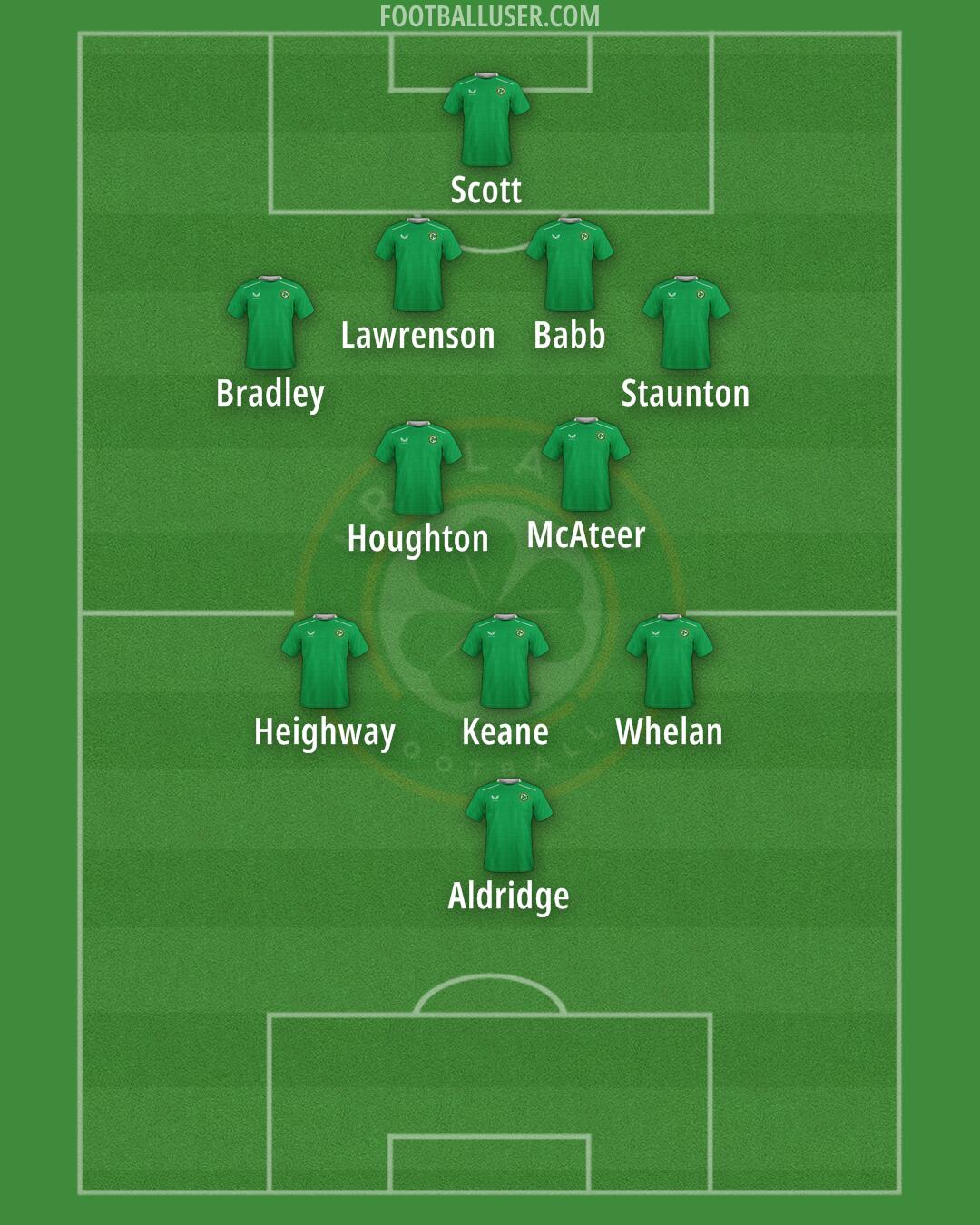

Republic of Ireland National Football Team Formation
 May 5, 2025


Starting Lineup
Scott · Heighway · Lawrenson · Bradley · Whelan · Houghton · Aldridge · Keane · Staunton · Babb · McAteerA heavy emphasis on direct attacking and verticality defines the Republic of Ireland in this 4-2-4 formation. The team looks to bypass the opposition midfield to find the front four as quickly as possible. This lineup is built to catch opponents on the transition and use speed to exploit gaps in the defensive line.
Scott stays between the posts to organize the defense. The back line sits as a flat back four with Bradley acting as an attacking full back on the right to provide width. Staunton provides balance on the left, while Lawrenson and Babb act as the central defensive pairing. Lawrenson is known for his reading of the game and positioning, while Babb provides the necessary cover to handle runners. The unit works together to hold a high line when the team pushes forward.
The midfield functions as a double pivot designed to provide a platform for the attackers. McAteer and Houghton work to win the second ball and shield the back four from direct threats. Houghton acts as a deep lying playmaker to recycle possession, while McAteer works to carry the ball forward and connect the defensive line to the attack. They must remain disciplined to prevent the opposition from playing through the center, as the distance between the midfield and the strikers can grow large.
In the attacking third, the Republic of Ireland utilizes four dedicated forwards to pin the opposition back. Keane and Aldridge operate as a strike partnership, with Aldridge using his aerial strength to win headers and Keane finding space between the lines. Heighway and Whelan act as wide attackers who look to stretch the defense. Heighway likes to cut inside to create goal scoring chances, while Whelan stays wide to provide crosses. The forwards press the opposition back line to force mistakes and launch quick attacks.
This formation offers significant speed of transition when the ball is won in the middle third. By using two strikers and two wingers, the team can create wide overloads and force the opposition defenders into one on one situations. The setup also allows for heavy pressure in the final third, which can pin an opponent deep into their own half.
The 4-2-4 is a high risk, high reward formation that relies on quick direct play. It is best suited for games where the team needs to score goals and can exploit a high defensive line.