
Barcelona Football Formation
 May 6, 2025


Starting Lineup
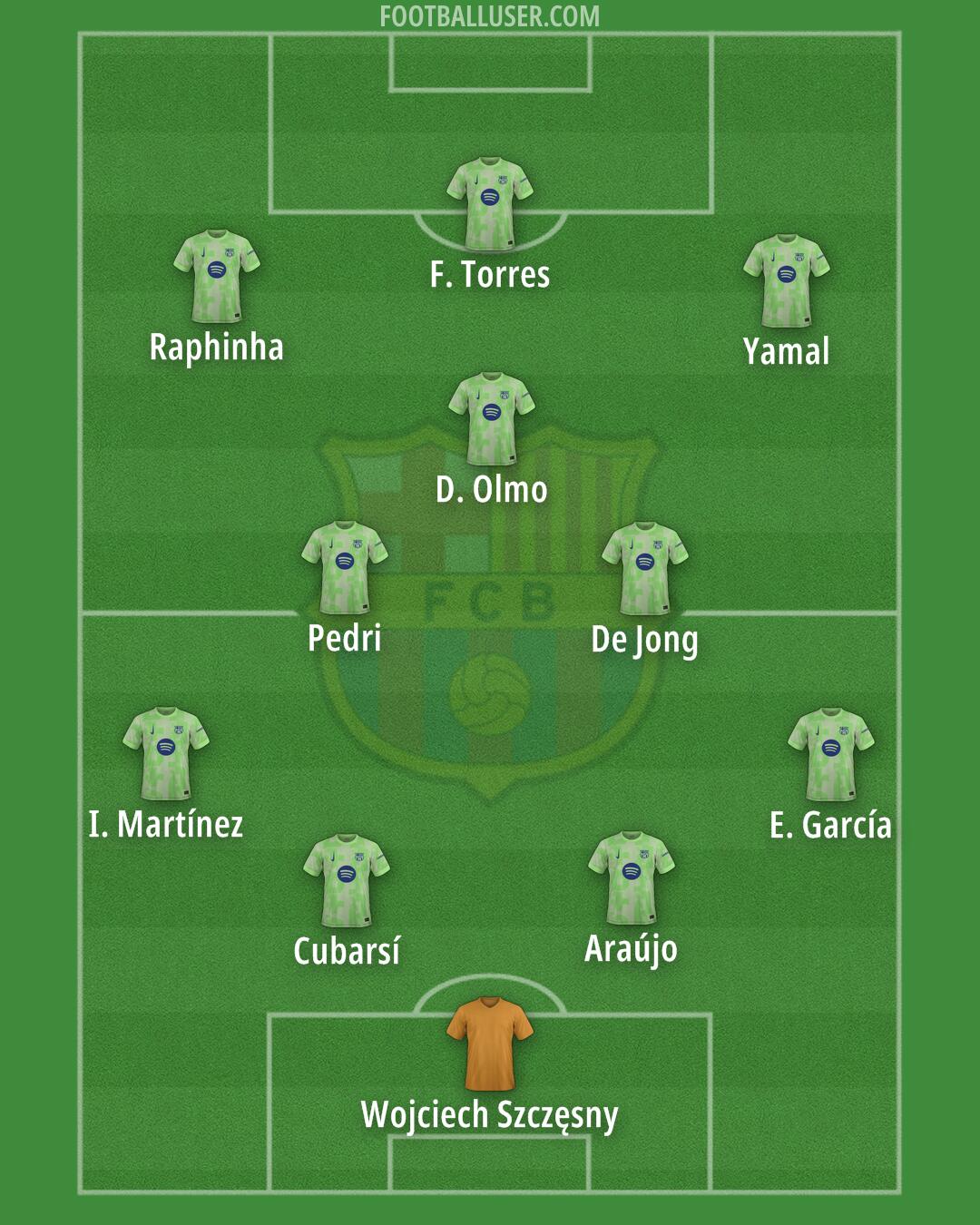
Wojciech Szczęsny · I. Martínez · Cubarsí · Araújo · E. García · Pedri · De Jong · D. Olmo · Yamal · Raphinha · F. TorresControl of the ball and high intensity pressing define the tactical identity of Barcelona. The team utilizes a 4-3-3 formation to dominate the game through heavy possession. This lineup is built to press the goalkeeper and win it back high up the pitch to keep the opposition under constant pressure. By keeping the ball in the opponent half, the team limits the chances for the other side to attack.
Wojciech Szczęsny plays in goal to oversee the defensive unit. The back four works as a zonal line with Cubarsí acting as a ball playing defender who can pass through the lines to find midfielders. Araújo provides cover and is dominant in the air to protect the center during crosses. I. Martínez and E. García play as full backs to defend the flanks, with the ability to overlap the winger to add width. This defensive unit works to hold a high line and set the offside trap to keep the game moving forward.
The midfield connects the defense to the attack using a mix of roles. De Jong works as a carrier to move the ball forward and bypass the opposition press, while Pedri uses his exceptional passing range and vision to control the tempo and recycle possession. D. Olmo plays as an attacking ten behind the striker to link play and find pockets of space. This group allows Barcelona to squeeze the space and ensure the team can move the ball through the thirds efficiently.
The front line consists of three attackers designed to stretch the defence. Yamal acts as an inverted winger on the right who uses his dribbling to cut inside and create chances, while Raphinha occupies the left flank to provide width and hit in behind. F. Torres plays as a pressing centre-forward to disrupt the opposition build up. The attack looks to use combinations in tight spaces and move players to create runs in behind the defense.
A key strength of this formation is the ability to create numerical superiority in the middle of the pitch. The team can also trigger a press in coordinated waves to force a long ball from the opponent. This helps the players win the second ball and launch quick attacks. Another advantage is the flexibility to shift between formations when the full backs move up the pitch.
This 4-3-3 formation is built on a foundation of possession and aggressive ball recovery. It is most effective against teams that try to play out from the back and leave gaps in the midfield.