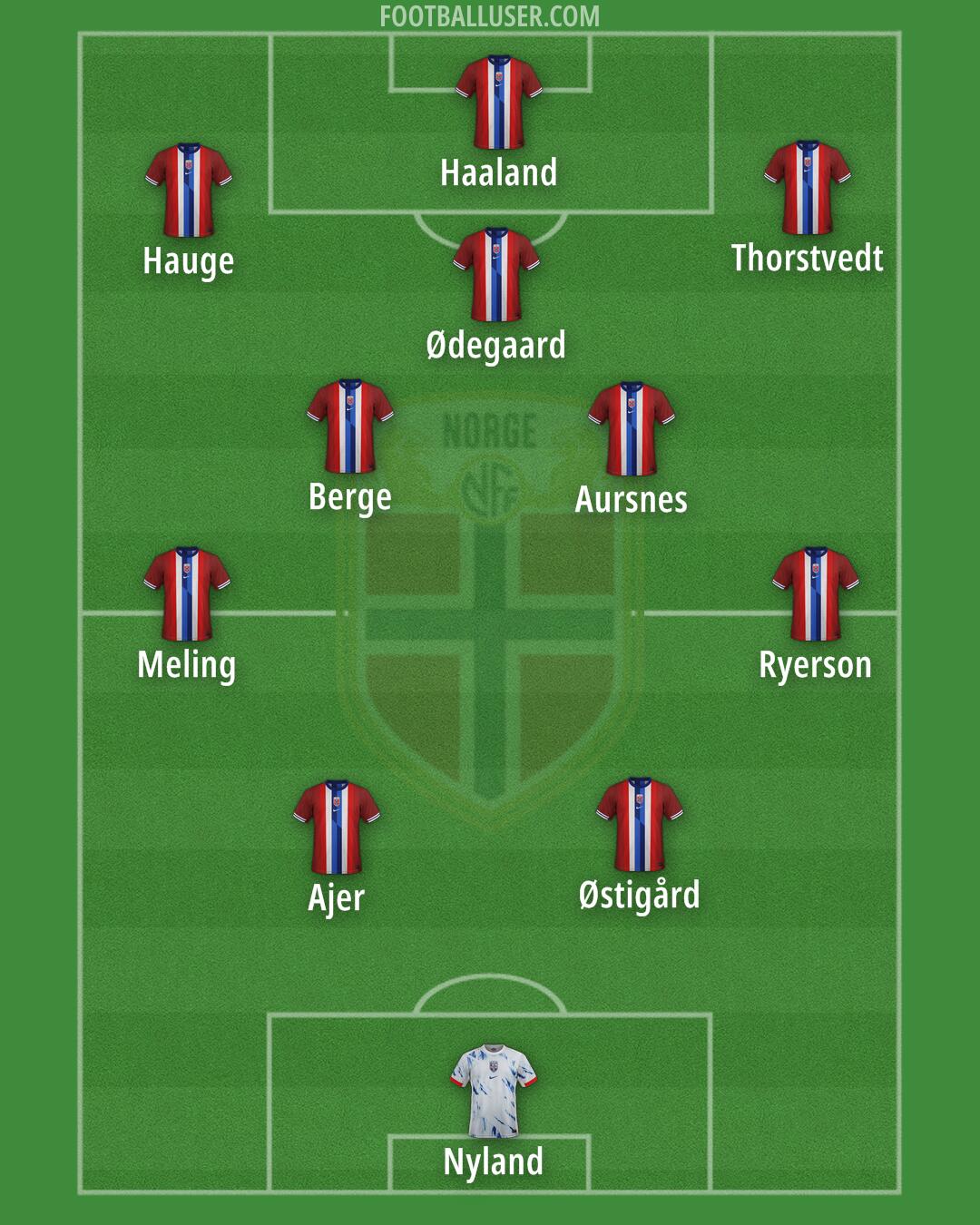

Norway National Football Team Formation
 May 25, 2025


Starting Lineup
Meling · Ajer · Østigård · Ryerson · Haaland · Berge · Aursnes · Ødegaard · Hauge · Thorstvedt · NylandNorway utilizes a highly vertical and aggressive identity through a 2-5-3 formation. The team aims to squeeze the pitch and move the ball quickly through the thirds to catch the opponent off guard. This lineup is built to dominate the middle of the pitch and turn defensive wins into immediate attacking threats through direct play.
Nyland acts as the last line of defense, organizing the team from the goal. The defensive unit is a high line consisting of Ajer and Østigård playing as a pair of central defenders. These two must be able to play out from the back and act as ball playing defenders to start attacks. Since they operate in such a small unit, they must be ready to cover and sweep behind the high line if the opposition attempts to hit in behind or find space.
The midfield is the engine of the Norway side, using a double pivot and an advanced playmaker. Meling and Ryerson function as a deep pairing to shield the defense and recycle possession. Ahead of them, Aursnes and Berge operate in the half-spaces to connect the lines and arrive late into the box. Ødegaard plays as the attacking ten, using his passing range to find teammates and play through the lines. This density in the middle helps the team win the second ball and maintain control.
In the attacking third, Norway employs three players to stretch the defense. Haaland plays as a central striker, using his strength to hold up the ball and pin the last defender. Hauge and Thorstvedt play wide to provide width, with Hauge often looking to cut inside to join the attack. The movement is designed to create runs in behind and allow the wingers to whip it in or cut it back for Haaland.
A primary tactical strength of this formation is the numerical superiority in midfield. By placing five players in the center, Norway can easily overload the opposition and squeeze the space. The team also possesses the ability to press high in coordinated waves, using the front three to trigger a press and win the ball back high up the pitch. This creates frequent chances to break quickly and counter at pace.
This 2-5-3 formation is a high intensity system built for total dominance. It is best suited for matches where Norway can exploit a team that sits deep or struggles to manage wide overloads.