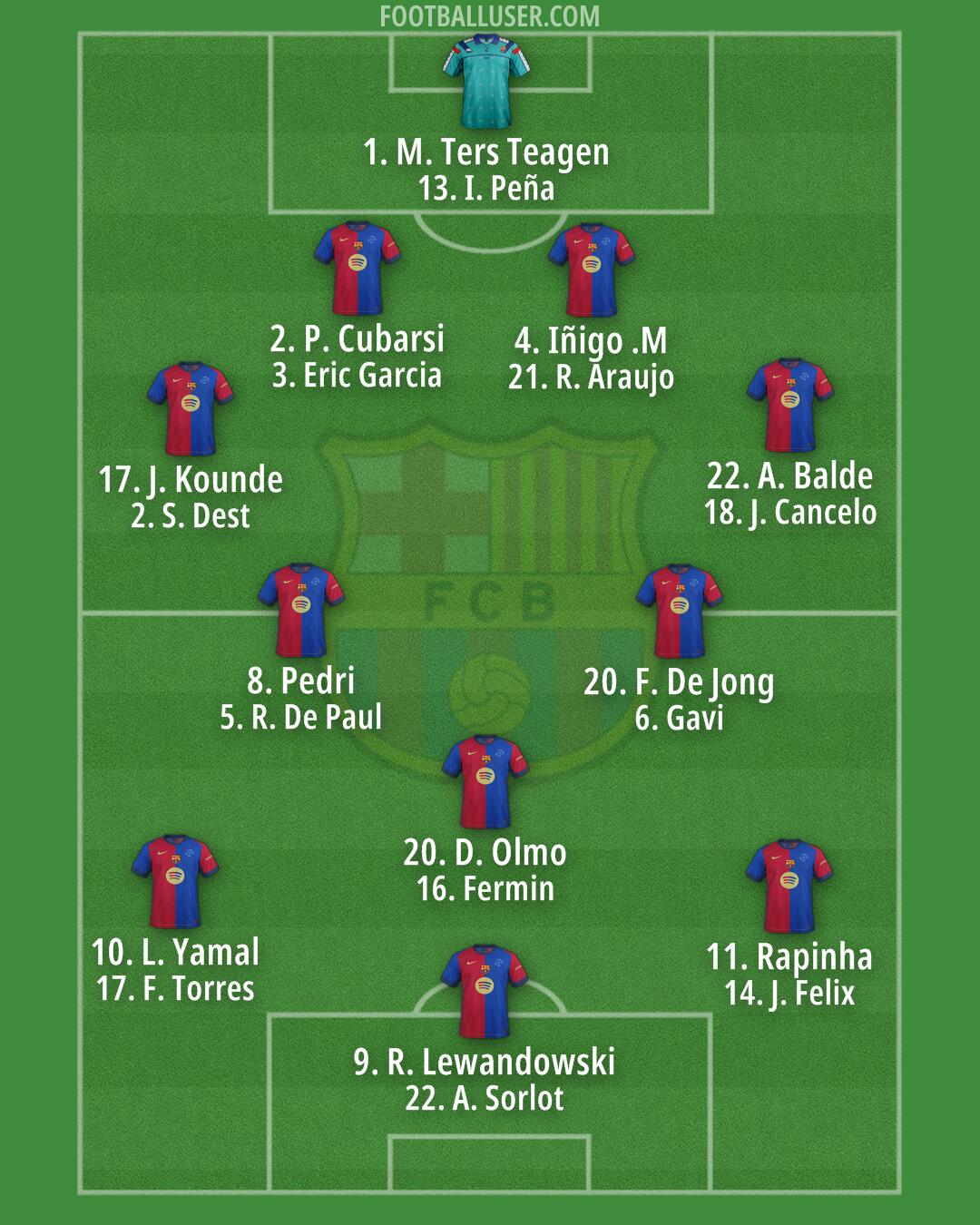

Barcelona Football Formation
 May 26, 2025


Starting Lineup
1. M. Ters Teagen (13. I. Peña)2. P. Cubarsi (3. Eric Garcia)
4. Iñigo .M (21. R. Araujo)
22. A. Balde (18. J. Cancelo)
17. J. Kounde (2. S. Dest)
20. F. De Jong (6. Gavi)
8. Pedri (5. R. De Paul)
20. D. Olmo (16. Fermin)
10. L. Yamal (17. F. Torres)
11. Rapinha (14. J. Felix)
9. R. Lewandowski (22. A. Sorlot)
Barcelona aims to control games through heavy possession and high pressing in a 4-3-3 formation. This lineup is built to dominate the ball and squeeze the opponent in their own half. The team seeks to play out from the back and move the ball through tight spaces to break down deep defensive blocks.
M. Ters Teagen starts between the posts to manage the defensive line. The back four operates with a high line to keep the team compact. J. Kounde plays as a right back, often tucking in to provide stability, while A. Balde acts as an attacking full back to provide width. In the center, P. Cubarsi serves as a ball playing defender with high composure, while Iñigo .M provides aerial strength and covers space behind the high line. The defensive unit works to win the ball back high up the pitch.
The midfield relies on a three man midfield with a carrier and technical creators. F. De Jong operates in a role where he can carry the ball forward and connect the defense to the attack. Pedri plays as an inverted eight, looking to receive on the half-turn and play through the lines to find attackers. D. Olmo operates as an attacking ten behind the striker, looking to arrive late into the box and find pockets of space between the lines. This trio works to recycle possession and maintain control of the center of the pitch.
Barcelona uses three attackers across the front to stretch the opposition. L. Yamal plays as an inverted winger on the right who likes to cut inside to create chances, while Rapinha operates on the left to provide directness. R. Lewandowski acts as a pressing centre-forward and a target man who holds up the ball to bring others into play. The front three press the opposition back line aggressively to force a long ball. This setup creates many opportunities for runs in behind and cutbacks from the byline.
The main advantages for Barcelona include numerical superiority in midfield when the attackers drop deep and the ability to press high in coordinated waves. The team can also create wide overloads when A. Balde pushes forward to overlap the winger. This makes it difficult for opponents to defend the half spaces.
This 4-3-3 formation is a possession based identity designed to dominate territory. It is best suited for games against teams that sit deep and defend in a low block.