
Norway National Football Team Formation
 June 7, 2025


Starting Lineup
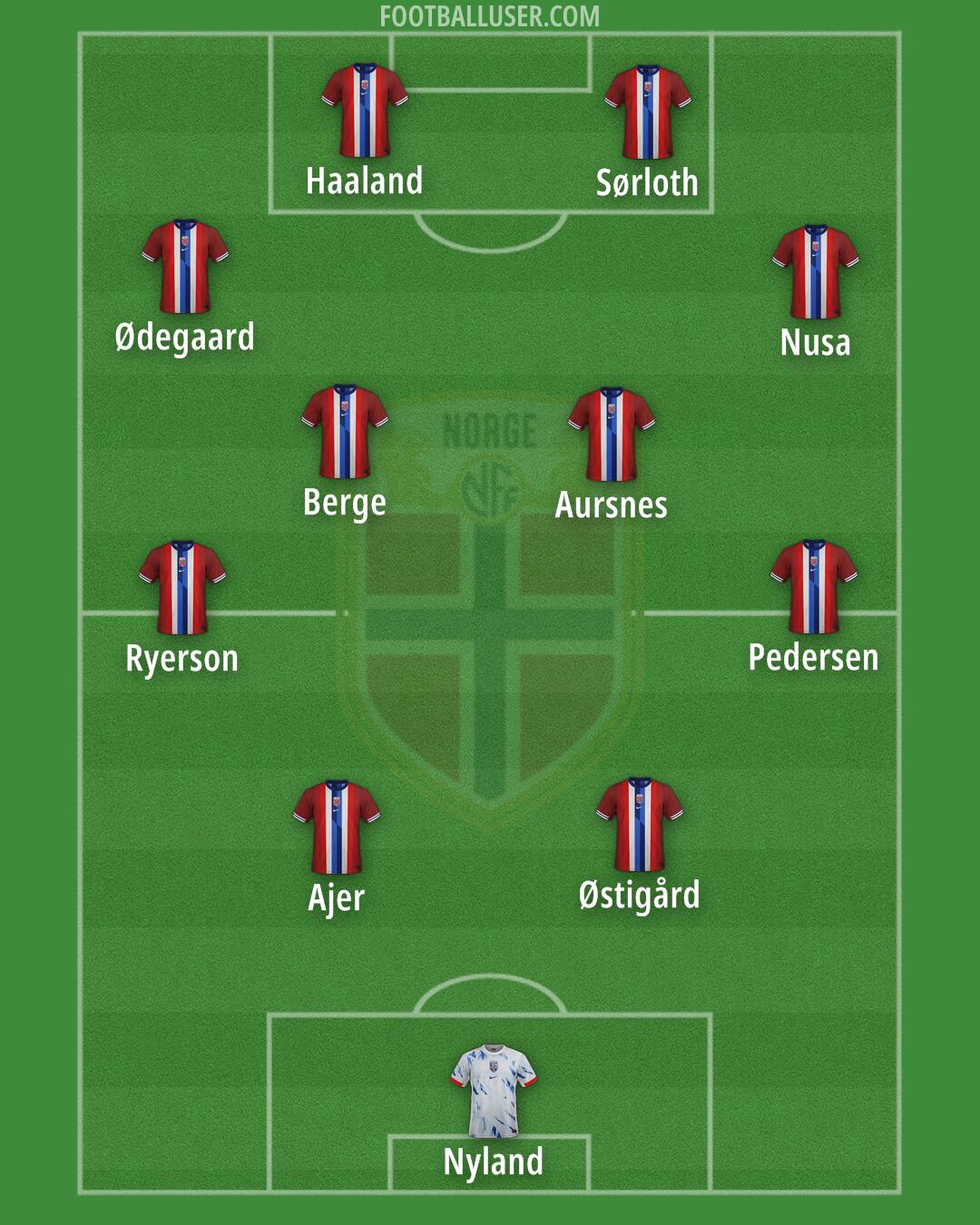
Pedersen · Ajer · Østigård · Ryerson · Haaland · Berge · Aursnes · Ødegaard · Nusa · Sørloth · NylandNorway focuses on a high press and rapid vertical transitions, utilizing a 2-4-4 formation to overwhelm opponents. This lineup is built to win the ball high up the pitch and move forward with great speed. By pushing many players into advanced positions, the team seeks to create chaos in the opponent defensive line and exploit spaces left behind.
Nyland acts as the lone goalkeeper, often required to sweep behind a high line when the defense is pushed up. The back line consists of a central pair with Ajer and Østigård. Ajer provides physical presence while Østigård works to cover the space behind him. As there are only two central defenders, they must be prepared to defend large amounts of grass and often defend in a high line to keep the distance between the units short.
The midfield functions as a four man unit that connects the back two to the attack. Ryerson and Pedersen form a double pivot to provide some stability, with Pedersen working to shield the defense and Ryerson looking to carry the ball forward. In front of them, Berge and Aursnes operate in the half spaces as two attacking eights. Berge uses his work rate to press aggressively, while Aursnes looks to find pockets of space to link the play.
The attacking line is very heavy, using two central forwards and two wide players. Haaland and Sørloth operate as a powerful partnership in the center, with Haaland using his explosive movement and Sørloth providing a presence to hold up the ball. On the flanks, Ødegaard and Nusa provide width and directness. Ødegaard looks to cut inside to create chances, while Nusa seeks to isolate defenders one on one. This front four is designed to press from the front and hunt for turnovers.
Norway gains a significant advantage through its ability to press in coordinated waves, making it hard for opponents to play out from the back. The numerical superiority in the attacking third can quickly overwhelm a back four. Furthermore, the speed of transition is a major threat, as the team can go from winning the ball in midfield to having four players behind the opposition line in seconds.
This formation relies on extreme aggression to win the ball back high up the pitch. It is most effective against teams that struggle to play under intense pressure or leave space behind their defenders.