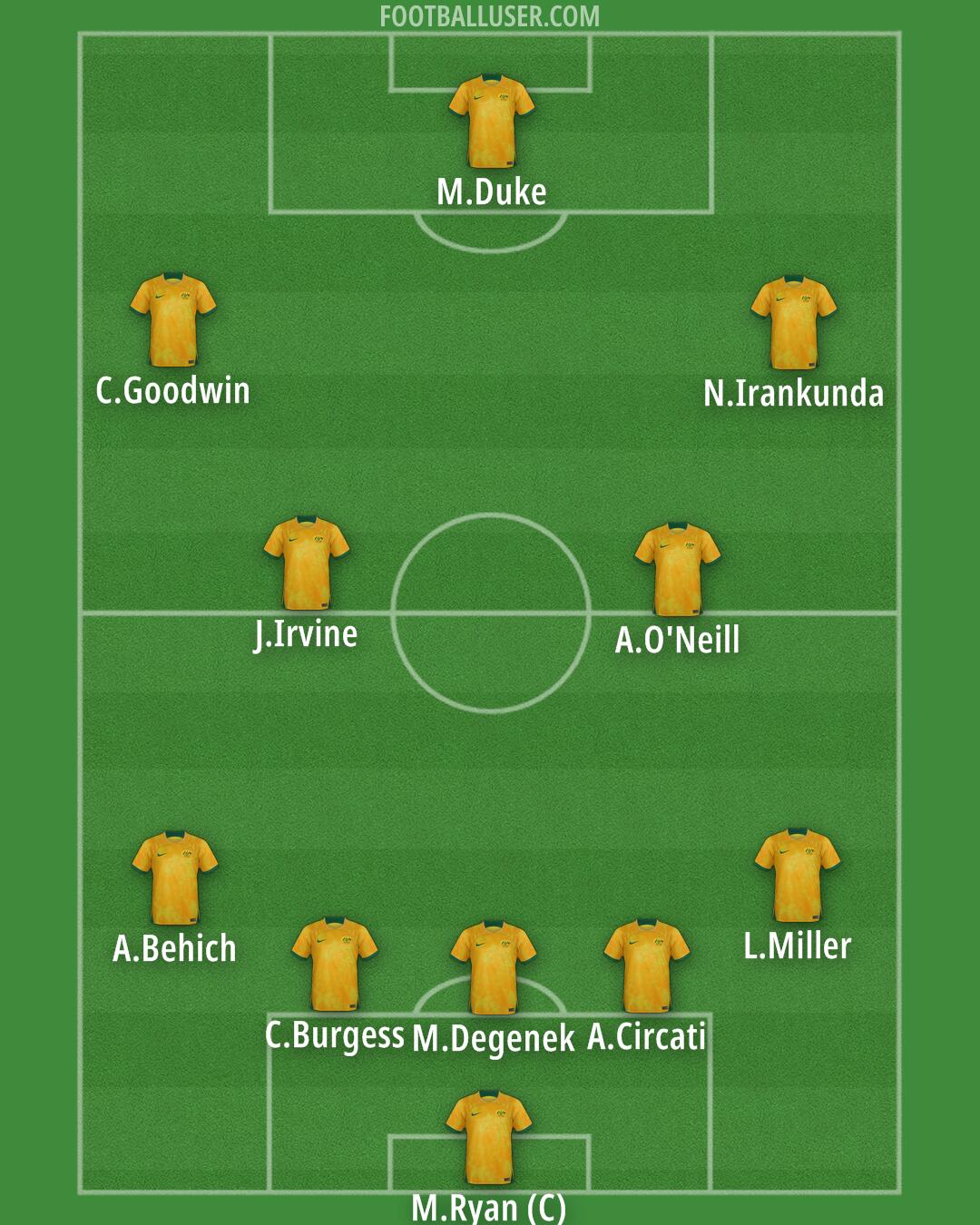
Australia National Soccer Team Formation
 September 15, 2025
 bosan
bosan


Starting Lineup
M.Ryan (C) · M.Degenek · C.Burgess · A.Circati · A.Behich · L.Miller · J.Irvine · A.O'Neill · M.Duke · N.Irankunda · C.GoodwinAustralia relies on a solid defensive foundation to launch quick transitions, operating within a 5-2-3 formation. This lineup seeks to remain compact when out of possession and use the width provided by wing backs to stretch the opposition. The tactical intent is to sit deep, soak up pressure, and then exploit spaces left by attacking teams through rapid direct play.
In goal, captain M.Ryan acts as the last line of defense, organizing the back five from deep. The defensive unit functions as a narrow defensive block consisting of three central defenders. M.Degenek provides strength in the air, while A.Circati and C.Burgess cover the lateral spaces to ensure the center stays tight. The wing backs, L.Miller and A.Behich, play as attacking wing backs. They are expected to push high to provide width but must track back quickly to support the back three when the team loses the ball.
The midfield consists of a double pivot designed to protect the central area. J.Irvine and A.O'Neill work to control the tempo and screen the defense. J.Irvine often drops deep to receive the ball and help play out from the back, while A.O'Neill acts as a carrier to drive the ball forward. This pairing must work hard to win the second ball and prevent opponents from playing through the middle. They connect the defensive unit to the front three, often looking to switch play to the wide areas.
Up front, the attack uses three attackers to pressure the opposition back line. M.Duke acts as the focal point, holding up the ball to allow others to join the play. On the flanks, N.Irankunda and C.Goodwin operate as wide wingers. N.Irankunda looks to use his pace to drive toward the byline, while C.Goodwin works to find pockets of space to cut inside. The goal is to use the width of the pitch to create one on one situations for the wingers or to deliver crosses for M.Duke.
Australia gains a major advantage through the numerical superiority in the defensive line, making them very difficult to break down centrally. The combination of the wing backs and the three attackers allows for wide overloads that can catch a defense off guard. By keeping a compact shape in a mid-block, the team can also trigger a press in specific zones to force a long ball.
This 5-2-3 formation is built to absorb pressure and strike with speed on the break. It is best suited for matches against teams that dominate possession and leave space behind their high defensive line.