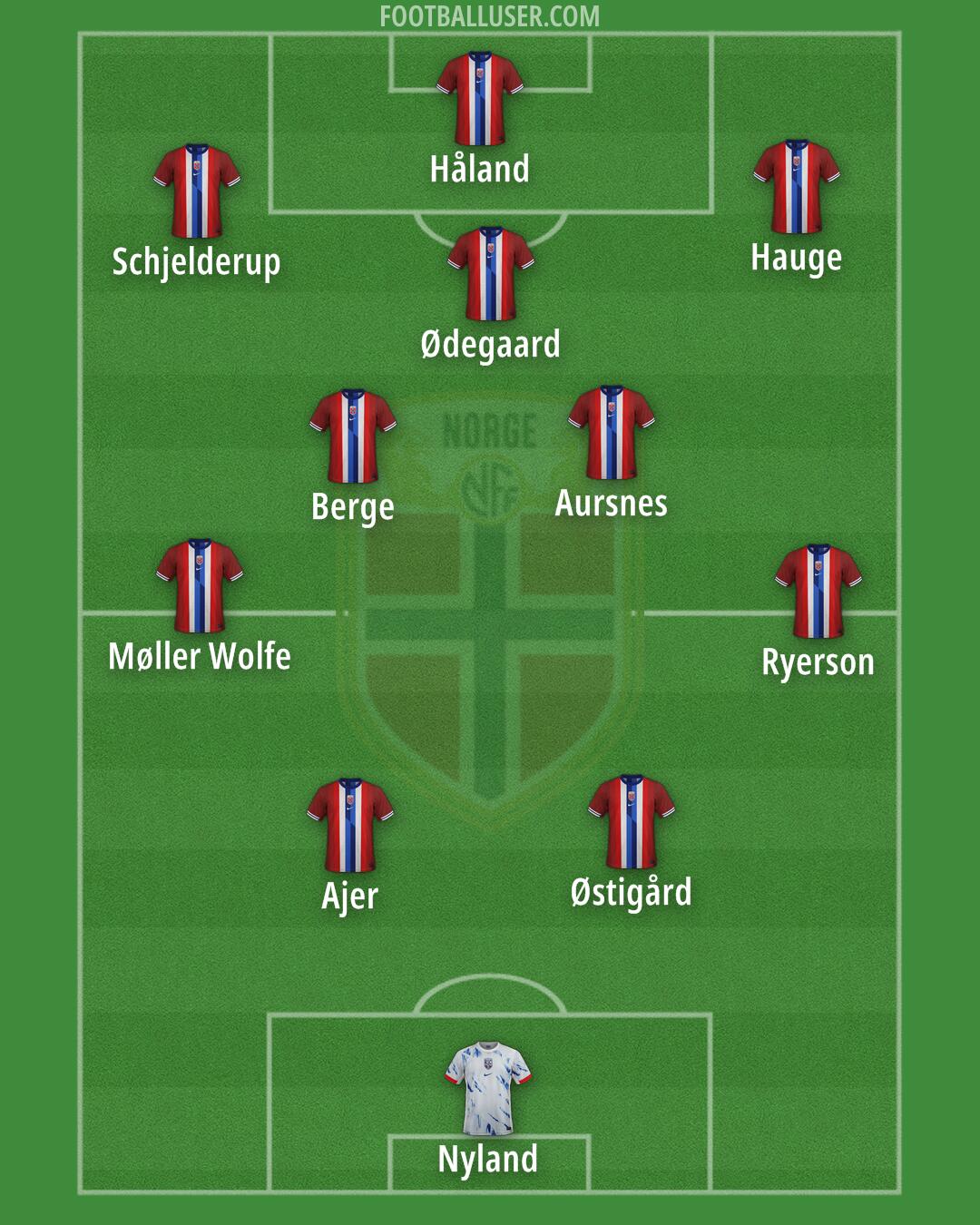

Norway National Football Team Formation
 October 13, 2025


Starting Lineup
Møller Wolfe · Ryerson · Ajer · Østigård · Berge · Aursnes · Schjelderup · Ødegaard · Håland · Hauge · NylandFocusing on rapid transitions and heavy central pressure, the Norway lineup utilizes a 2-5-3 formation. This system seeks to dominate the middle of the pitch and overwhelm opponents through direct vertical passing. The Red Devils look to control games by flooding the center, allowing them to regain the ball quickly and launch immediate attacks toward the goal.
Nyland stands between the posts to organize the defensive unit. Behind a very high line, Ajer and Østigård operate as a central defensive pair. Both players must be ready to step up to intercept long balls or drop deep to cover space behind them. Because there are only two defenders, the entire backline must work in close proximity to prevent attackers from finding gaps between the center backs.
A heavy midfield block sits in front of the defenders to control the game. Ryerson and Møller Wolfe act as a double pivot to shield the back two, while Berge and Aursnes occupy the central channels to connect the lines. Ødegaard operates in the attacking midfield role, using his vision and passing range to break the line with through balls. This midfield group provides the necessary numbers to control possession and press in waves.
The attacking front line is built to punish defenses through both width and central power. Schjelderup stays wide on the left to stretch the opposition, while Hauge provides width on the right. In the center, Håland acts as the lone striker, using his strength and pace to hold up the ball and run in behind. This front three pushes high to press the opponent's buildup, forcing mistakes that the midfield can exploit.
Norway gains a significant advantage through numerical superiority in the central zones. By placing five players in the middle, they can easily outnumber most standard midfield units and win second balls. The presence of Ødegaard allows the team to transition from defense to attack with precision. Furthermore, the ability of Håland to occupy two defenders creates space for Schjelderup and Hauge to cut inside and find shooting positions.
This high risk formation relies on intense pressing and quick transitions to stay effective. It is a setup best suited for games where Norway can exploit a disorganized opponent through directness and central dominance.