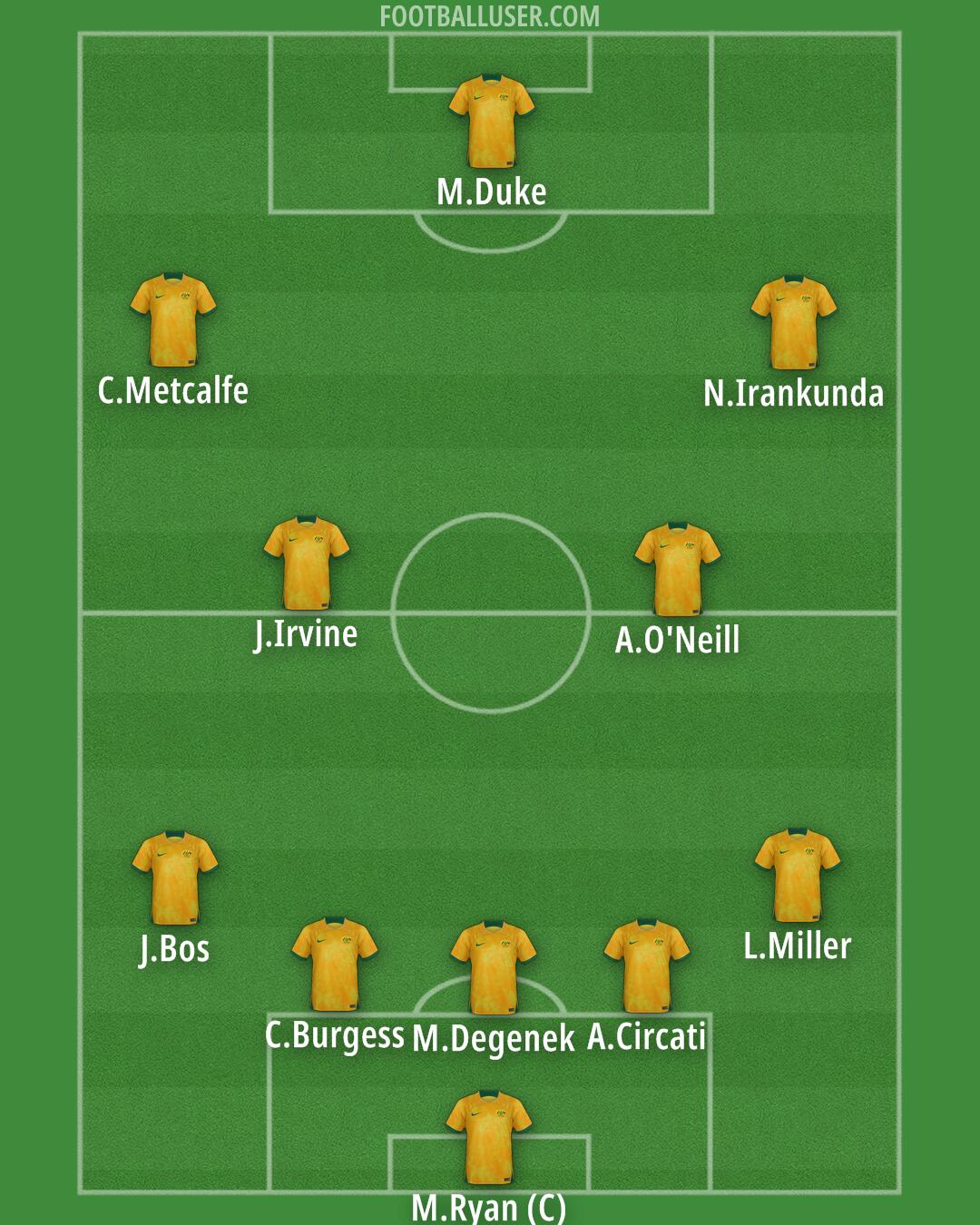
Australia National Soccer Team Formation
 October 17, 2025
 bosan
bosan


Starting Lineup
M.Ryan (C) · M.Degenek · C.Burgess · A.Circati · J.Bos · L.Miller · J.Irvine · A.O'Neill · M.Duke · N.Irankunda · C.MetcalfeA focus on defensive solidity and rapid transitions defines this Australia lineup, which operates within a 5-2-3 formation. The Socceroos aim to remain compact and hard to break down while using the width of the pitch to launch quick attacks. This formation is built to sit deep when out of possession and then explode forward through the wide areas and central channels.
Mathew Ryan, the captain, commands the defensive unit from the goal. A back three provides a heavy layer of protection, with M. Degenek acting as the central anchor. To his sides, A. Circati and C. Burgess provide cover and ability to step up into space. The wing backs, L. Miller and J. Bos, are vital to this defensive block. Miller and Bos must track back to defend the flanks but also push high to provide width. This unit functions by keeping the distance between the lines small to prevent opponents from playing through the middle.
The midfield utilizes a double pivot to control the central zone. J. Irvine and A. O'Neill work to protect the back three and break up play. Irvine acts to shield the defense and pick up loose balls, while O'Neill helps to connect the defense to the front three. This pair must be disciplined to ensure the team does not get overrun in the center. They shift side to side to close down passing lanes and support the wing backs when they push forward.
In the attacking phase, Australia uses three forwards to stretch the opponent. M. Duke leads the line as a lone striker, working to hold up the ball and bring others into play. On the flanks, N. Irankunda and C. Metcalfe provide the main threat. Irankunda can cut inside or use pace to beat defenders, while Metcalfe provides width and service from the left. These three press the opposition defenders to force mistakes and create chances through quick turnover plays.
This formation offers significant tactical advantages through its defensive density. The presence of five defenders makes it difficult for opponents to find space in the box, creating a compact low block. Australia can also create wide overloads when L. Miller and J. Bos overlap the wingers. This allows the team to transition from a defensive stance to an attacking one with great speed, often isolating defenders in one on one situations.
The 5-2-3 formation prioritizes a strong defensive base and quick verticality. It is best suited for games where the team needs to absorb pressure from a dominant side before striking on the break.