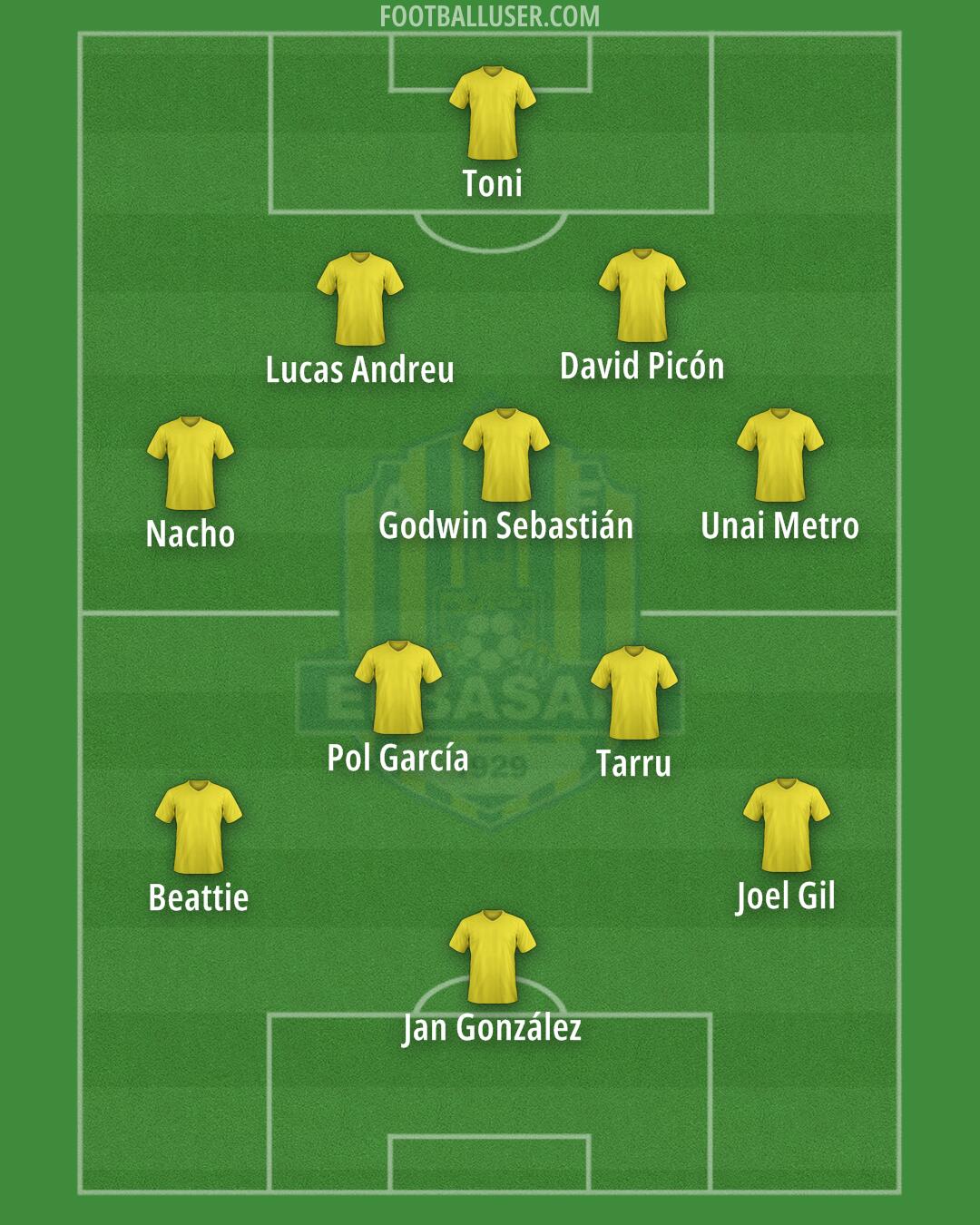

AF Elbasani Football Formation
 October 30, 2025


Starting Lineup
Toni · Lucas Andreu · David Picón · Nacho · Godwin Sebastián · Unai Metro · Beattie · Joel Gil · Pol García · Tarru · Jan GonzálezPrioritizing defensive solidity and rapid transitions, AF Elbasani operates within a 5-2-3 formation. This lineup is built to sit deep and absorb pressure before hitting opponents on the break. The team looks to control space behind the ball while maintaining enough verticality to punish teams in transition.
Toni stands between the posts to command the penalty area. The back line consists of a central trio where Godwin Sebastián acts as the anchor to block shots and win headers. David Picón and Lucas Andreu sit on either side of him to cover wide channels and intercept passes. Unai Metro and Nacho operate as wing backs, tasked to push high up the pitch to provide width or drop back to form a flat five when defending.
A double pivot controls the middle of the pitch to protect the back three. Pol García and Tarru work to shield the defense and win second balls in the center. These two must hold their positions to prevent opponents from breaking the lines, while also looking to find the attackers quickly once the ball is recovered. They act as the vital link between the defensive block and the front three.
The attacking unit uses three players to stretch the opposition. Jan González leads the line as a lone striker, tasked to hold up the ball and bring others into play. Joel Gil and Beattie occupy the wide areas as wingers, looking to cut inside or deliver crosses into the box. This front three will press high when the ball is lost to force mistakes near the opponent goal.
AF Elbasani gains a significant advantage through wide overloads when Unai Metro and Nacho overlap the wingers. This creates extra passing lanes and forces defenders to shift out of position. The formation also provides great compactness when defending, making it difficult for opponents to find gaps between the lines. The speed of transition from the double pivot to the front three allows for quick counter attacks.
This formation provides a heavy defensive presence that is difficult to break down. It is best suited for matches against dominant teams where sitting deep and exploiting spaces on the break is necessary.