
Barcelona Football Formation
 November 5, 2025


Starting Lineup
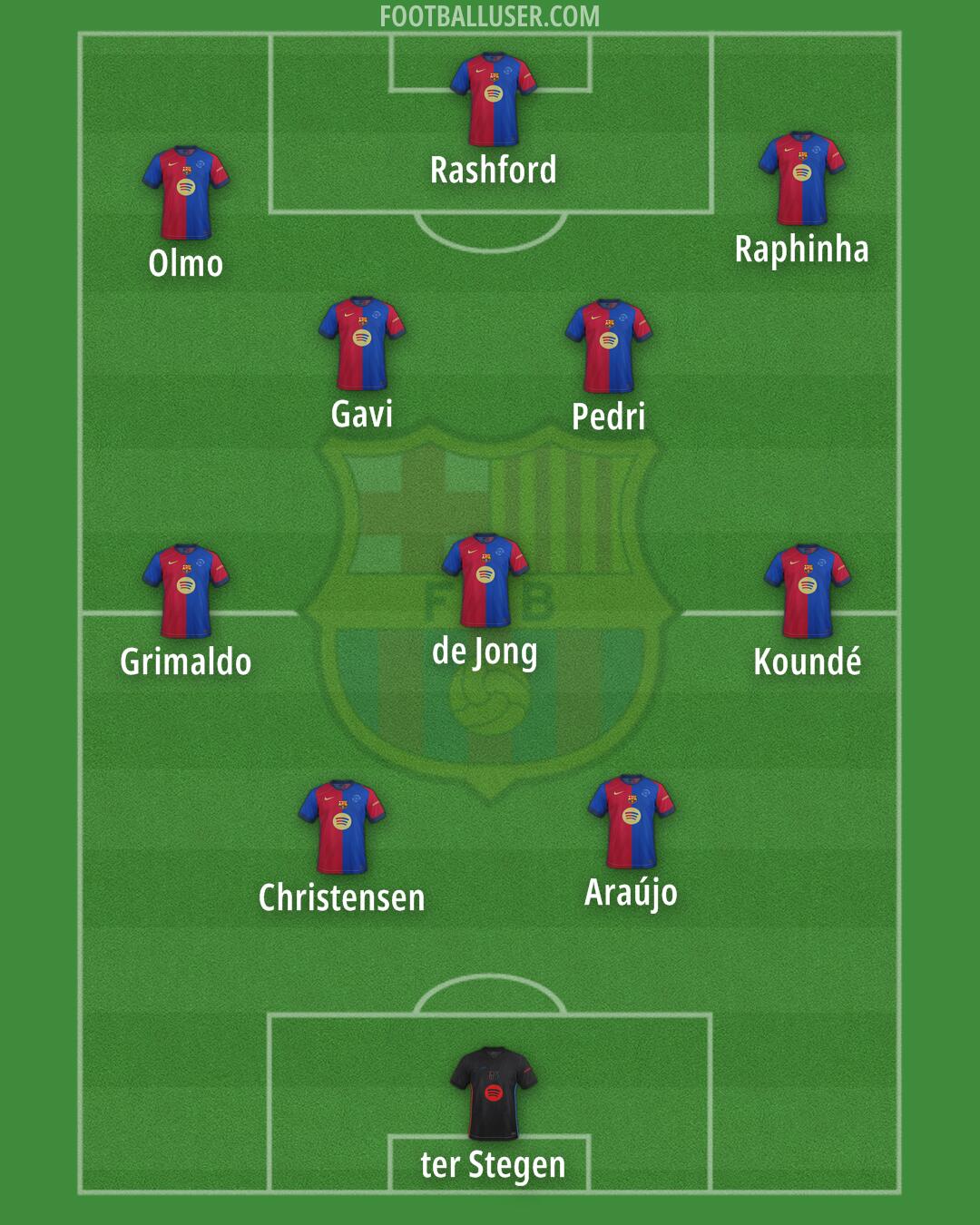
Rashford · Olmo · Raphinha · Gavi · Pedri · de Jong · Koundé · Grimaldo · Christensen · Araújo · ter StegenFocusing on high pressing and intense ball recovery, Barcelona operates with a 5-2-3 formation. This lineup is built to dominate the pitch through territorial control and immediate pressure when the ball is lost. The team seeks to suffocate opponents in their own half and use quick vertical passes to exploit gaps in the defensive line.
Ter Stegen acts as the goalkeeper, playing a vital role in starting attacks from the back. The defense consists of a back three with de Jong, Christensen, and Araújo. Christensen and Araújo provide physical presence and aerial strength, while de Jong works to distribute the ball out of the back. On the flanks, Grimaldo and Koundé act as wing backs to provide the necessary width. Grimaldo is expected to overlap frequently and deliver crosses, whereas Koundé provides defensive stability while also stepping up to support the advance.
The midfield functions as a double pivot with Pedri and Gavi controlling the central area. Gavi uses his high pressing intensity to disrupt the opposition, while Pedri uses his passing range to connect the defense to the attack. This pair must work hard to cover the spaces between the lines and prevent counter attacks. They act as the engine, with Pedri dropping deeper to collect the ball and Gavi pushing higher to press the opponent's pivot.
In the attacking third, the team uses three forwards to stretch the opponent. Rashford leads the line as a lone striker, tasked to hold up the ball and run into channels. On the wings, Olmo and Raphinha provide width and directness. Olmo is able to cut inside to create chances, while Raphinha uses his pace to drive at the defense. The front three press in unison to force mistakes high up the pitch.
One major advantage for Barcelona is the ability to create wide overloads through the movement of Grimaldo and Koundé. The formation also allows for a high press in coordinated waves, as the front three and the two central midfielders can all step up together. This creates compactness when defending a mid block and makes it very difficult for opponents to play through the middle.
This 5-2-3 formation is designed for teams that want to dominate possession while remaining dangerous on the break. It is particularly effective against opponents that play a high defensive line and struggle with speed in transition.