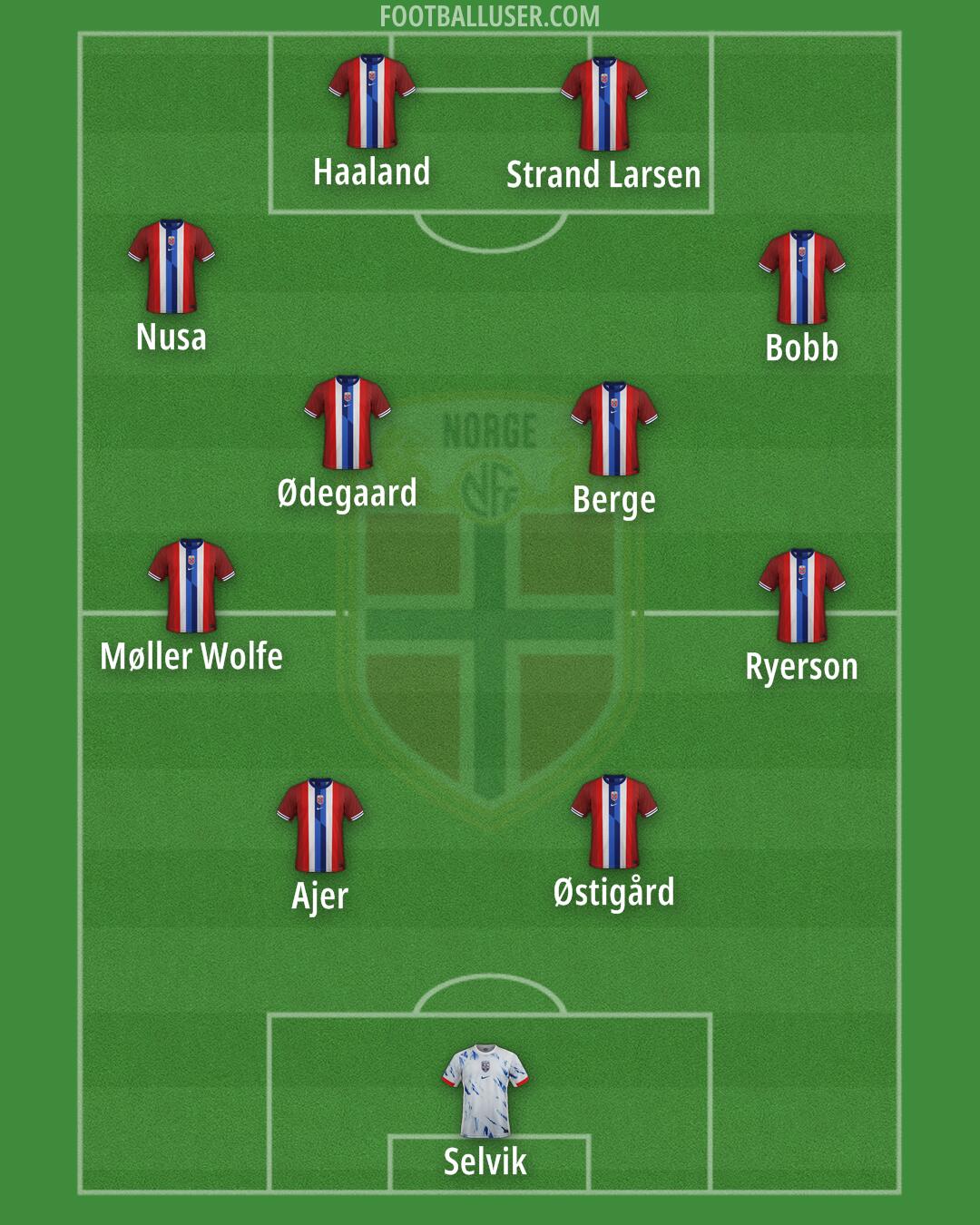

Norway National Football Team Formation
 November 16, 2025


Starting Lineup
Haaland · Strand Larsen · Nusa · Bobb · Berge · Ødegaard · Ryerson · Møller Wolfe · Ajer · Østigård · SelvikFocusing on high intensity pressing and quick vertical transitions, the Norway national team operates within a 2-4-4 formation. This lineup aims to overwhelm opponents in the final third by committing massive numbers forward. The tactical goal is to win the ball high up the pitch and use lightning fast passing to exploit gaps before the opposition can settle.
Selvik guards the goal while the defensive unit relies on a compact pairing of two central defenders. Ajer and Østigård form the back line, where they must stay disciplined to cover the massive space behind them. Since there are no traditional full backs in this lineup, these two central defenders often have to step up to intercept long balls or track runners in wide areas. They must be ready to drop deep or push high depending on where the ball sits to maintain the integrity of the Norway defense.
The midfield operates as a central block designed to control the center of the pitch and link the defense to the heavy frontline. Ryerson and Møller Wolfe act as a double pivot to shield the two defenders and break up opposition plays. Moving ahead of them, Berge and Ødegaard function as attacking midfielders who occupy the half spaces. Ødegaard is known for his vision and precise passing range, which helps him break the line with through balls. Berge provides the engine to drive the team forward and connect the defensive work of the pivot to the attackers.
The attacking force is built on extreme width and central power using four forwards. Nusa and Bobb stay wide to stretch the opposition defense, while Nusa uses his pace to drive at defenders. In the center, Strand Larsen and Haaland provide a dual threat. Haaland is famous for his immense physical strength and clinical finishing in the box. They work to hold up the ball or make runs behind the line, forcing the opposition back into their own area through constant movement.
A major strength of this formation is the ability to create numerical superiority in the attacking zones. By having four players high up the pitch, Norway can press in coordinated waves to trap opponents in their own half. Another advantage is the isolation of wide players, where Bobb or Nusa can find space to cut inside once the central defenders are pulled out of position. The speed of transition from the Ryerson and Møller Wolfe pivot to the front four makes them dangerous in open play.
This high octane lineup is designed to dominate teams that struggle to play out from the back under pressure. It is a high risk, high reward setup that works best against opponents who sit in a deep block and lack speed in transition.