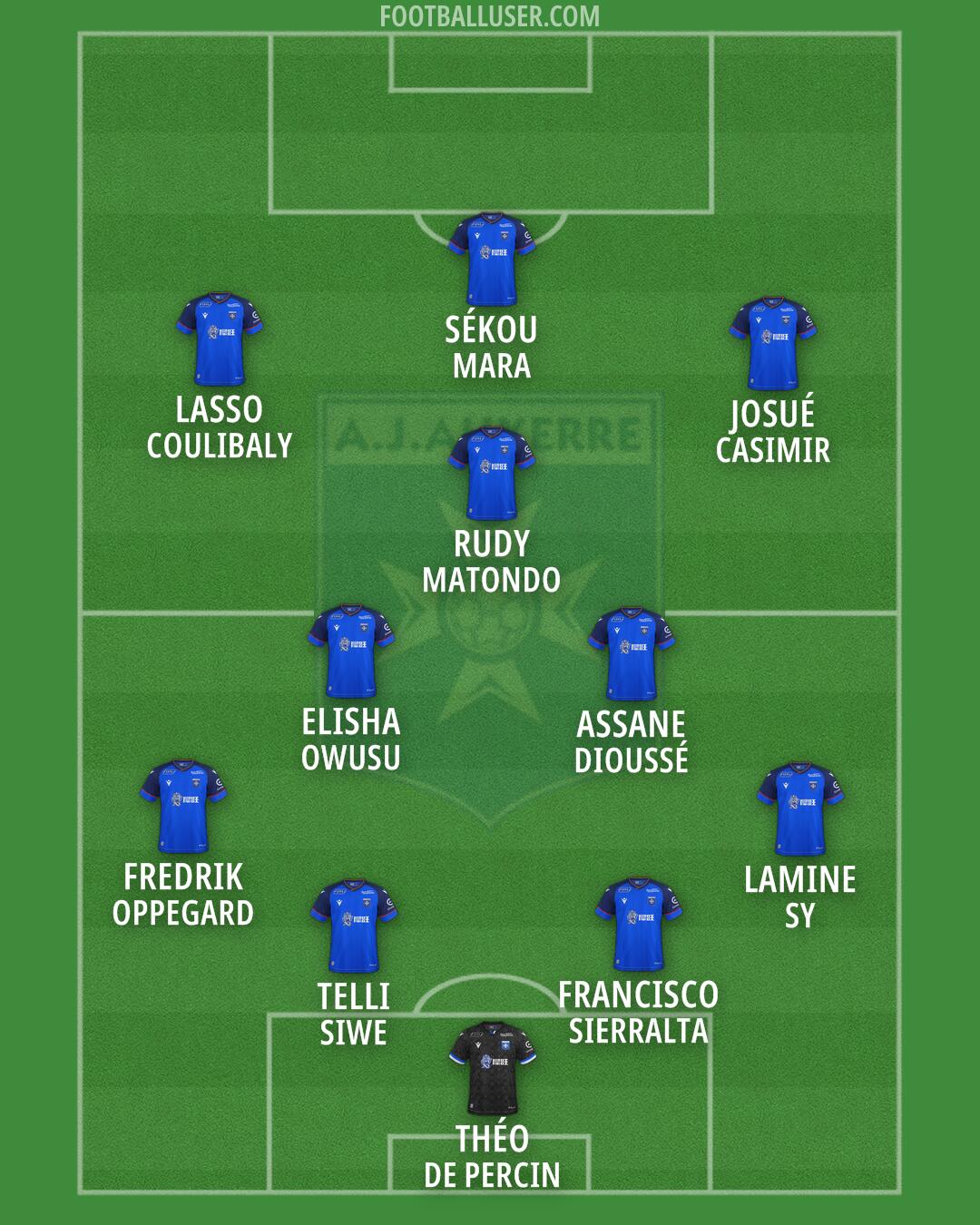

Auxerre Football Formation
 January 24, 2026
 lucaosantos85


Starting Lineup
THÉO (DE PERCIN) · LAMINE (SY) · FRANCISCO (SIERRALTA) · TELLI (SIWE) · FREDRIK (OPPEGARD) · ELISHA (OWUSU) · ASSANE (DIOUSSÉ) · RUDY (MATONDO) · JOSUÉ (CASIMIR) · LASSO (COULIBALY) · SÉKOU (MARA)A high pressing identity defines Auxerre as they operate within a 4-3-3 formation. This lineup is built to hunt the ball deep in the opposition half and transition quickly once the ball is won. The team seeks to control games through aggressive movement and rapid verticality to catch opponents off guard.
Théo guards the goal as the last line of defense for Auxerre. Behind a flat back four, TELLI and FRANCISCO form the central pairing where they must stay compact to block through balls. LAMINE pushes up the right flank to provide width, while FREDRIK works on the left to support the attack. The defensive unit works together to step up and compress the space between the lines.
The midfield functions with a single attacking ten, RUDY, positioned behind two central midfielders. ELISHA and ASSANE act as the engines, tasked to cover ground and shield the back four during defensive transitions. RUDY operates in the pockets of space to create chances and connect the play from the middle third to the front line. This trio works to intercept passes and maintain control through short, sharp movements.
In the attacking phase, SÉKOU leads the line as a lone striker. He works to hold up the ball and bring others into play while the wide players, LASSO and JOSUÉ, look to cut inside or stretch the defense. LASSO and JOSUÉ stay high to press the opposition full backs, creating space for the midfielders to push forward. The front three aim to make runs behind the defense to exploit gaps.
One major advantage is the ability to press high in coordinated waves, forcing mistakes near the opponent goal. By having ELISHA and ASSANE nearby, the team can quickly recover the ball in dangerous areas. Another strength is the wide overloads created when LAMINE and FREDRIK overlap the wingers, creating two on one situations against the opposition defenders.
This 4-3-3 formation relies on intense pressing and rapid transitions to dominate the pitch. It is best suited for matches against teams that struggle to play out from the back under pressure.