
Barcelona Football Formation
 January 28, 2026


Starting Lineup
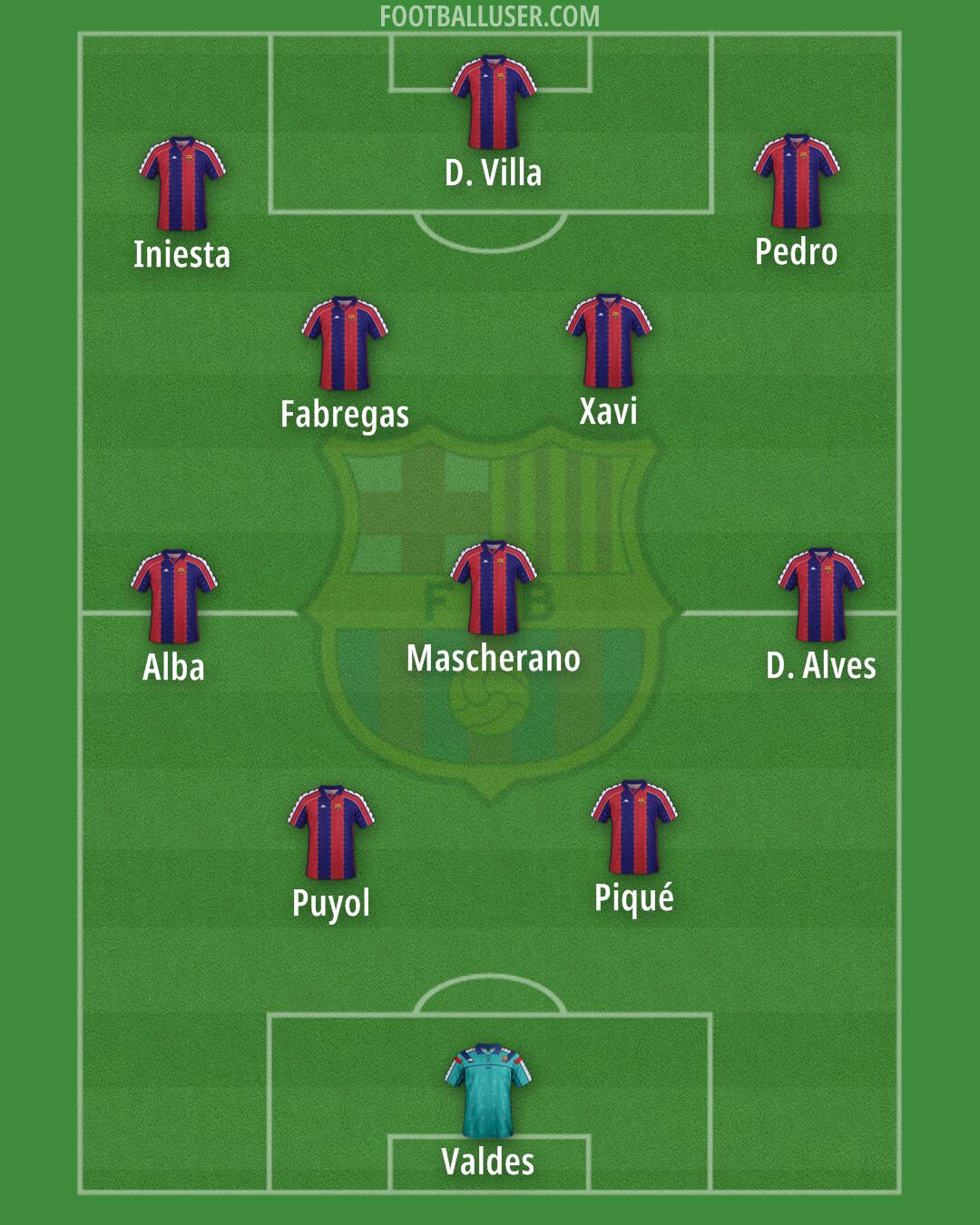
D. Villa · Pedro · Iniesta · Fabregas · Xavi · Mascherano · Puyol · Piqué · D. Alves · Alba · ValdesA commitment to heavy possession defines the Barcelona lineup as they deploy a 5-2-3. This formation seeks to control the ball and dominate the tempo through constant short passing. The team wants to occupy the ball in the opponent half to limit the chances of a counter attack. It is a system built to squeeze the pitch and dictate every phase of play.
Valdes guards the goal while a back five provides a solid foundation for the team. Mascherano, Puyol (C), and Piqué form the central defensive unit where Puyol provides immense aerial strength and aggression. Jordi Alba acts as the left wing back to push high up the pitch, while Dani Alves operates on the right side to overlap and provide width. This back line can drop deep to sit deep or step up to compress the space between the lines.
The midfield functions as a central duo designed to dictate the rhythm of the game. Xavi works to control the tempo with his exceptional passing range, while Fabregas helps to connect the defense to the attack. They occupy the central zones to prevent opponents from breaking the line through the middle. This pair must be ready to shift and cover ground to maintain compactness when the ball is lost.
An aggressive front three aims to stretch the opponent defense. David Villa leads the line as the lone striker to hold up the ball and find spaces between the central defenders. Iniesta operates on the left to cut inside and create chances, while Pedro stays wide on the right to stretch the play. These attackers press high in a coordinated way to force mistakes from the opposing back line.
Barcelona can gain significant advantages through their control of the middle third. The presence of Xavi and Fabregas allows for numerical superiority in central areas during build up play. Wide overloads are frequently created when Alba and Alves push forward to support the wingers. This movement forces the opposition to defend a very wide area, which creates gaps for the attackers to exploit.
This 5-2-3 formation relies on ball retention and high pressure to control matches. It is best suited for games where the team wants to dominate possession against an opponent that sits deep.