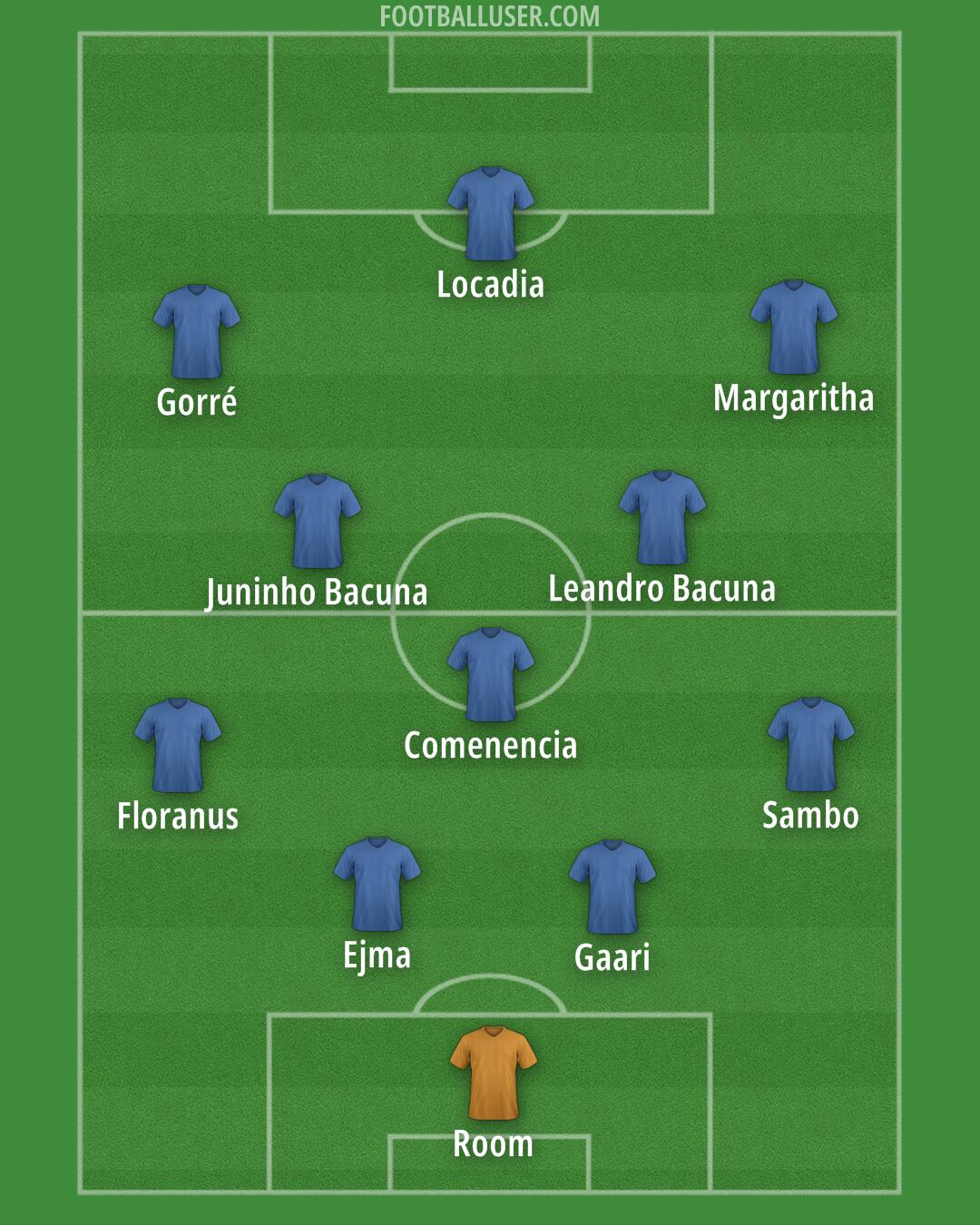
Australia National Soccer Team Formation
 March 9, 2026


Starting Lineup
Room · Sambo · Gaari · Ejma · Floranus · Comenencia · Leandro Bacuna · Juninho Bacuna · Margaritha · Gorré · LocadiaA high pressing and direct identity defines Australia and their 5-2-3 formation. This lineup works to win the ball back quickly in the final third and transition with speed to catch the opposition out of position. The team focuses on verticality to move from a compact defensive block into an attacking front as fast as possible.
Room stands between the posts to organize the defensive line. The back five consists of Comenencia acting as the central anchor while Gaari and Ejma sit on either side to cover the half spaces. Sambo and Floranus occupy the wide areas as wing backs, tasked with pushing high up the pitch to provide width. The central defenders must stay compact to block passing lanes, while the wing backs track back to help the back line when the team loses possession.
The midfield operates as a double pivot to control the central area. Juninho Bacuna and Leandro Bacuna hold the central zone, acting as the engine that connects the defense to the attack. One midfielder will often drop deeper to shield the back five, while the other looks to break the line with forward passes. This duo must press aggressively to prevent the opponent from building through the middle.
Frontline actions rely on a three man attacking unit. Locadia acts as the lone striker to hold up the ball and bring others into play. On the flanks, Gorré and Margaritha play as wide attackers, looking to cut inside or stretch the defense. The wingers press the opposition full backs relentlessly, creating space for the midfielders to move forward.
Australia gains a major advantage through wide overloads. When Sambo and Floranus overlap, they create two on one situations against the opponent wide defenders. The formation also offers great compactness when defending deep, making it hard for teams to play through the central channels. This allows the team to shift quickly from a deep block to a high press once the ball is recovered.
This 5-2-3 formation provides a heavy defensive foundation while allowing for rapid transitions. It is particularly effective against teams that play a high line and struggle with speed on the break.