
Norway National Football Team Formation
 April 15, 2026


Starting Lineup
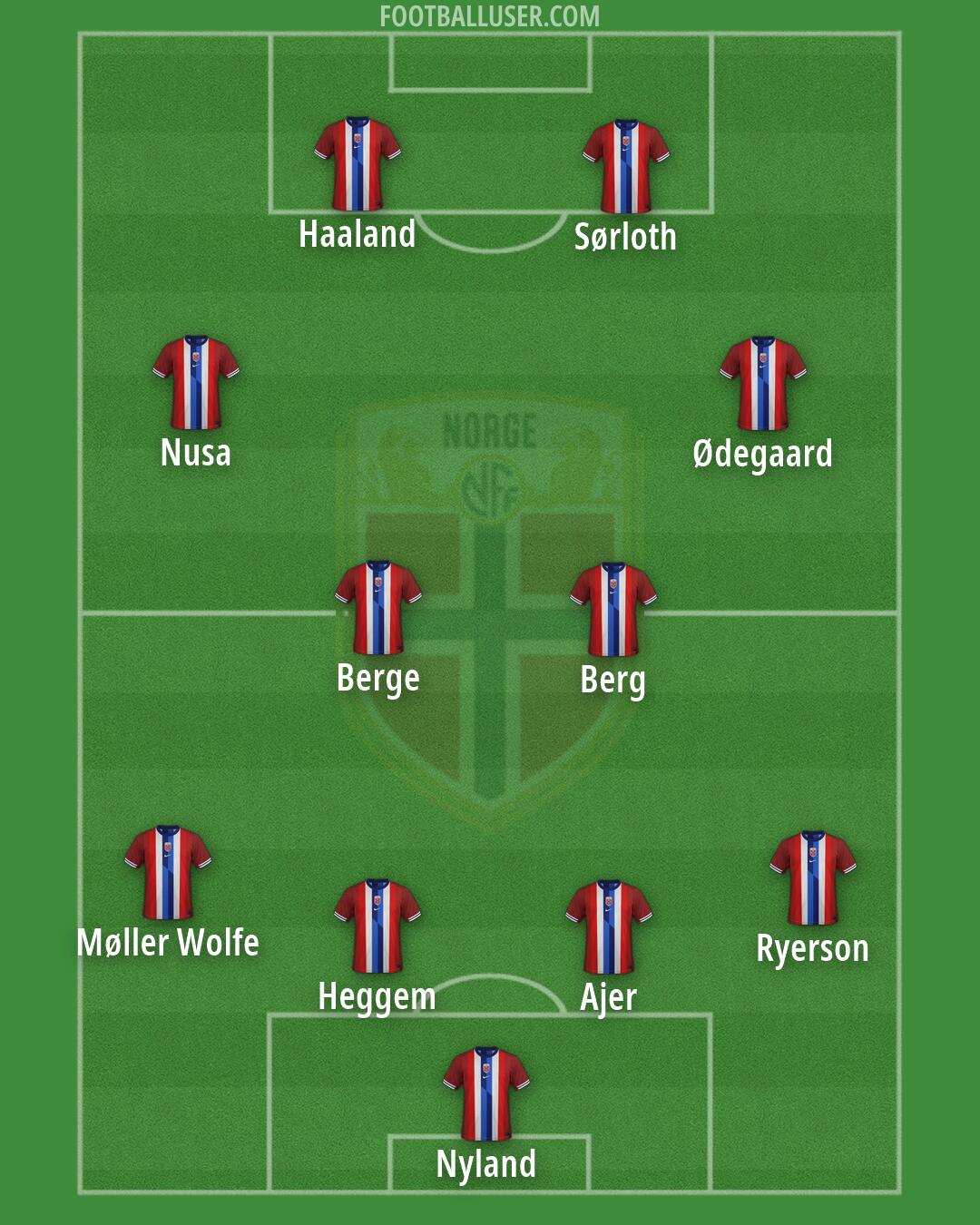
Nyland · Ryerson · Ajer · Heggem · Møller Wolfe · Ødegaard · Berg · Berge · Nusa · Sørloth · HaalandNorway plays with a 4-2-4 formation. This lineup focuses on a vertical style of play that looks to exploit space quickly. The main goal is to overwhelm the opponent in the final third by pushing many players forward. It is a high risk, high reward formation built to pin the opposition back through constant pressure and direct attacking runs.
Nyland stays between the posts to command the area. The back line consists of a flat back four that needs to step up to keep the team compact. Ryerson acts as a full back to cover the right side, while Møller Wolfe handles the left. In the center, Ajer provides aerial strength and covers space, while Heggem works to intercept passes and clear danger. The defensive unit must shift quickly to prevent being caught out during transitions.
The midfield utilizes a double pivot to maintain control. Berge and Berg sit in front of the defense to shield the back four and break up opposition plays. Berge uses his passing range to connect the defense to the attack, while Berg helps to drive the ball forward from deep positions. They act as the engine room, tasked with winning second balls and ensuring the team does not get overrun in the center of the pitch.
Norway employs four attackers to create constant chaos. Haaland and Sørloth act as two central forwards, with Haaland using his incredible speed and finishing to lead the line. Nusa operates as a wide winger on the left to stretch the defense, while Ødegaard plays on the right. Ødegaard uses his precise passing and vision to cut inside and create chances for the strikers. The front four press high to force turnovers near the opponent goal.
This formation offers significant advantages in the attacking third. The presence of two central strikers creates constant pressure on the opposition center backs, while the wide players help to create wide overloads. Norway can also utilize speed of transition to catch the opponent while they are out of position. The heavy presence in the final third makes it difficult for the opposition to find time on the ball.
This 4-2-4 formation is built for aggressive, direct football that seeks to dominate through sheer numbers in attack. It is best suited for games where the opponent sits deep and can be broken down by rapid vertical movements and high pressure.