Hull Football Formation
 May 9, 2026


Starting Lineup
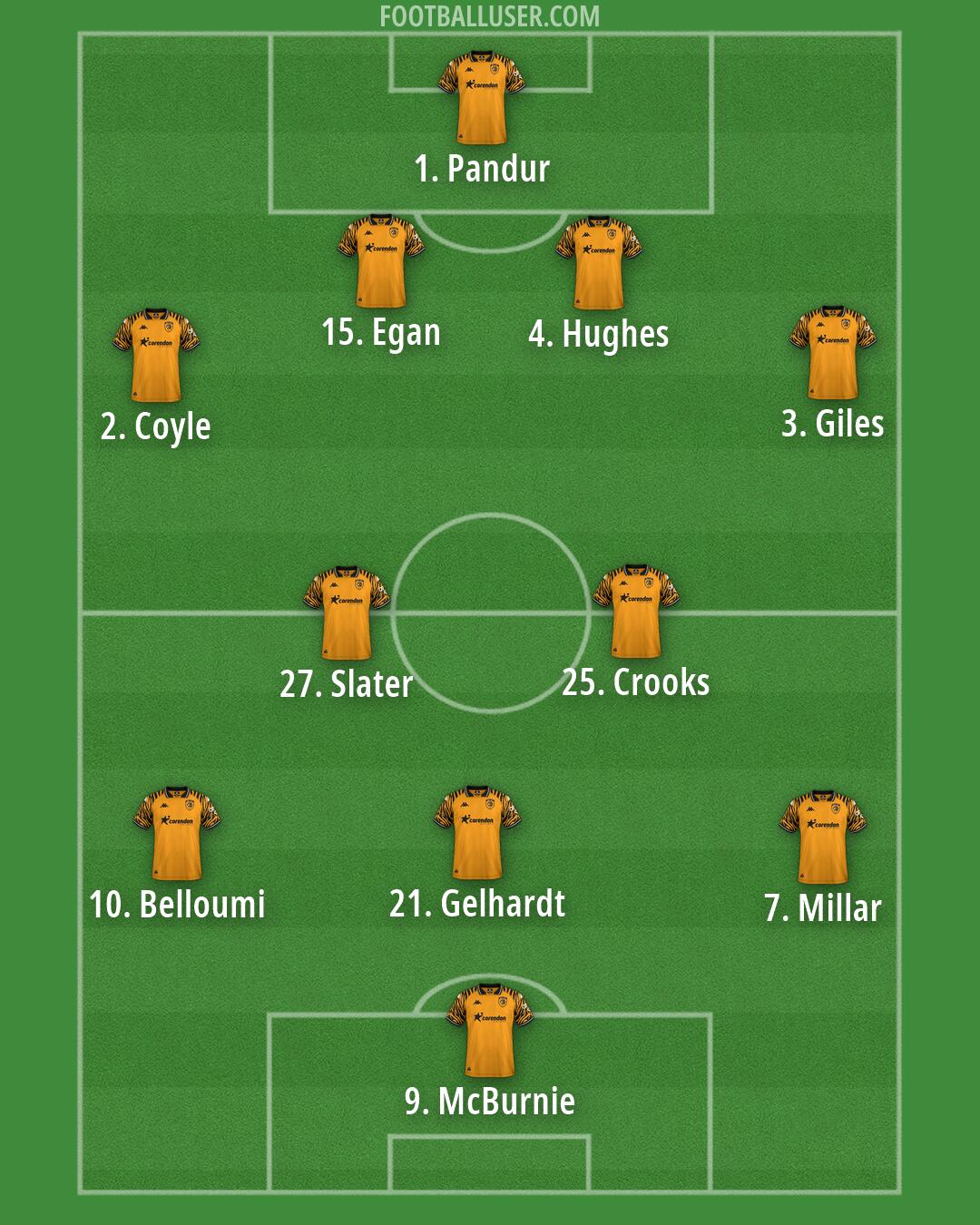
1. Pandur2. Coyle
15. Egan
4. Hughes
3. Giles
27. Slater
25. Crooks
10. Belloumi
21. Gelhardt
7. Millar
9. McBurnie
Hull (England) utilizes a 4-2-4 formation that prioritizes a high press and verticality. This lineup is built to pin the opponent in their own half and launch direct attacks. The team seeks to dominate the final third by committing many players forward to force errors and create scoring chances through quick transitions.
Pandur acts as the goalkeeper behind a flat back four. Egan and Hughes operate as the central defenders, with Egan providing cover on the right and Hughes marking the left side. They must stay alert to step up when the team pushes the line high. Coyle and Giles function as the wide defenders. Coyle looks to overlap to add numbers to the right wing, while Giles must track back to prevent counter attacks. The defensive unit must stay compact to avoid leaving gaps when the team pushes up.
The midfield relies on a double pivot consisting of Crooks and Slater. Crooks plays a holding role to shield the defense, while Slater works to drive the ball forward and connect the midfield to the attack. They have a heavy workload because they must cover the central areas left vacant by the advancing forwards. They must remain disciplined to stop the opponent from playing through the center.
The attacking line features four players to stretch the defense. Belloumi and Millar play as wide attackers, with Belloumi looking to cut inside and Millar using his pace to stretch the play on the left. Gelhardt and McBurnie operate as two central strikers who work together to hold up the ball. These four forwards press high to disrupt the opposition build up and create turnovers.
A key tactical advantage is the ability to create wide overloads when Coyle pushes up to support Belloumi. The team also benefits from the ability to press high in coordinated waves, which puts immense pressure on the opposing defenders and forces them into mistakes. Having both Gelhardt and McBurnie in the box makes it very difficult for central defenders to mark everyone.
This 4-2-4 formation is defined by its aggressive attacking intent and high pressing intensity. It is best suited for games where the goal is to overwhelm an opponent through sheer numbers in the attacking third.