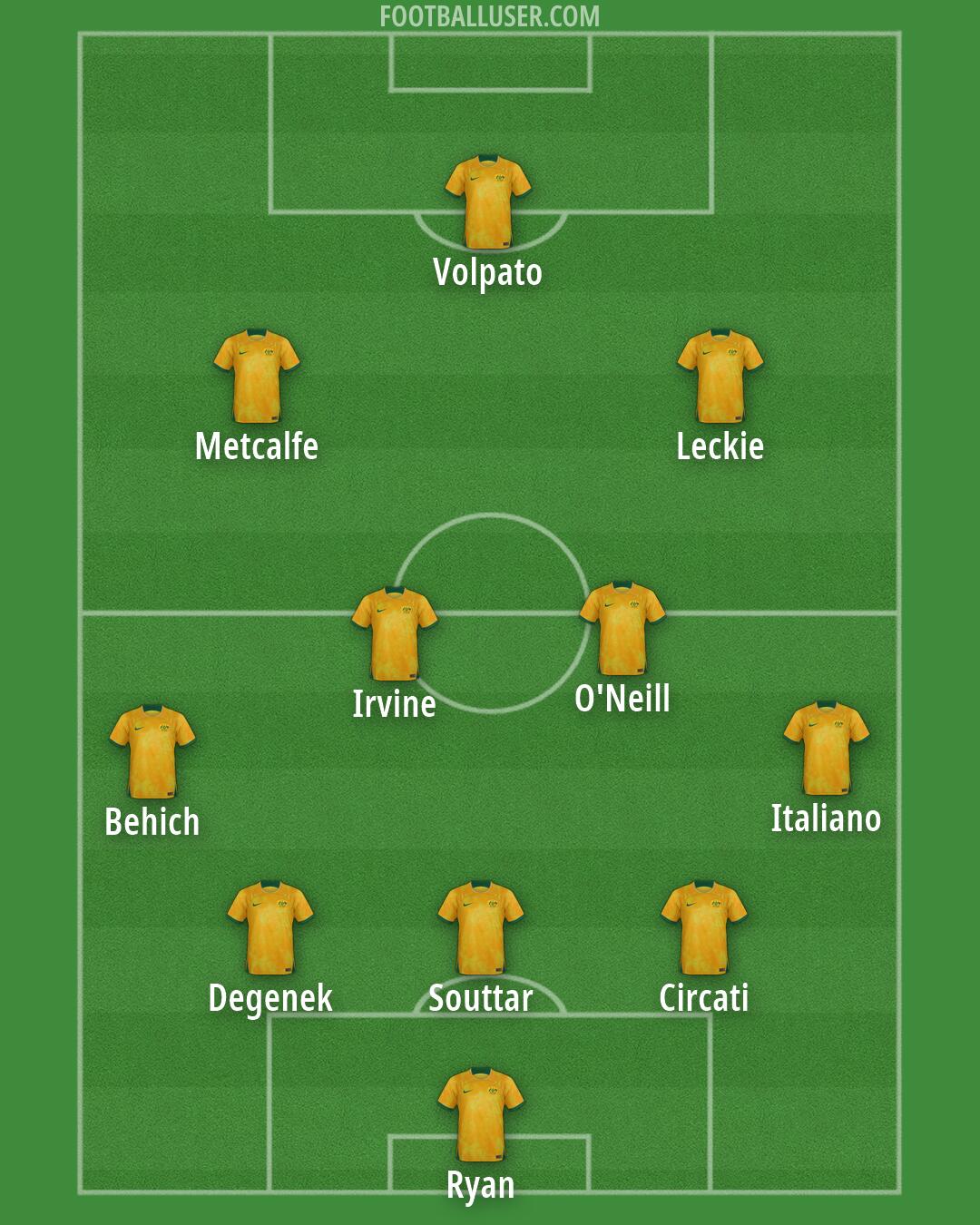
Australia National Soccer Team Formation
 June 1, 2026


Starting Lineup
Ryan · Souttar · Circati · Degenek · Italiano · Behich · Irvine · O'Neill · Metcalfe · Leckie · VolpatoPrioritizing a high press and quick transitions defines the tactical identity for Australia in a 3-4-3 formation. This lineup is built to win the ball high up the pitch and use rapid vertical movements to catch opponents out of position. The Socceroos aim to control wide areas while maintaining a compact unit when they lose possession.
Ryan stays between the posts to command the area. The back three features Souttar, Circati, and Degenek working in close proximity. Souttar provides significant aerial strength during defensive set pieces and clears long balls. Degenek and Circati act as the covering defenders, ready to step up or drop back to maintain the line. Behich and Italiano act as wing backs, pushing high to provide width or tracking back to form a five man defense when the team sits deep.
The midfield functions as a central block designed to control the tempo and protect the defense. Irvine and O'Neill occupy the central roles to shield the back three and intercept passes. Irvine works to connect the lines by receiving the ball from the defenders and driving forward into space. O'Neill provides the physical presence needed to tackle and disrupt the opponent in the middle of the pitch. This duo ensures that the transition from defense to attack remains efficient.
Australia utilizes three attackers to stretch the opposition defense. Volpato leads the line as the lone striker, tasked to hold up the ball and bring others into play. Metcalfe and Leckie play as wide attackers, often looking to cut inside to create shooting opportunities or cross from the flanks. The movement of Metcalfe and Leckie forces the opposing full backs to stay wide, which opens central passing lanes for the midfielders to break the line.
A major advantage of this lineup is the ability to create wide overloads through the runs of Behich and Italiano. When they push up, they provide extra support for the wingers, making it difficult for the opponent to mark everyone. The team also benefits from the ability to press high in coordinated waves, with Volpato and the wingers forcing turnovers near the opponent's goal. This creates immediate chances before the opposition can reorganize.
This formation relies on high intensity and quick transitions to overwhelm the opponent. It is best suited for matches against teams that play a high defensive line or struggle with wide numerical advantages.