Australia National Soccer Team Formation
 Today, June 23, 2026


Starting Lineup
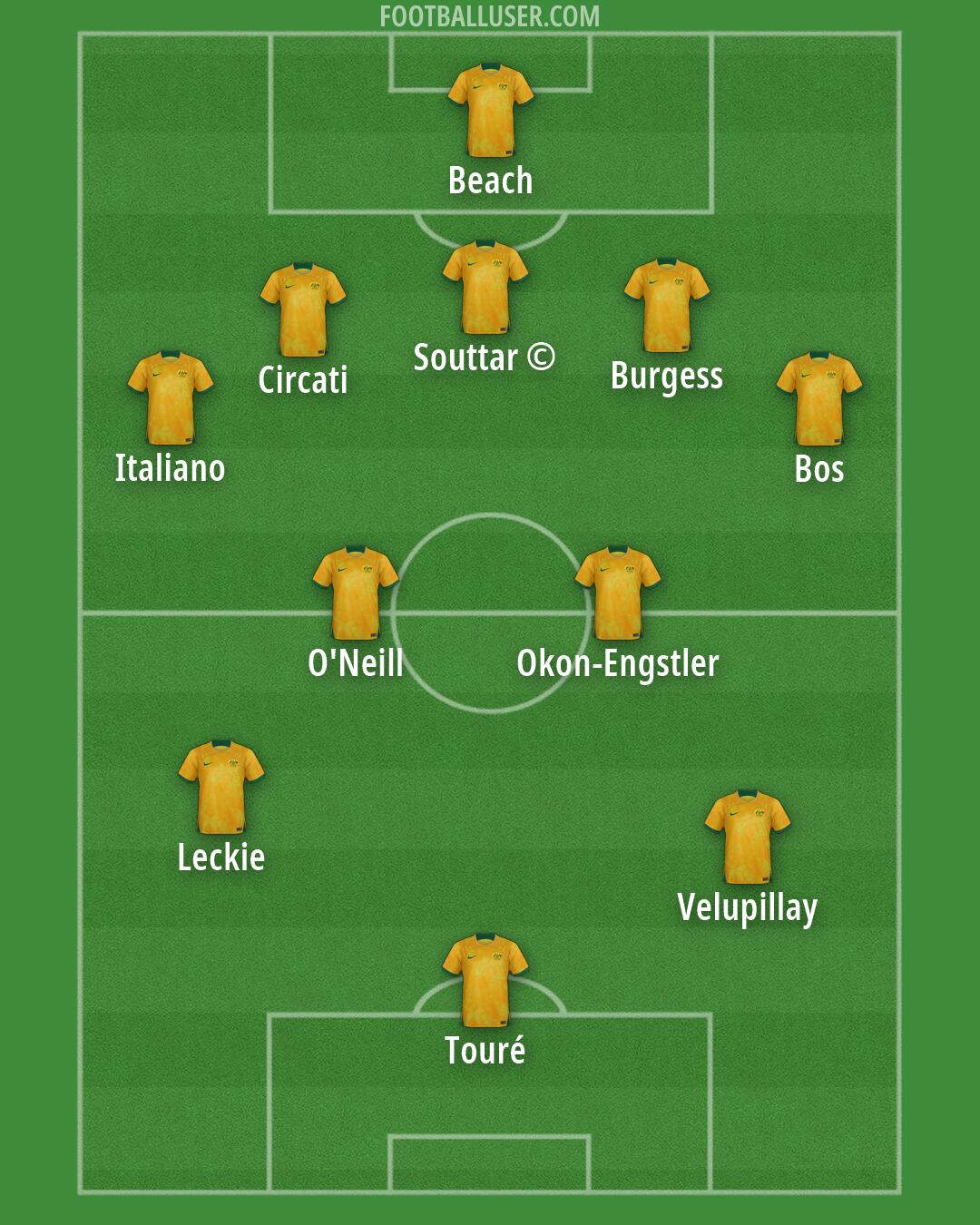
Beach · Circati · Souttar © · Burgess · Bos · Italiano · O'Neill · Okon-Engstler · Leckie · Velupillay · TouréAustralia relies on defensive stability that looks to hit teams in transition. This 5-2-3 formation is built to sit deep and absorb pressure before launching attacks. The team aims to win the ball back high up the pitch or in a mid-block and then use quick vertical passes to catch the opponent out of position.
Beach stays in goal to organize the defense for Australia. The back line consists of a back five with Burgess, Souttar, and Circati. The captain, Souttar, is dominant in the air and helps to lead the central block. Burgess and Circati work to cover the space behind the captain and defend zonally. Bos acts as an attacking wing back on the left to provide width, while Italiano plays as an attacking wing back on the right. The defensive unit works to stay compact and prevent runners from moving between the lines.
O'Neill and Okon-Engstler form a two-man midfield to protect the central zone. These two must work hard to shield the defense and win the second ball. O'Neill and Okon-Engstler are tasked to press in a mid-block and connect the defensive and attacking lines. They look to find the feet of the striker, Touré, to move the play forward. They are also required to carry the ball forward and recycle possession to keep the pressure off the back five.
The front line uses three attackers to stretch the opposition defense. Velupillay and Leckie play as wide wingers, with Leckie using his high pressing intensity to disrupt the play. Touré acts as the lone striker, looking to hold up the ball and receive on the half-turn. The team looks to create runs in behind and use cutbacks from the byline to exploit the area around the goal. They often combine in tight spaces to break the line of the defense.
One advantage of this 5-2-3 is the compactness when defending in a low block. The wide players, Bos and Italiano, allow for wide overloads when the team shifts into an attacking phase. This creates numerical superiority on the flanks and helps the team spread wide during transitions. Furthermore, the three central defenders make it very difficult for opponents to find space through the middle.
This formation is designed for a team that prioritizes defensive security and rapid breaks. It is best suited for games against opponents that dominate possession and leave space behind their defenders.