
Norway National Football Team Formation
 June 27, 2026


Starting Lineup
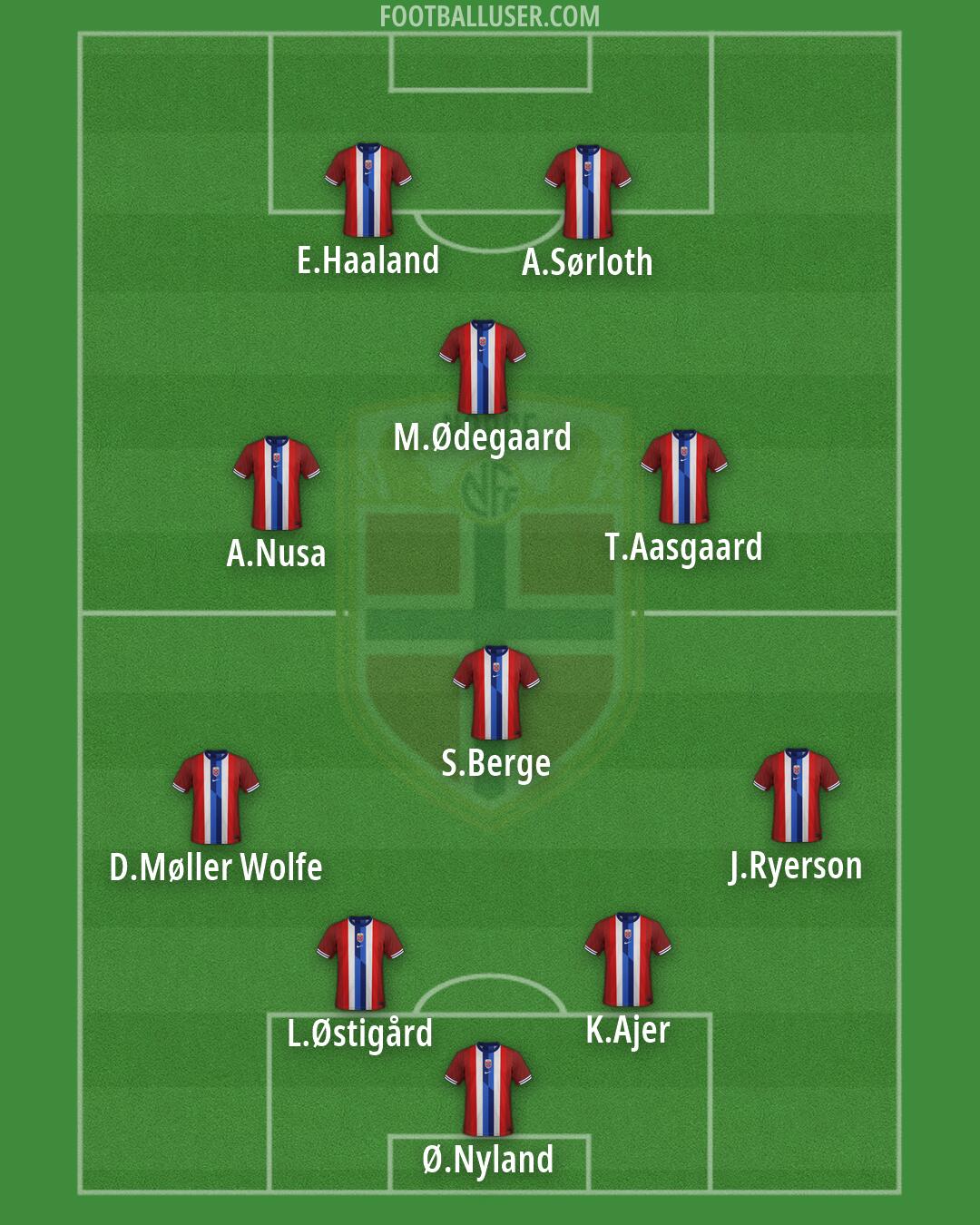
E.Haaland · A.Sørloth · J.Ryerson · D.Møller Wolfe · M.Ødegaard · T.Aasgaard · S.Berge · A.Nusa · L.Østigård · K.Ajer · Ø.NylandNorway focuses on a direct and vertical style of play through a 5-3-2 formation. This lineup is built to absorb pressure and strike with immense speed on the transition. By using a deep defensive block and a compact midfield, the team looks to win the second ball and quickly find their two powerful forwards.
Ø.Nyland guards the goal and organizes the defensive line. The back five consists of a central trio of S.Berge, K.Ajer, and L.Østigård. K.Ajer provides aerial strength, while L.Østigård and S.Berge work to cover space behind the wing backs. J.Ryerson and D.Møller Wolfe act as attacking wing backs, pushing high to provide width when the team has the ball. This unit stays narrow when defending to force opponents wide and protect the central zones.
A three-man midfield connects the defence to the attack. M.Ødegaard operates as the advanced attacking ten, looking to play through the lines and find the strikers. He is supported by A.Nusa and T.Aasgaard, who operate as inverted eights. T.Aasgaard works to carry the ball forward, while A.Nusa helps to press in a mid-block. This trio must work hard to squeeze the space and deny the opposition pivot any time on the ball.
The attack relies on a potent partnership of two forwards. E.Haaland acts as a pressing centre-forward with immense physical presence, often making runs in behind the defence. A.Sørloth plays as a second striker, often dropping slightly deeper to hold up the ball and link play with the midfield. The team uses the width provided by J.Ryerson and D.Møller Wolfe to stretch the defence, allowing the strikers to isolate defenders in one on one situations or receive crosses from the byline.
Norway gains a significant advantage from the speed of transition. When the ball is won, the combination of the long passing range of the midfielders and the pace of E.Haaland allows the team to hit in behind on the transition before the opposition can recover. Another strength is the compactness when defending, as the five defenders and three midfielders make it very difficult for opponents to play through the middle.
This formation provides a solid base for a team that wants to exploit large spaces behind the opponent. It is best suited for matches against teams that commit many players forward and leave themselves vulnerable to quick counters.