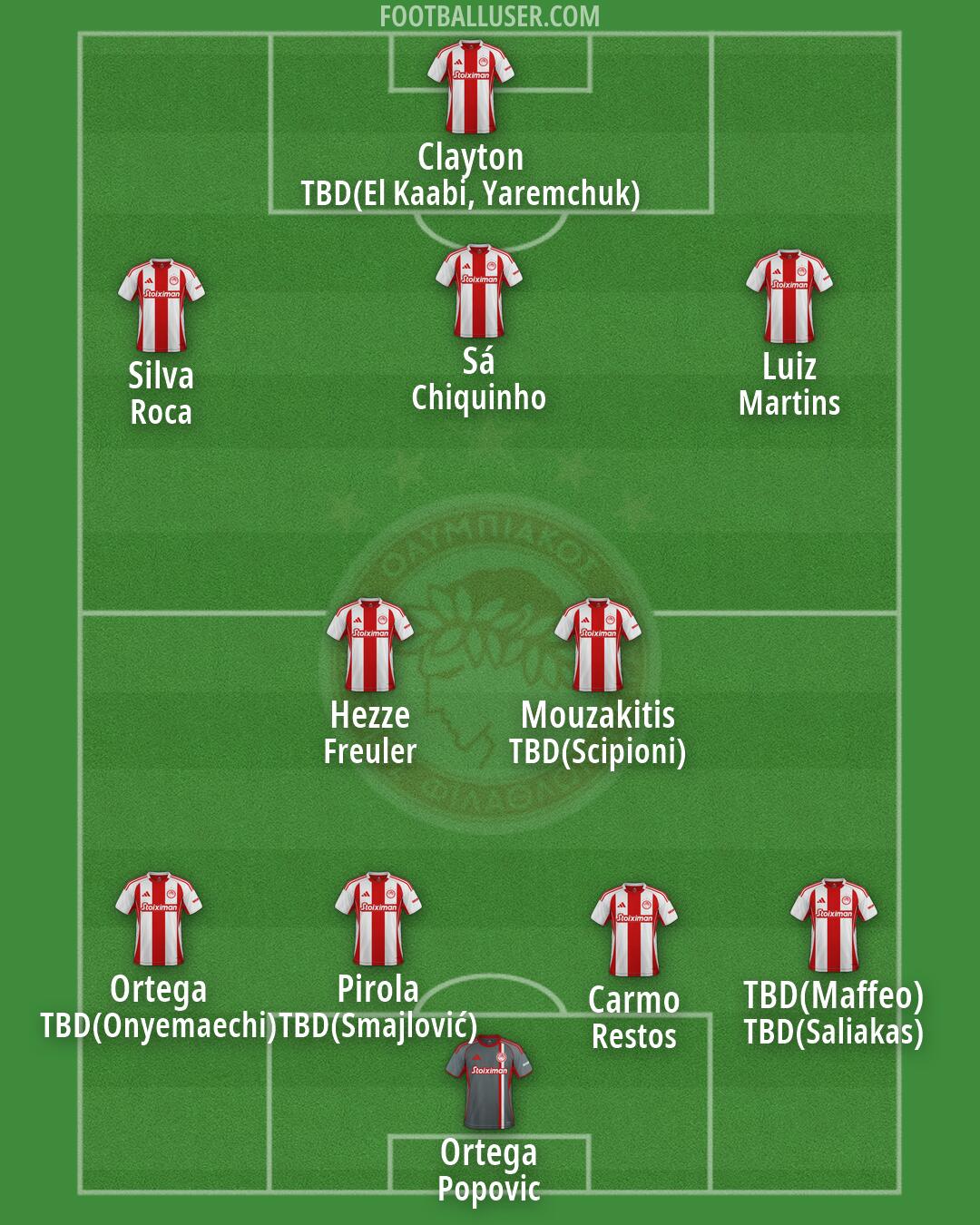

Olympiacos Football Formation
 August 17, 2026
 MihaiLina


Starting Lineup
Ortega (Popovic) · Ortega (TBD(Onyemaechi)) · Pirola (TBD(Smajlović)) · Carmo (Restos) · TBD(Maffeo) (TBD(Saliakas)) · Mouzakitis (TBD(Scipioni)) · Hezze (Freuler) · Silva (Roca) · Luiz (Martins) · Sá (Chiquinho) · Clayton (TBD(El Kaabi, Yaremchuk))Olympiacos relies on a direct and vertical way of playing using a 4-2-4. This formation seeks to overwhelm the opposition by pushing many players into the final third to create immediate threats. The intent is to win the ball and move forward with pace to catch the defense before they can settle.
Ortega stays between the posts to organize the back line. The defensive unit functions as a flat back four with Carmo acting as a right centre-back and Pirola holding the left centre-back position. Carmo and Pirola must hold the line and defend zonally to prevent runs in behind. Maffeo operates as the right back to provide width and track back when needed, while Ortega covers the left flank. This defensive unit must stay compact to avoid being split by through balls.
The midfield relies on a double pivot to manage the central area. Hezze and Mouzakitis act as the engine room, with Hezze working to shield the defense and win the second ball. Mouzakitis helps to connect the defensive and attacking lines by receiving the ball from the defenders and looking to progress through the thirds. These two players must work hard to cover the large spaces left behind the high attacking line.
The attack is built around four players meant to stretch the defense. Sá and Clayton operate as a central partnership, with Clayton acting as a target man to hold up the ball and Sá looking to find space between the lines. On the flanks, Silva and Luiz play as wide wingers who stay near the touchline to spread the defense wide. This lineup is designed to create combinations in the final third, often looking to whip it in or find the feet of the striker during rapid transitions.
Olympiacos gains a clear advantage through the ability to attack in waves. By using four forwards, the team can isolate wide players in one on one situations and create overloads against a standard back four. The high number of attackers also allows the team to press from the front and win the ball high up the pitch, forcing the opponent into mistakes.
This 4-2-4 formation is built for high intensity and rapid offensive transitions. It is best suited for games where the team needs to chase a result against a side that sits deep.