
Barcelona Football Formation
 Today, September 9, 2026


Starting Lineup
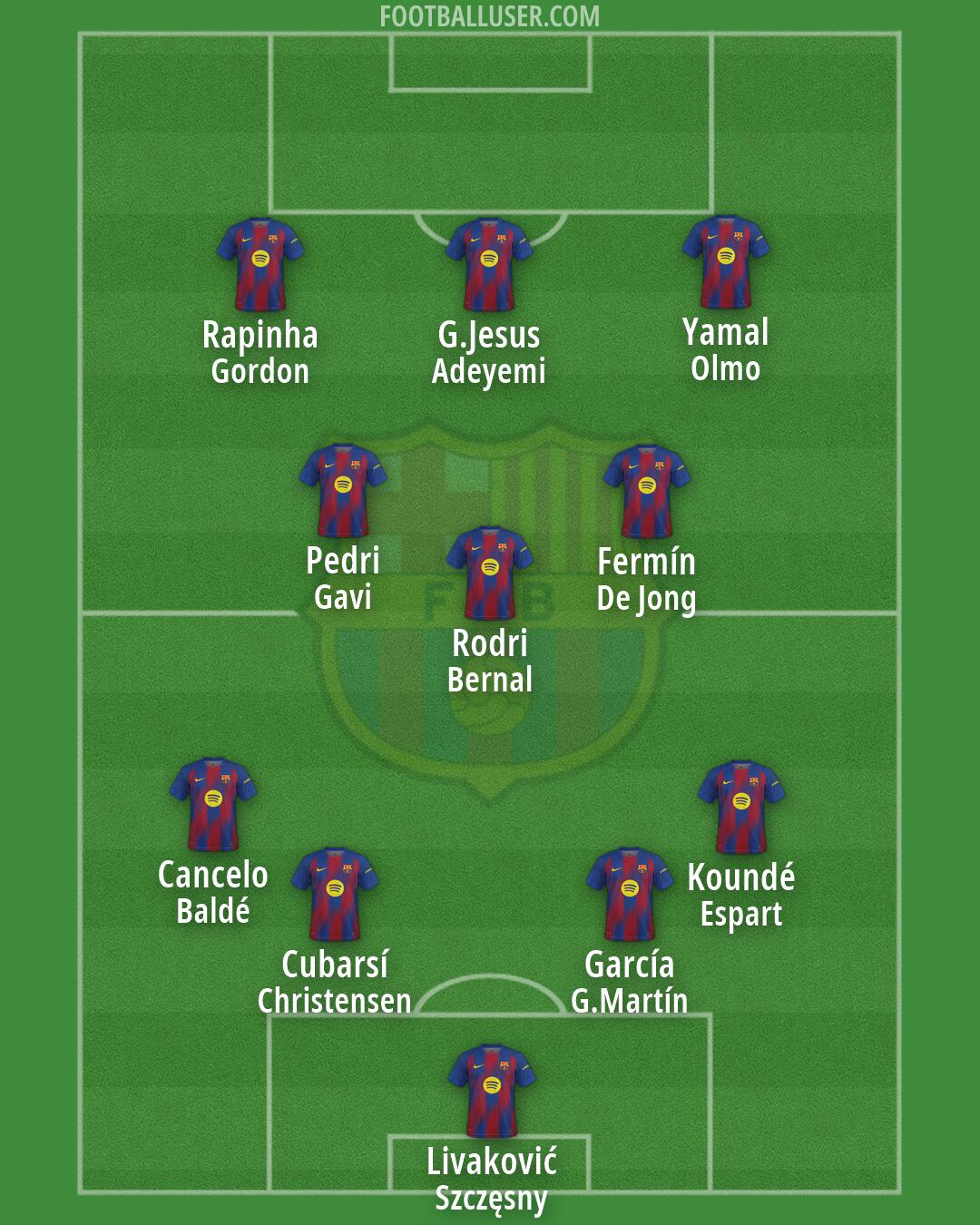
Cubarsí (Christensen) · García (G.Martín) · Koundé (Espart) · Cancelo (Baldé) · Livaković (Szczęsny) · Rodri (Bernal) · Pedri (Gavi) · Fermín (De Jong) · Rapinha (Gordon) · G.Jesus (Adeyemi) · Yamal (Olmo)Barcelona relies on heavy possession and a high press, playing a 4-3-3. This formation aims to control the tempo through short passing and constant movement to break the opposition lines. The goal is to dominate the ball and use high positioning to win it back quickly.
Livaković acts as the last line of defense in goal. The back line consists of a flat back four that often plays with a high line to squeeze the space. Koundé provides stability at right back while Cancelo functions as an attacking full back to provide width. In the center, García and Cubarsí work together, with Cubarsí often acting as a ball playing defender to start the build up from the back.
A single pivot system governs the midfield, with Rodri sitting deep to shield the defense. He acts as the primary anchor, protecting the center while recycling possession. Ahead of him, Pedri and Fermín operate as two eights who connect the defense to the attack. Pedri uses his passing range to find teammates in tight spaces, while Fermín looks to arrive late into the box. This midfield trio works to maintain control and progress through the thirds.
The attack features three players across the front. G.Jesus operates as a pressing centre-forward, working to pin the last defender and hold up the ball. On the flanks, Yamal and Rapinha provide width and threat. Yamal plays as an inverted winger on the right to cut inside, while Rapinha stays wide on the left to stretch the defense. The front line is designed to create runs in behind and use combinations to isolate wide players in one on one situations.
Barcelona offers several tactical advantages with this lineup. The midfield trio can create numerical superiority in the center to control games. Using Cancelo and Koundé allows for wide overloads when they push up to overlap the wingers. The ability to press from the front helps the team win it back high up the pitch and catch opponents in transition.
This 4-3-3 setup is built for teams that want to dictate the rhythm of the match through ball retention. It is most effective against opponents that play a low block and struggle to deal with constant pressure in the final third.