
Olympiacos Football Formation
 Today, October 1, 2026


Starting Lineup
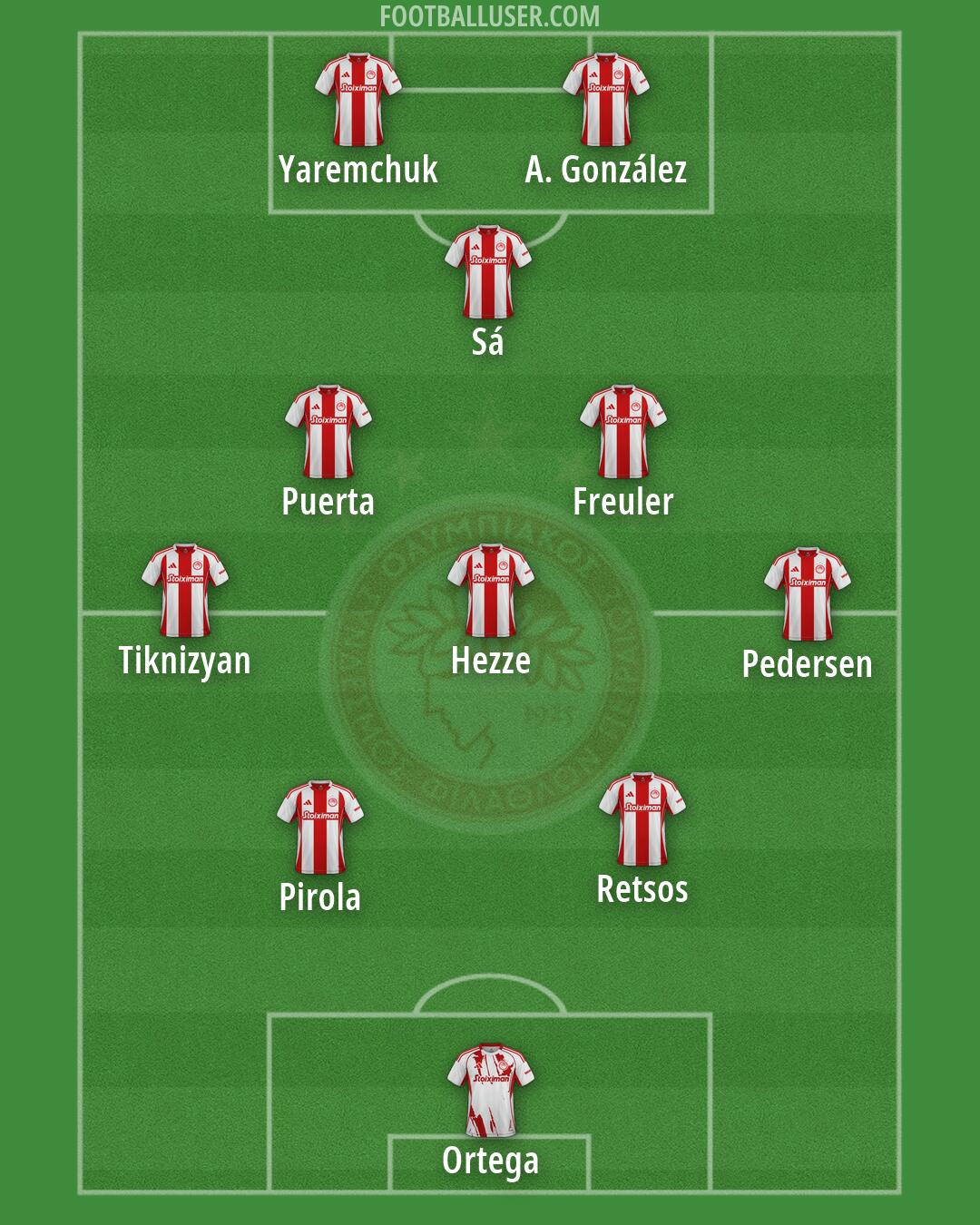
Pirola · Retsos · Tiknizyan · Pedersen · Yaremchuk · A. González · Sá · Hezze · Puerta · Freuler · OrtegaOlympiacos aims to dominate the central areas and control the tempo through a massive midfield presence using a 2-6-2 formation. This lineup is built to squeeze the space in the middle of the pitch and keep the ball through high volumes of short passing. By stacking the center, the team seeks to suffocate opponents and win the second ball constantly.
Ortega acts as the last line of defense in goal. The back line is a narrow two man unit consisting of Pirola and Retsos. These central defenders must stay highly concentrated and act as covering defenders to manage the large spaces left behind them. Because there are only two in the back, Pirola and Retsos must be ready to step up and intercept long balls or track runners in behind quickly.
The midfield operates as a heavy six man block designed to bypass the opposition. Pedersen, Tiknizyan, and Hezze form a deep trio that shields the defense and wins possession. Tiknizyan and Hezze look to carry the ball forward, while Pedersen stays deeper to recycle possession. Ahead of them, Freuler, Puerta, and Sá operate in the advanced zones to connect the lines. Freuler uses his passing range to find teammates, while Puerta and Sá look to play through the lines to find the forwards.
The attacking unit relies on a partnership of two forwards. Yaremchuk operates as a pressing centre-forward to harass the opposition back line, while A. González works to find space between the defenders. The team builds the attack through the heavy midfield, using the six players to create overloads. The forwards focus on link-up play between the lines and making runs in behind to exploit the space created by the midfield pressure.
Olympiacos possesses a massive advantage in terms of numerical superiority in the middle of the pitch. This formation allows the team to press high in coordinated waves, making it very difficult for opponents to play out from the back. The ability to squeeze the space in the center forces the opposition to play wide, where the team can then shift to close down passing lanes.
This formation relies on total control of the central zones to starve the opponent of the ball. It is best suited for games where the team needs to pin a deep sitting opponent into their own half.