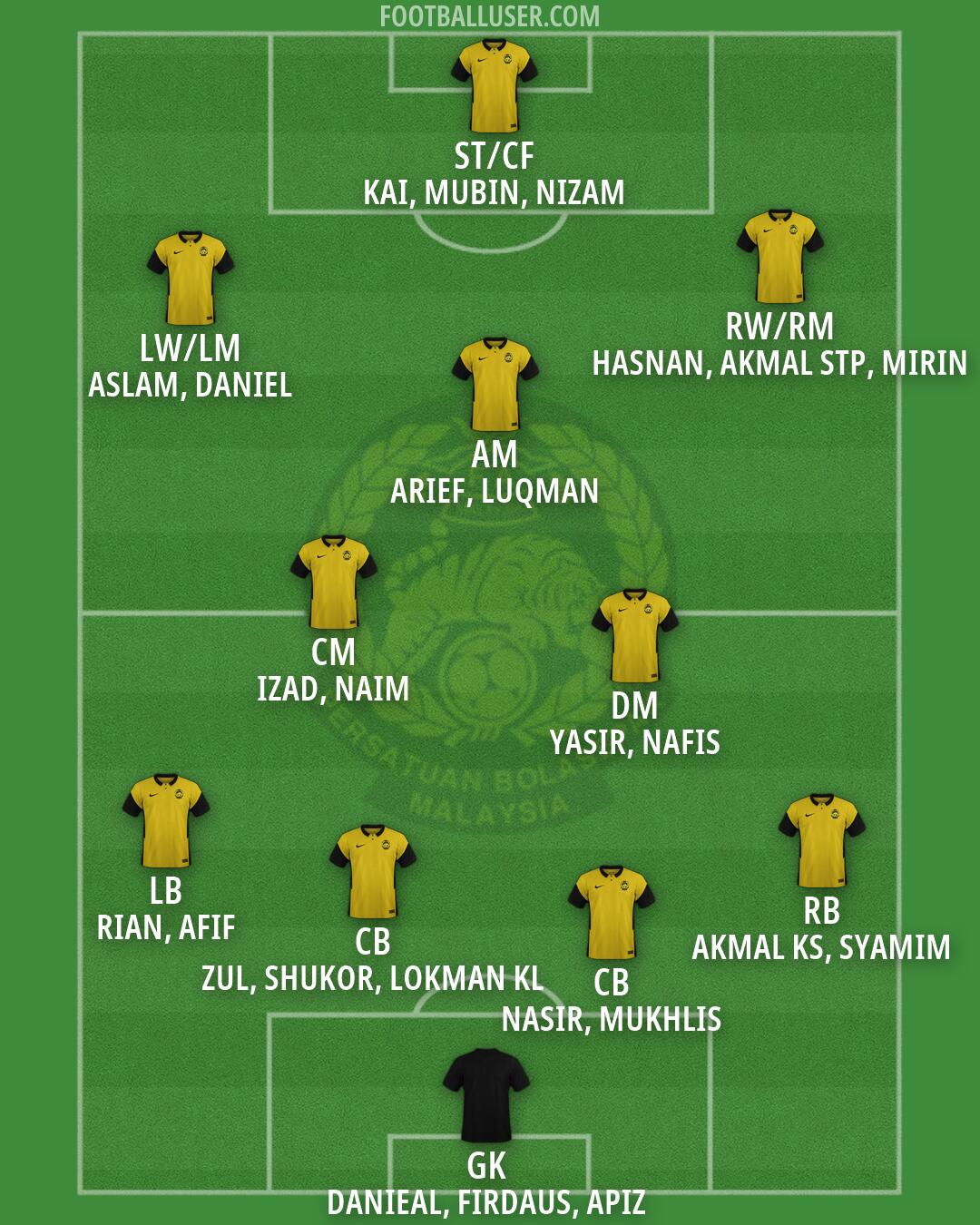

Malaysia National Football Team Formation
 Today, October 7, 2026


Starting Lineup
GK (DANIEAL, FIRDAUS, APIZ) · LB (RIAN, AFIF) · CB (ZUL, SHUKOR, LOKMAN KL) · CB (NASIR, MUKHLIS) · RB (AKMAL KS, SYAMIM) · DM (YASIR, NAFIS) · CM (IZAD, NAIM) · AM (ARIEF, LUQMAN) · RW/RM (HASNAN, AKMAL STP, MIRIN) · LW/LM (ASLAM, DANIEL) · ST/CF (KAI, MUBIN, NIZAM)Malaysia aims to control the game through a high press and verticality using a 4-3-3. This formation is built to win the ball back high up the pitch and quickly attack the opposition back line. The team looks to dominate the central areas while using wide players to stretch the defence.
GK stands between the posts to organize the back line. The defensive unit operates as a flat back four where RB and LB provide width. CB on the right and CB on the left act as the central defenders, tasked to defend zonally and clear the lines when under pressure. The RB and LB must track back to cover wide areas and prevent crosses, while the central defenders aim to win the header during defensive set pieces.
The midfield functions with a three-man midfield with a carrier. DM sits in front of the defence to shield the back four and deny the pivot from finding space. LCM and RCM work to connect the defensive and attacking lines, with one midfielder looking to carry the ball forward to break the line. AM operates as an attacking ten behind the striker, looking to find the feet of the striker or arrive late into the box to score. This central trio must stay compact to squeeze the space between the lines.
In the final third, Malaysia uses three attackers across the front. ST operates as a pressing centre-forward to force a long ball from the opposition. LW and RW act as inverted wingers who cut inside to create overloads in the half-spaces. This movement allows the attackers to combine in tight spaces and create runs in behind. When the team attacks, the wingers often pull wide to create space for the AM to exploit.
One major advantage for Malaysia is the ability to press high in coordinated waves, putting immediate pressure on the opposition goalkeeper and defenders. Another strength is the speed of transition when the midfield wins the second ball. This allows the LW and RW to hit in behind on the transition before the opponent can set the offside trap.
This 4-3-3 lineup relies on high intensity to disrupt the opponent's build up play. It is best suited for games against teams that struggle to play out from the back under heavy pressure.