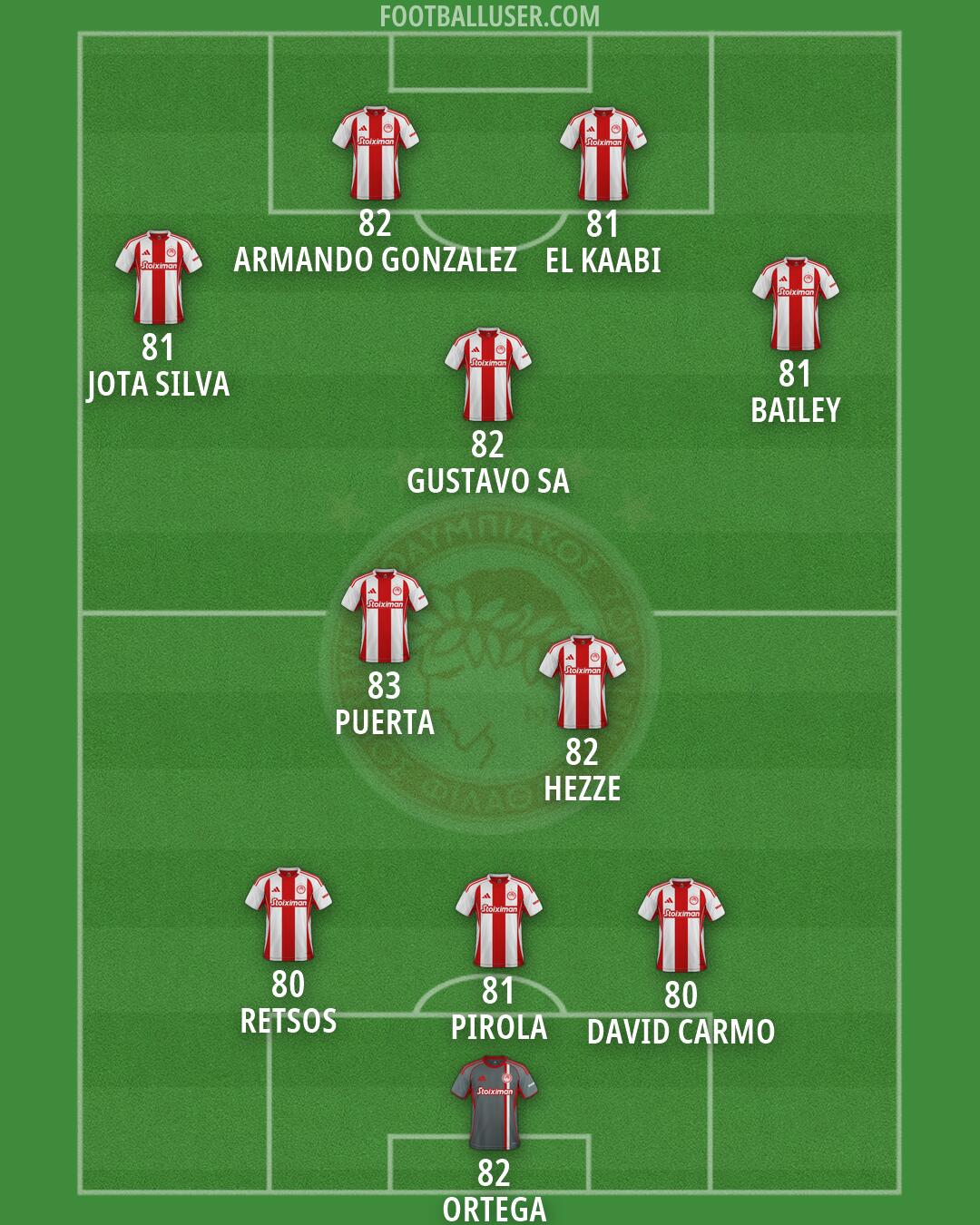

Olympiacos Football Formation
 Today, October 24, 2026


Starting Lineup
82 (ORTEGA)81 (PIROLA)
80 (RETSOS)
80 (DAVID CARMO)
82 (HEZZE)
83 (PUERTA)
82 (GUSTAVO SA)
81 (JOTA SILVA)
81 (BAILEY)
82 (ARMANDO GONZALEZ)
81 (EL KAABI)
Olympiacos looks to control matches through defensive solidity and rapid transitions using a 5-3-2. This formation is built to remain compact when without the ball while utilizing width during attacking phases. By sitting in a mid-block, the team can absorb pressure and then hit the opposition on the break.
In goal, 82 acts as the last line of defense. The back line operates as a back five where 83 and 82 form a central core, with 81 providing additional cover alongside them. This trio focuses on defending zonally and winning the second ball. On the flanks, 80 as the RWB and 80 as the LWB are expected to push high to provide width, while also tracking back to form a five man line when defending deep. The center backs, specifically 83 and 82, must be dominant in the air to clear crosses and prevent runs in behind.
The midfield consists of a three man midfield with a carrier. Within this unit, 82 sits centrally to shield the defense and recycle possession. The wide midfielders, 81 as the RCM and 81 as the LCM, are responsible for connecting the defensive and attacking lines. They must press aggressively to win the ball high and carry the ball forward into the final third. These three players work to compress the midfield and deny the turn of the opposition playmakers.
Olympiacos employs two forwards in a partnership upfront. The LS and RS act as a dual threat, often combining in tight spaces to break the line. They work together to press from the front, forcing the opposition back line to play long. When the team moves into transition, the LS and RS look to run in behind the defenders or hold up the ball to allow the RWB 80 and LWB 80 to join the attack. This movement creates opportunities for cutbacks from the byline or through balls played between the lines.
One major advantage for Olympiacos is the ability to create wide overloads when the wing backs push forward. This forces the opposition to stretch the defense, leaving gaps in the middle. Additionally, the formation offers great compactness when defending in a mid-block, making it very hard for opponents to play through the center. The speed of transition from a narrow defensive block to a wide attacking front allows the team to catch opponents out of position.
This 5-3-2 formation provides a reliable way to defend against teams that dominate possession. It is best suited for matches where the team needs to sit deep and exploit space on the counter attack.