
Barcelona Football Formation
 Today, October 26, 2026


Starting Lineup
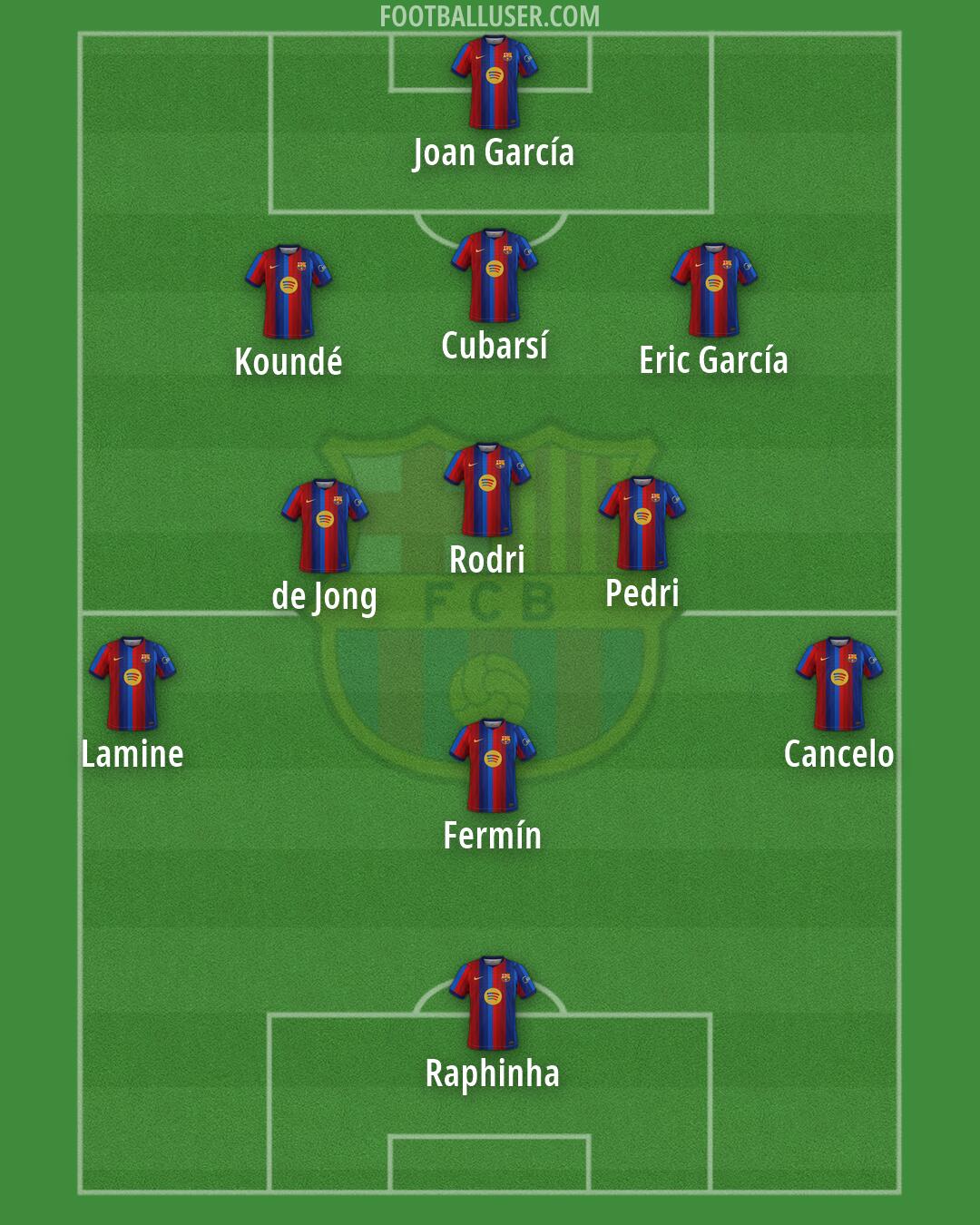
Joan García · Cubarsí · Koundé · Cancelo · Rodri · de Jong · Fermín · Lamine · Pedri · Raphinha · Eric GarcíaBarcelona aims to dominate through heavy ball possession and high pressing in a 3-3-4 formation. This lineup is built to control the tempo of the game and pin the opposition deep within their own half. By utilizing a heavy attacking front line, the team seeks to overwhelm the defensive line of the opponent through constant movement and rapid ball circulation.
Joan García starts in goal to oversee the defensive unit. The back line operates as a back three with Cubarsí acting as a ball playing defender to help play out from the back. Eric García occupies the left position to cover the space while Koundé sits on the right as a wide centre-back who can track runners. This unit works to keep a high line to squeeze the space and keep the team compact.
A three-man midfield provides the engine for Barcelona. Rodri sits as a single pivot to shield the defence and recycle possession when the team needs to build play. Beside him, Pedri uses his passing range to connect the defensive and attacking lines, while de Jong acts as a carrier to drive forward with the ball. These three players work to win the ball back high up the pitch and progress through the thirds.
The attacking unit is designed for relentless pressure with four players across the front. Fermín and Raphinha operate as two forwards in a partnership, pressing the opposition back line to force a long ball. Lamine plays as an inverted winger on the right to cut inside and create chances, while Cancelo pushes up from the left to provide width. This attacking setup creates many runs in behind and allows the forwards to combine in tight spaces.
One major strength of this Barcelona lineup is the ability to press high in coordinated waves to win the ball back quickly. The team also gains a huge advantage by creating wide overloads when Cancelo pushes forward to join the attack. This presence forces the opposition to stretch the defence, which opens up passing lanes for the central players to play through the lines.
This formation is built to overwhelm opponents through sheer attacking volume and control of the ball. It is best suited for matches against teams that sit deep and rely on defensive numbers.