4-3-3: The Dynamic Line-up
An attacking formation with a good balance at ball loss. Winger play is important in this formation, which requires individually strong players who can take the upper hand in one-on-one situations. This system is often used with youth teams because it's the best system for learning to play in a zone.
The 4-3-3 is one of the most widely used formations in world football, favoured by some of the greatest club sides and national teams of the modern era. Its appeal lies in the combination of width through the wingers, control through a three-man midfield, and a high press that can suffocate opponents from the front. When executed correctly, the 4-3-3 is as effective without the ball as it is with it.
Formation Overview
- Description
- Harness the power of a four-man defence, a trio in midfield and a three-point attack with the 4-3-3 line-up. This formation offers an ideal balance between attacking flair and defensive stability, with wingers providing width and a defensive midfielder protecting the back four.
- Setup
- Four defenders, three midfielders and three attackers.
- Features
- Balanced formation with both attacking and defensive stability. Often used by teams that prioritise width and attacking play. The high press is a defining feature: the three forwards close down defenders quickly, forcing errors high up the pitch.
- Pros and cons
-
- When switching from ball possession to ball loss and from ball loss to ball possession, all zones on the pitch are covered.
- If the wingers neglect their defensive duties, the midfield can struggle when outnumbered, for example, against a 4-4-2 or 3-5-2.
- The spaces on the flank can be exploited effectively by overlapping full-backs.
- Ability to play high pressure: apply quick pressure on the defenders.
- Ball-secure players needed in midfield to maintain shape.
- Multiple passing options up front due to the three-forward structure.
- 1 defensive midfielder provides a shield in front of the back four.
- Used by
- Jürgen Klopp's Liverpool achieved remarkable success with their high-pressure 4-3-3 formation during the 2018-2019 season. The team won the UEFA Champions League and finished runners-up in the Premier League. Barcelona under Pep Guardiola also perfected the 4-3-3 during their dominant 2008-2012 era, using tiki-taka principles to control possession and press intensely without the ball.
How the 4-3-3 Works in Practice
The foundation of the 4-3-3 is the relationship between the three midfielders. The central defensive midfielder (CDM) sits deepest, protecting the space in front of the back four and acting as the first line of defence when possession is lost. The two attacking midfielders (LAM and RAM) operate higher up the pitch, providing a link between defence and attack. They must have the engine to contribute both defensively (pressing and tracking runners) and offensively, arriving late into the box to add a goal threat from midfield.
The three forwards are the identity of the system. The centre forward leads the line and is typically the focal point of attacks, holding up play, making runs in behind, and finishing chances. The left and right wingers hug the touchlines to stretch the opposition defence wide, creating space centrally and in behind the full-backs. In a high-pressing variant like Klopp's Liverpool, the wingers are the first line of the press. Their work-rate off the ball is just as important as their quality on it.
Full-backs play an important supporting role in the 4-3-3. When the team has the ball, they push forward to provide width and overlapping runs, effectively turning the formation into a 2-3-5 in attack. This overlapping dynamic means that even when the winger cuts inside, there is always cover on the outside. However, it also means the full-backs must be athletic enough to recover quickly when possession is lost.
4-3-3 vs Other Formations
Against a 4-4-2 diamond, the 4-3-3 can exploit the wide areas that the diamond leaves exposed, using the wingers to stretch play and the full-backs to deliver crosses into the two centre forwards. The diamond's central overload can be problematic, however. If the 4-3-3's midfield three are outnumbered in central areas, the team can struggle to control possession. Against a 3-5-2, the 4-3-3's wingers can pin back the opposition wing-backs, preventing them from joining attacks and effectively neutralising one of the 3-5-2's key strengths.
The biggest risk the 4-3-3 faces is a midfield overload. Formations like the 4-4-2 flat or 4-4-2 diamond can outnumber the 4-3-3's three midfielders if the wingers fail to press and support defensively. Discipline from the wide forwards is therefore not optional. It is essential to the formation's defensive integrity.
Frequently Asked Questions
- What is the 4-3-3 formation?
- The 4-3-3 is a football formation with four defenders, three midfielders and three forwards (a centre forward and two wingers). It is known for its width, high pressing game and attacking intent, and is one of the most popular formations in modern football.
- Why is the 4-3-3 good for youth football?
- The 4-3-3 is widely regarded as the best formation for teaching young players to play in a zonal system. Every area of the pitch is covered, players learn positional responsibility clearly, and the wide positions develop one-on-one skills that are valuable throughout a player's career.
- What type of players does the 4-3-3 require?
- The 4-3-3 requires wingers who are strong in one-on-one situations and willing to press defensively, a disciplined defensive midfielder, athletic full-backs who can overlap, and a centre forward who can lead the press as well as finish. Ball-secure midfielders are essential to maintaining the formation's shape under pressure.
- What are the weaknesses of the 4-3-3?
- The main weakness is midfield overload. If the wingers do not track back, the three midfielders can be outnumbered by formations that use four midfielders. The spaces left behind attacking full-backs can also be exploited on the counter-attack.
- Which famous teams use the 4-3-3 formation?
- Liverpool under Jürgen Klopp, Barcelona under Pep Guardiola, and the Netherlands national team are among the most famous exponents of the 4-3-3. The formation has been central to some of the most successful and entertaining football played in the last two decades.
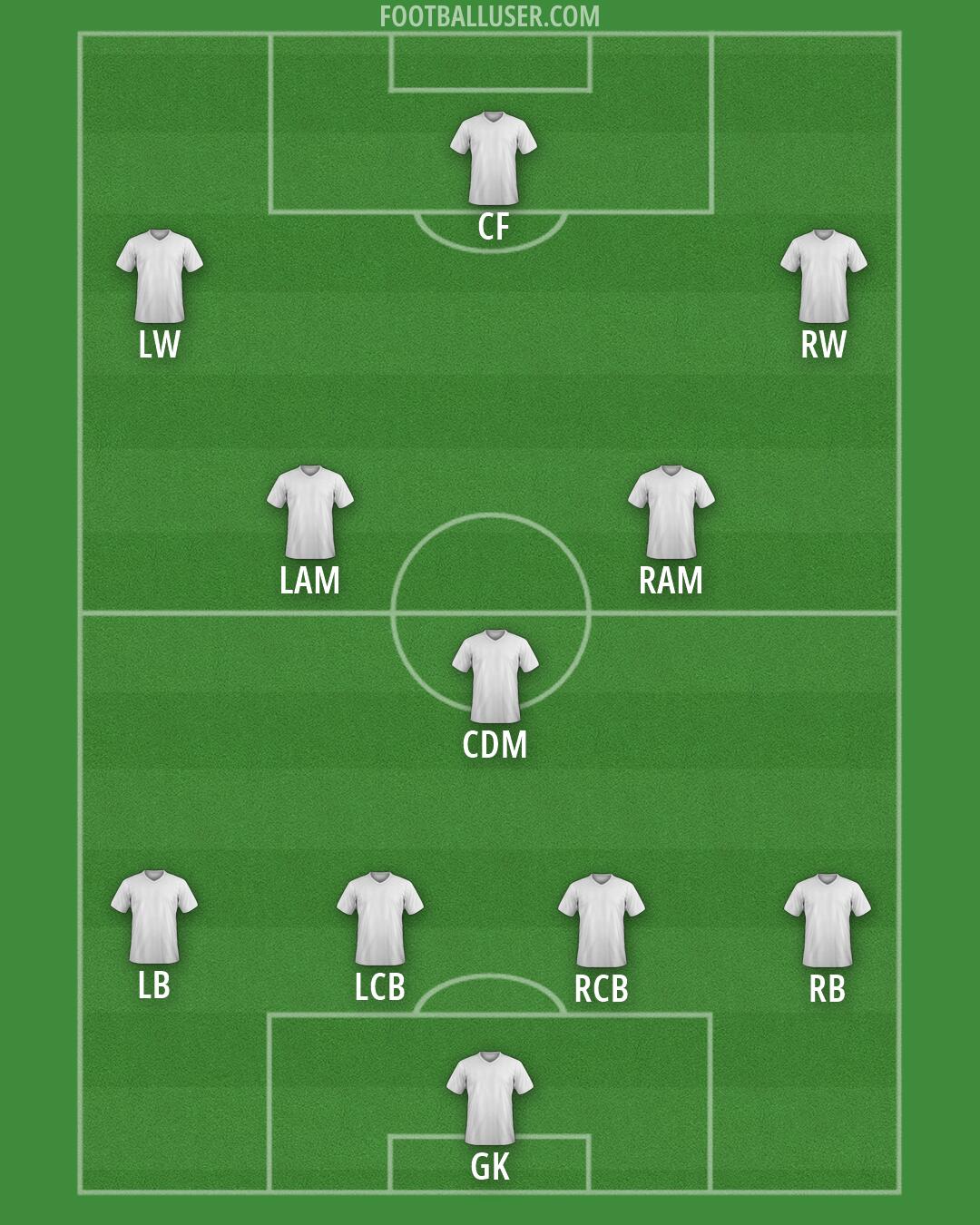
| Goalkeeper | GK |
| Left Back | LB |
| Left Centre Back | LCB |
| Right Centre Back | RCB |
| Right Back | RB |
| Central Defensive Midfielder | CDM |
| Left Attacking Midfielder | LAM |
| Right Attacking Midfielder | RAM |
| Left Winger | LW |
| Right Winger | RW |
| Centre Forward | CF |