3-5-2 Attacking: The German System
Nicknamed "The German System", the 3-5-2 attacking formation allows a manager to field a large number of midfielders simultaneously. It is particularly well suited to coaches who have a wealth of quality midfield players at their disposal, or who want to decisively win the battle in the middle of the pitch. The formation also produces many players in positions to shoot on goal from second-ball situations and rebound opportunities.
The 3-5-2 is one of the most midfield-heavy systems in football. With three centre-backs providing defensive cover, five midfielders controlling the centre and flanks, and two centre forwards leading the attack, this formation creates numerical dominance in the areas of the pitch where matches are most often decided. The wing-backs are crucial: they must cover enormous ground up and down the flanks, effectively acting as both full-backs and wingers within a single system.
Formation Overview
- Description
- The 3-5-2 attacking formation lines up with three centre-backs at the back, five midfielders across the middle (one defensive, two attacking, and two wing-backs), and two centre forwards. The wing-backs are pivotal: they must provide width in both attack and defence, covering the flanks that would normally be handled by full-backs.
- Setup
- Three centre-backs, five midfielders (one defensive midfielder, two attacking midfielders centrally, and two wing-backs), and two centre forwards.
- Features
- A midfield-dominant formation that creates numerical superiority in central areas and makes it very difficult for opponents to play between the lines. The defensive block of eight players provides strong defensive organisation, while the two attacking midfielders offer constant penetration and goal threat from deep positions.
- Pros and cons
-
- Difficult to play high pressure with only 2 centre forwards.
- Numerical superiority in midfield.
- Playing between the lines is difficult for the opponent.
- Cutting off passing lanes to the opposition's centre forwards is straightforward.
- Defensive block of 8 players when out of possession.
- Penetration through the right and left attacking midfielders (RAM and LAM).
- Space left open on the flanks at the back.
- Large distances for the wing-backs to cover.
- Used by
- The German national team and Bundesliga clubs popularised the 3-5-2 during the 1980s and 1990s, earning it the nickname "The German System". More recently, Antonio Conte deployed a modern variant with great success at Juventus, Inter Milan, and Chelsea, winning league titles in Italy and England.
How the 3-5-2 Attacking Formation Works in Practice
The engine of the 3-5-2 is its midfield unit. The defensive midfielder (DM) sits in front of the three centre-backs, acting as a shield and providing the first line of protection when possession is lost. In front of the DM, the two attacking midfielders (RAM and LAM) operate as box-to-box players who combine defensive work-rate with the ability to arrive late into the penalty area. Their runs from deep are one of the most dangerous weapons this formation offers: opposition defences must track not just the two centre forwards but also the two attacking midfielders arriving late.
The left and right wing-backs (LWB and RWB) are perhaps the most physically demanding positions on the pitch in this system. When the team has the ball, they push high and wide to stretch the opposition and deliver crosses. When the ball is lost, they must sprint back to form a back five alongside the three centre-backs, preventing the wide areas from being exploited. This role requires exceptional fitness, pace, and tactical discipline.
Up front, the two centre forwards work as a classic partnership. One drops into pockets of space to link midfield and attack, pulling centre-backs out of position to create space for runs from the attacking midfielders. The other holds their position higher up the pitch, providing a physical presence and aerial threat in the box.
3-5-2 vs Other Formations
Against a 4-3-3, the 3-5-2's five-man midfield creates a numerical advantage in the centre, but the opposition's wide forwards can exploit the space behind the wing-backs if they push forward too high. Against a 4-4-2 diamond, the 3-5-2 offers more width and can stretch the compact diamond shape by using the wing-backs to deliver balls into the two centre forwards. When facing a flat 4-4-2, the 3-5-2 typically wins the midfield battle decisively thanks to its 5-vs-4 advantage in that zone.
The formation's biggest vulnerability comes against teams that use fast wingers or overlapping full-backs, as the space behind the wing-backs on the flanks can be difficult to cover when the three centre-backs are reluctant to step out wide. Coaches deploying the 3-5-2 must ensure their three central defenders are positionally intelligent and comfortable defending one-on-one on the edge of the penalty area.
Frequently Asked Questions
- What is the 3-5-2 attacking formation?
- It is a football formation with three centre-backs, five midfielders (including two wing-backs), and two centre forwards. It is nicknamed "The German System" and is known for its midfield dominance and solid defensive block.
- Why is the 3-5-2 called "The German System"?
- The name comes from the formation's widespread use by German clubs and the German national team in the 1980s and 1990s, a period during which Germany were one of the dominant forces in international football.
- What are the key roles in a 3-5-2 formation?
- The wing-backs (LWB and RWB) are the most critical roles, as they provide both defensive width and attacking threat. The attacking midfielders (RAM and LAM) are the formation's primary source of goals from midfield, while the defensive midfielder anchors the team when out of possession.
- What are the weaknesses of the 3-5-2 formation?
- The main weakness is the space left on the flanks behind the wing-backs. If the wing-backs push forward and possession is lost quickly, the wide channels behind them become exposed. It is also difficult to play a high pressing game with only two centre forwards leading the press.
- When should you use the 3-5-2 formation?
- The 3-5-2 is ideal when you have a strong group of midfielders, athletic wing-backs, and two complementary centre forwards. It works particularly well against teams that rely on a single striker or narrow formations, as the three centre-backs can comfortably deal with the forward threat while the five midfielders dominate centrally.
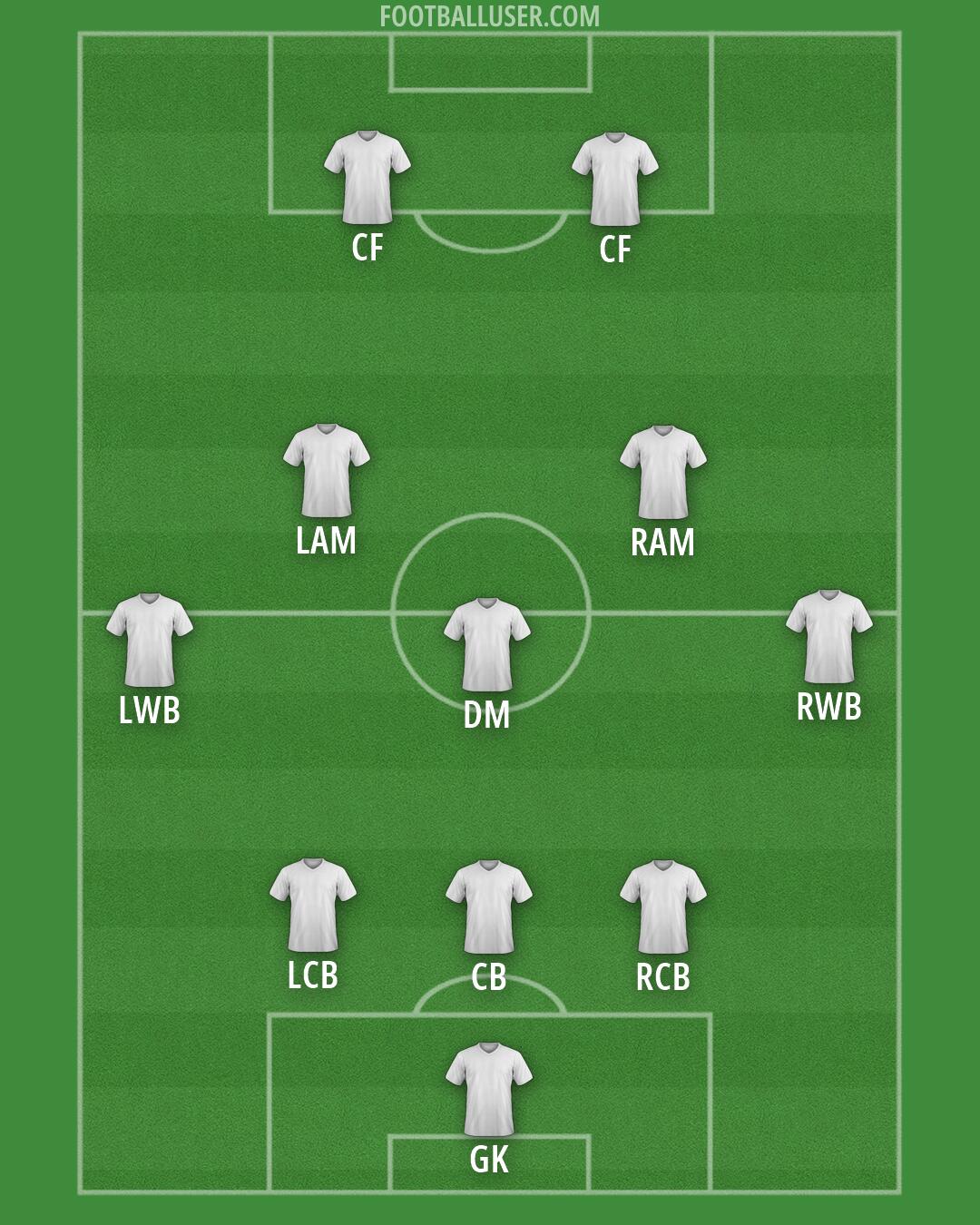
| Goalkeeper | GK |
| Right Centre Back | RCB |
| Centre Back | CB |
| Left Centre Back | LCB |
| Defensive Midfielder | DM |
| Right Attacking Midfielder | RAM |
| Left Attacking Midfielder | LAM |
| Left Wing-Back | LWB |
| Right Wing-Back | RWB |
| Centre Forward | CF |
| Centre Forward | CF |