5-3-2 Defensive Triangle: The Fortress Formation
A highly defensive formation featuring five defenders and two defensive midfielders. The five-man defensive line provides exceptional balance and solidity at the back, though the two centre forwards will find it challenging to contribute regularly on the scoresheet given the limited support they receive from midfield. The counter-attack is an important weapon in this system and can be deployed very effectively when the defensive block wins the ball and transitions quickly. This formation is rarely seen in modern football.
The 5-3-2 defensive triangle is a formation built for teams that prioritise not conceding over scoring. With eight players behind the ball when out of possession, it is one of the most compact and difficult systems to break down. The central axis is completely shut off, making it very hard for the opposition to find space between the lines. When the ball is won, the two centre forwards are tasked with making rapid runs to receive the ball and convert counter-attacking chances before the opposition can reorganise.
Formation Overview
- Description
- The 5-3-2 defensive triangle lines up with five defenders across the back, three midfielders arranged in a defensive triangle (one attacking midfielder at the tip, two defensive midfielders as the base), and two centre forwards. The defensive triangle in midfield combines with the back five to create an impenetrable central block, forcing opponents wide where they are less dangerous.
- Setup
- Five defenders (three central and two wing-backs), three midfielders in a defensive triangle (two defensive midfielders and one attacking midfielder), and two centre forwards.
- Features
- An extremely defensive formation that shuts the central axis completely and presents a defensive block of eight players. The counter-attack through the centre is the primary attacking outlet, with the attacking midfielder acting as the link between defence and the two centre forwards. Rarely used in modern football but highly effective against technically superior opponents.
- Pros and cons
-
- Impossible to play a high press with this formation.
- Large amounts of space left on the flanks.
- The central axis is completely closed off to the opposition.
- Cutting off passing lanes to the opposition's centre forwards is straightforward.
- Defensive block of 8 players when out of possession.
- Counter-attack through the centre is a key weapon.
- The centre of the pitch is entirely locked down.
- Penetration through the attacking midfielder (AM).
- Large distances for the left and right wing-backs (LWB and RWB) to cover.
- Used by
- Otto Rehhagel's Greece used a highly organised defensive system during their shock victory at UEFA Euro 2004. While not a pure 5-3-2, the principles of compactness, a solid back line and rapid counter-attacks were central to their success. The 5-3-2 defensive triangle is also frequently used by lower-ranked teams facing stronger opponents, where defensive organisation and the counter-attack offer the best chance of a positive result.
How the 5-3-2 Defensive Triangle Works in Practice
The backbone of the 5-3-2 defensive triangle is its back five. The three central defenders cover the most dangerous central areas, while the two wing-backs (LWB and RWB) patrol the flanks. When the team is in possession, the wing-backs can push forward to provide width, but they must be disciplined enough to recover their defensive positions quickly when the ball is lost. This recovery distance is one of the most physically demanding aspects of the formation and requires wing-backs with excellent stamina and pace.
In midfield, the two defensive midfielders (LDM and RDM) form the base of the triangle, sitting deep to protect the back five and close down any space between the defensive and midfield lines. The attacking midfielder (AM) operates at the tip of the triangle, higher up the pitch. This player is the most creative in the system: their job is to receive the ball quickly after a turnover and distribute it to the two centre forwards before the opposition can reorganise defensively. The AM must be technically excellent, with the ability to play under pressure and make fast decisions.
The two centre forwards work almost in isolation from the rest of the team for long periods. Their primary task is to stay high up the pitch, ready to receive the ball on a counter-attack. One centre forward drops deep to link play with the AM and create space, while the other holds their position higher up the pitch to threaten in behind. When the ball is won in the defensive third, the speed and precision of the transition from defence to attack is what makes this formation effective.
5-3-2 Defensive Triangle vs Other Formations
Against a 4-3-3, the 5-3-2 defensive triangle is very well equipped. The back five comfortably deals with the three forwards, and the central block prevents the two attacking midfielders from finding space between the lines. However, the 4-3-3's width can stretch the wing-backs, and if the wing-backs push too high, the space behind them becomes a serious vulnerability. Against a 4-4-2 diamond, the 5-3-2 benefits from having an extra central defender to deal with the diamond's two centre forwards, but the attacking midfielder at the tip of the diamond can find pockets of space in front of the two defensive midfielders if they are not disciplined in their positioning.
Against an attacking formation like the 3-5-2, the 5-3-2 can match up numerically in midfield, but the five midfielders of the 3-5-2 will create significant pressure and make it difficult for the 5-3-2 to build out from the back. In this scenario, the direct counter-attack becomes even more important, as playing out under pressure with only three midfielders is tactically risky.
Frequently Asked Questions
- What is the 5-3-2 defensive triangle formation?
- The 5-3-2 defensive triangle is a football formation with five defenders, three midfielders arranged in a defensive triangle shape, and two centre forwards. It is one of the most defensive formations in football, known for its compact central block and reliance on the counter-attack as the primary offensive outlet.
- Why is the 5-3-2 defensive triangle rarely used today?
- Modern football increasingly favours possession-based and high-pressing systems, which require more attacking players and midfield coverage. The 5-3-2 defensive triangle's extreme defensive shape leaves the two centre forwards very isolated and makes it difficult to control games or respond to a deficit, which limits its appeal for most coaches.
- When should you use the 5-3-2 defensive triangle?
- This formation is best used when facing a technically or physically superior opponent where defensive solidity is the top priority. It is also well suited to teams with limited attacking resources but strong defensive organisation, and to situations where a draw is an acceptable result.
- What are the weaknesses of the 5-3-2 defensive triangle?
- The main weaknesses are the large spaces left on the flanks and the isolation of the two centre forwards. Because the formation cannot press high, the opposition has plenty of time on the ball in their own half. Teams with fast wide players can exploit the flanks effectively, and a goal deficit makes the system very difficult to play out of.
- What type of players does the 5-3-2 defensive triangle require?
- The formation requires disciplined and positionally intelligent defenders, athletic wing-backs with excellent stamina, two hardworking defensive midfielders, a technically gifted attacking midfielder who can play under pressure and transition quickly, and two centre forwards who are comfortable holding their position and finishing on the counter-attack with limited service.
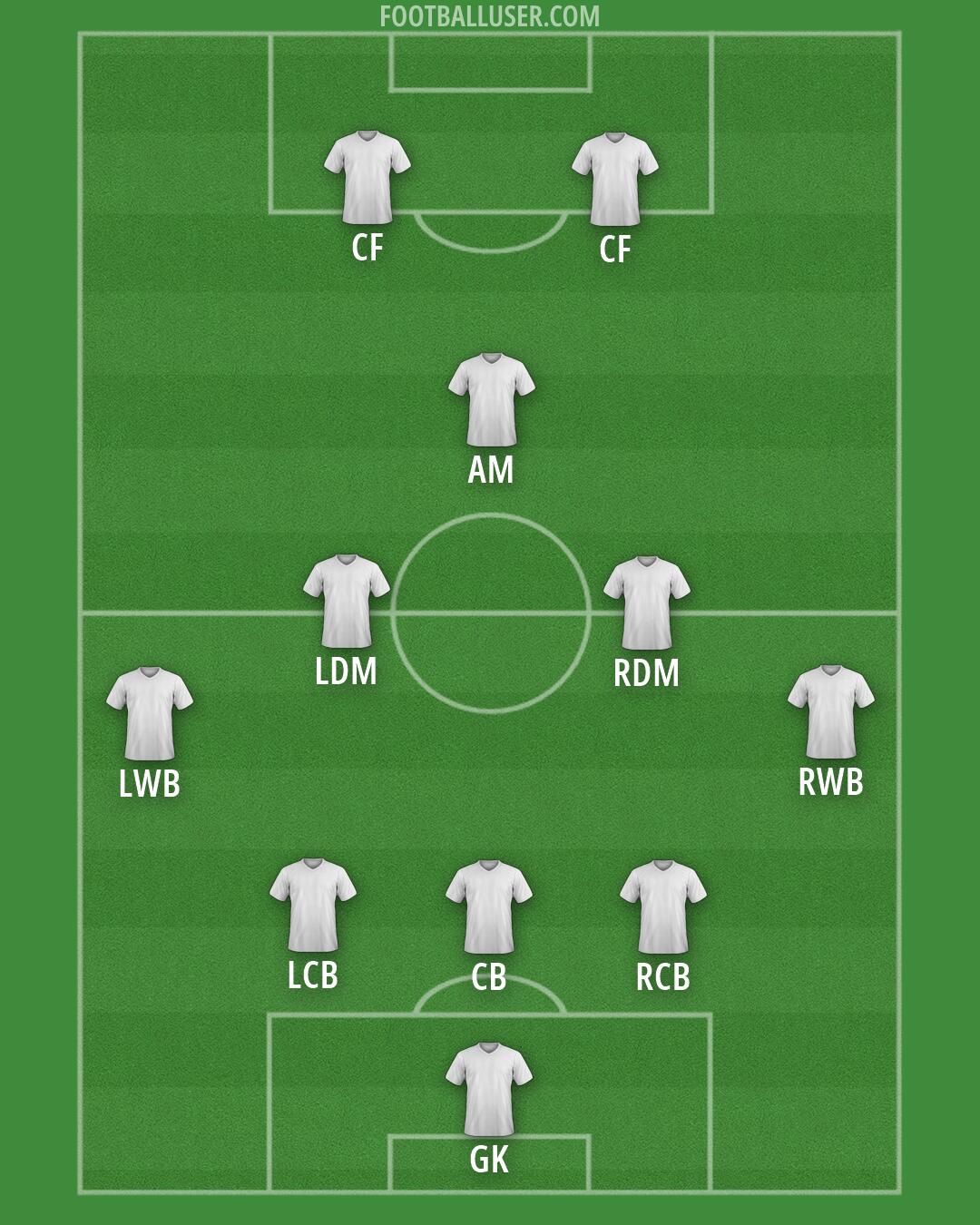
| Goalkeeper | GK |
| Right Centre Back | RCB |
| Centre Back | CB |
| Left Centre Back | LCB |
| Left Wing-Back | LWB |
| Right Wing-Back | RWB |
| Attacking Midfielder | AM |
| Left Defensive Midfielder | LDM |
| Right Defensive Midfielder | RDM |
| Centre Forward | CF |
| Centre Forward | CF |